Six Republicans Join Democrats as House Votes to Block Trump’s Canada Tariffs
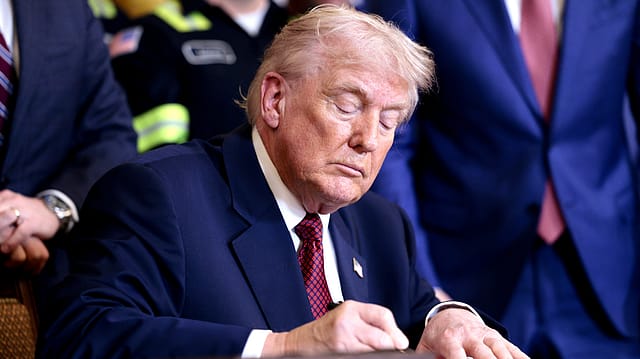
The U.S. House of Representatives on Wednesday delivered a rare rebuke to President Donald Trump’s trade agenda, voting to terminate the emergency declaration underpinning his tariffs on Canadian imports and rejecting his signature economic policy despite a last minute warning of political consequences.
Lawmakers passed the Democratic-led resolution by a 219 to 211 margin, with six Republicans joining almost all Democrats. One Democrat, Jared Golden, voted against the measure.
The six Republicans who broke ranks were Don Bacon of Nebraska, Kevin Kiley of California, Brian Fitzpatrick of Pennsylvania, Dan Newhouse of Washington, Thomas Massie of Kentucky and Jeff Hurd of Colorado.
The Modi Years
02 Oct 2026 - Vol 05 | Issue 40
A Nation Rebuilt
The resolution seeks to reverse Trump’s tariffs on Canadian goods. Trump had imposed a 35 per cent tariff on many Canadian products last year, while providing lower rates for energy imports and sweeping exclusions for goods entering under the U.S.-Mexico-Canada Agreement.
Separately, the House vote rejected the national emergency that allowed the administration to impose a 25 per cent tariff on Canadian goods.
Will Trump veto the House move to block his Canada tariffs?
Even if the measure passes the Senate, it is likely to face a presidential veto. Trump has threatened to veto similar efforts, making it unlikely the legislation will become law.
As voting was underway, Trump reiterated his support for tariffs in a post on Truth Social.
“Any Republican, in the House or the Senate, that votes against TARIFFS will seriously suffer the consequences come Election time, and that includes Primaries! Our Trade Deficit has been reduced by 78%, the Dow Jones has just hit 50,000, and the S&P, 7,000, all Numbers that were considered IMPOSSIBLE just one year ago. In addition, TARIFFS have given us Great National Security because the mere mention of the word has Countries agreeing to our strongest wishes. TARIFFS have given us Economic and National Security, and no Republican should be responsible for destroying this privilege. PRESIDENT DONALD J. TRUMP," he added.
Trump has used emergency economic powers since returning to office early last year to justify multiple waves of tariffs on Canada and other trading partners, though broad exemptions for Canadian goods have softened the impact.
How Did Republican Defections Impact the House Vote on Trump’s Tariffs?
About 80 per cent of goods imported from Canada meet USMCA criteria and are exempt from tariffs.
The vote underscored strains within the narrow Republican majority and marked a rare instance of GOP defections at a time when Trump has maintained a strong grip over the party.
Speaker Mike Johnson and the White House sought to block the resolution by embedding language into a procedural rule that would have delayed similar measures from reaching the floor until late July.
That effort failed when Bacon, Kiley and Massie joined Democrats to defeat the maneuver.
Is Trump Upset Over the House Vote on His Canada Tariffs?
Johnson later told CNN that Trump was “not upset” with Republicans who voted to curb his executive authority on tariffs.
“He’s not upset. I just left the White House. He understands what’s going on. It’s not going to affect or change his policy. He can veto these things if they come to it,” Johnson said.
Earlier in the day, Bacon wrote on social media that lawmakers “cannot & should not outsource our responsibilities.”
He described tariffs as a tax on American consumers and said Congress needs to be able to debate the issue, calling them a net negative for the economy.
Jeff Hurd said his vote reflected constitutional accountability and feedback from constituents across his district.
Economic concerns have weighed on lawmakers from trade dependent states. Canada remains one of Colorado’s significant international trading partners, with 1.6 billion dollars in goods exported in 2024, according to the Office of the U.S. Trade Representative.
How Are Trump’s Tariffs Impacting Small Businesses and Fueling Economic Uncertainty?
Some small businesses have reported rising costs and uncertainty linked to the tariffs.
Democratic Representative Jason Crow emphasized Congress’s constitutional role in trade policy. “I’m going to do everything possible to claw back that power and authority. And this is the first step in that when it comes to trade,” he said.
GOP leaders had argued that lawmakers should wait for a U.S. Supreme Court ruling on whether the International Emergency Economic Powers Act authorizes the president to impose tariffs.
The vote came after the expiration of a measure barring consideration of tariff related resolutions in the House, which had previously stifled opposition.
The measure’s passage also comes as Trump privately weighs quitting the U.S.-Mexico-Canada trade pact he signed during his first term, a move that could further heighten trade tensions in North America.
(With inputs from ANI)