Trump’s Morning Menu: ‘Economic D-Day’ for Iran, Love for Kim and a Tariff Timeout for Canada
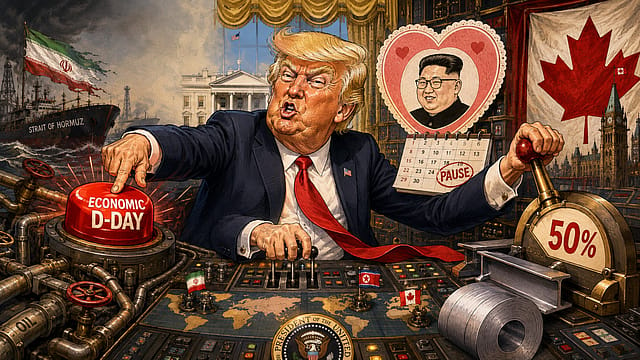
By the time India woke up, Donald Trump had threatened to economically isolate Iran, warned every country helping Tehran, praised his personal chemistry with Kim Jong Un, rebuked South Korea, defended a naval blockade, talked oil prices down and moved Canada back from the edge of a 50 per cent tariff cliff.
Three countries. Two nuclear confrontations. One tariff pause. Several capital letters.
Trump’s latest burst of foreign policy began with what he christened “Economic D-Day”, travelled through his friendship with one nuclear-armed leader and ended with a possible trade deal that could spare America’s closest neighbour another round of tariffs. The message shifted with the country. Iran received threats. Kim received affection. Canada received three days.
The Identity Project
11 Sep 2026 - Vol 05 | Issue 37
Amit Shah leads the mission for a national demographic correction
Iran Gets Trump’s ‘Economic D-Day’
Trump opened the most consequential front by announcing what he called the “most crushing economic operation ever taken against any country”.
In a post on Truth Social, the US President accused Iran of squandering repeated opportunities to strike a deal and declared that Washington would now pursue “economic warfare and isolation on an unprecedented scale”. The proposed operation would target oil-smuggling networks, swap lines, cash transfers, exchange houses, ship registries and front companies that help Tehran move money and energy despite existing sanctions.
Trump widened the threat beyond Iran. Any country that allows its banks, businesses, airports or government bodies to provide Tehran with a “lifeline”, he warned, would face “tremendous economic consequences” from the United States. “You know who you are,” he added.
The announcement threatens to turn the pressure campaign into a test for countries that retain commercial, financial or logistical links with Iran. Trump has not yet publicly detailed what penalties they could face, how quickly they would take effect or whether Washington would offer waivers to allies. Al Jazeera reported that the declaration came as negotiations aimed at ending the five-month conflict remained deadlocked. Trump insisted Iran would never be allowed to acquire a nuclear weapon and described Tehran as hanging “by a thread”. The language was unmistakably Trump: maximum pressure, maximum volume and a name built for television.
Is the Strait of Hormuz Open or Blocked?
Trump then delivered an apparently contradictory update on the Strait of Hormuz.
“The Strait is open. A lot of boats are coming through,” he said, before declaring that the American naval blockade had been “100 per cent successful”. A strait cannot be entirely open and completely blockaded in the conventional meaning of both terms. Trump appeared to be arguing that US action had stopped prohibited traffic linked to Iran while allowing approved oil shipments to pass.
He offered no operational data to establish that claim. The wider evidence has painted a more troubled picture. An earlier Al Jazeera report said only eight vessels crossed the waterway on August 11, compared with the 130 to 140 ships that travelled through it before the conflict.
Tehran also disputes Washington’s account. Iranian Parliament Speaker Mohammad Bagher Ghalibaf has said Iran will not fully reopen the strait until the US honours commitments under a proposed 14-point agreement, including easing oil sanctions, releasing frozen assets and lifting the blockade.
Trump nevertheless portrayed the operation as a success. He said fears of crude touching $350 a barrel had failed to materialise, with oil instead trading at around $84 to $85. Increased production from Texas, Alaska and Louisiana, he argued, had made Hormuz less important than it once was. That claim may hold more comfortably for the United States than for Asian importers. The Strait of Hormuz remains a critical energy route for countries that depend heavily on Middle Eastern oil.
If Everything Is Going So Well, Why Announce More Sanctions?
That is the tension at the heart of Trump’s Iran message.
He described Iran’s navy as gone, its air force as destroyed, its military factories as rubble and its currency as worthless. He simultaneously unveiled an unprecedented operation to apply even greater pressure. Trump suggested that the objective was to remove Tehran’s final economic escape routes. Existing sanctions may restrict direct trade, but oil-smuggling networks, intermediaries, front companies and alternative payment systems can keep money moving.
The threat to punish third countries aims to make dealing with Iran too costly even for businesses and governments outside American jurisdiction. The danger is that such secondary pressure can also widen the confrontation. Countries forced to choose between Iranian commerce and access to the US economy may retaliate, seek alternative financial channels or challenge Washington’s reach.
Trump left one exit open. Negotiations with Tehran could resume “maybe at some point”, he said. For the moment, however, he appeared happier with the squeeze than with the negotiating table.
From Threatening Iran to Talking Up Kim
Iran’s leaders were “maniacs”. Kim Jong Un, by contrast, was the man who “likes me”.
Trump said the North Korean leader disliked Barack Obama and Joe Biden but shared a “good relationship” with him. “He didn’t like anybody, but he likes me,” Trump said, reducing decades of nuclear diplomacy to something resembling a presidential popularity contest. The remark accompanied his defence of the decision to shorten joint US-South Korea military exercises. Trump called the drills “insulting” to Kim while presenting his personal relationship with the North Korean leader as a security guarantee for the United States, South Korea and Japan.
ABC News reported that the exercises, initially scheduled to continue until August 27, will now end early. Trump has also said he expects to meet Kim later this year. The President argued that staging large war exercises against North Korea made little sense while he was trying to rebuild ties with its leader. Pyongyang was unmoved. Kim Yo Jong, Kim Jong Un’s sister and a senior regime figure, said reducing the duration and scale of the exercises did not alter their “provocative” character. North Korea had “no interest” in discussing the gesture, she said.
Trump sent flowers. Pyongyang checked the thorns
Why Did South Korea Get Dragged Into Hormuz?
Trump linked the decision on military exercises to a separate grievance: South Korea’s refusal to help Washington in the Strait of Hormuz. He said Seoul receives 60 per cent of its oil through the route but declined when the United States sought assistance.
Trump presented the exchange as another example of an ally benefiting from American power while refusing to share the burden. He also complained that conducting expensive exercises for South Korea, after Seoul declined to support the US over Iran, made little sense. The connection has unsettled the alliance. South Korean Foreign Minister Cho Hyun said Trump appeared to be applying pressure on Seoul over Iran and its delayed $350-billion investment commitment in the US, Reuters reported.
Trump, however, framed the reduction primarily as an act of respect towards Kim, whom he described as “very well-behaved” during his presidency. He also credited the relationship with preventing conflict for at least the next two-and-a-half years, while acknowledging that North Korea possesses what he called 57 powerful nuclear weapons. The unresolved contradiction was hard to miss. Trump cited Kim’s nuclear arsenal while praising the leader who controls it, then used Iran’s potential nuclear ambitions to justify crushing pressure against Tehran.
The apparent distinction was personal trust. Kim, in Trump’s telling, likes him. Iran’s rulers do not.
Canada Gets a Three-Day Tariff Timeout
After declaring economic warfare against Iran and diplomatic affection for Kim, Trump moved to Canada with a softer weapon: a tariff lever temporarily left untouched.
The US had been preparing to impose a 50 per cent tariff on a range of Canadian goods. Trump said he postponed the measure for three days at Canada’s request so that negotiators could “iron out the details” of a prospective trade agreement. He also indicated that tariffs on Canadian steel and aluminium could be reduced and claimed American farmers would gain tariff-free access under the deal.
Canada sounded more cautious. Prime Minister Mark Carney confirmed “substantial progress” but said important work remained unfinished. The threatened duties would affect approximately $20 billion worth of imports, including products otherwise protected by the United States-Mexico-Canada Agreement, according to Reuters.
The unresolved issues reportedly include dairy access, alcohol imports, automotive-content rules and digital trade. Trump has announced that a deal exists, while Canadian officials have stressed that negotiations continue and the final documents remain unfinished. That gap matters. Trump has paused the tariff threat, not buried it.
Is There a Method Beneath the Morning Mayhem?
There is. Trump continues to use pressure as the opening language of diplomacy. Against Iran, he threatens economic isolation. With South Korea, he cuts military cooperation while demanding greater support. Against Canada, he brings tariffs to the brink of implementation and then trades a pause for concessions.
Personal relationships form the second layer. Kim receives an accommodation because Trump believes leader-to-leader chemistry can unlock a nuclear stalemate. Canada receives temporary relief after direct engagement with Carney. Iran faces escalation because negotiations have failed to produce the deal Trump wants.
The method swings between threat, theatre and transaction. It can generate movement because governments fear the cost of saying no. It can also unsettle allies, blur strategic commitments and make American policy appear dependent on Trump’s view of individual leaders. That produced the morning’s strangest split screen. Iran was told the economic gates were closing. Kim was told his feelings mattered. Canada was told the tariff clock had stopped, but only for three days.
And Trump? He had already moved to the next lever.
(With inputs from ANI)