Why Modi rolled out the Persian carpet for Pezeshkian
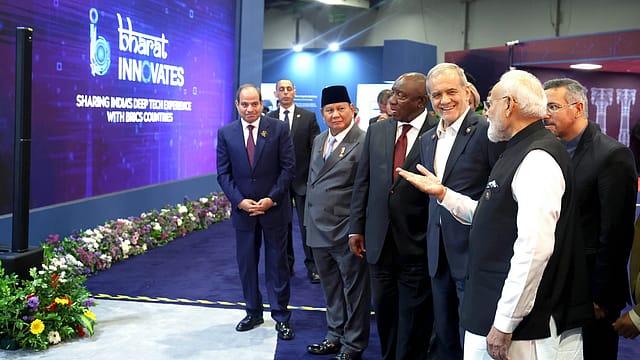
While Modi watchers were keeping an eye out for the hug, a warm handclasp made news as India rolled out the red carpet for Iranian President Masoud Pezeshkian and his delegation. The courting of Iran is not only an example of the pragmatism the underlies India’s practice of “strategic autonomy” and a desire for a positive outcome for the BRICS summit. It represents India’s desire to ensure safe passage for energy supplies at a time when the war in the Middle East shows no signs of ending.
Prime Minister Narendra Modi’s picture walking hand in hand with a smiling Iran President Masoud Pzeshkian on the opening day of the BRICS (Brazil, Russia, India, China, South Africa) summit went viral in no time. Not a customary Modi hug, but a warm handclasp. The armchair commentariat was nonplussed. The Modi government, they have assumed, saw Isreal as a “natural ally” and had been critical of India’s delayed response to the assassination of Ayatollah Ali Khamenei in American-Israeli attacks. India was surely going to be caught in a bind between balancing its unsettled relations with the United States with the interests of Iran and the United Aran Emirates and other BRICS nations.

Losing Memory
16 Oct 2026 - Vol 05 | Issue 42
The making of a medical and social emergency
The gesture did not proving critics wrong, but an unambiguous signal that India will prioritise its interests for reliable oil supplies at a time when the price of crude has again breached $ 105 due to the latest exchange of fire between opposing forces in the Gulf. The thinking is both pragmatic and strategic. If India needs to deal with Iran to try and ensure safe passage of energy supplies it would do so without waiting for the mess in the Middle East to be sorted out. The expectation in the Trump administration and some quarters in Washington that India, and indeed other nations, will wait endlessly for an enduring truce is misplaced. The expectation that the rest of the world should continue to support America’s “just” war against Iran while national economies bleed is plain unrealistic.
Keeping the Economy Rolling
The 7.8% first quarter growth achieved by the Indian economy in FY 27 is a result of considerable effort that included a shrewd utilization of fiscal space to absorb costs and protect consumers, duty and custom rejigs to compensate businesses for costlier inputs, a rapid re-configuration of gas and crude sources and exports benefitting from higher rupee earnings. Any fresh surge in energy prices is a matter of serious concern for India and the sub-text of the red carpet rolled out to Pezeshkian is just that: India will make every effort to facilitate safe movement of fuel cargoes through the Strait of Hormuz and any areas within the zone of Iran’s military interception.
The welcome accorded to Pezeshkian was no doubt also intended to achieve a positive outcome for the BRICS summit with a statement that Iran and UAE could both accept. The extensive references to nuclear issues in the BRICS statement and the condemnation of “deliberate attacks” on civilian infrastructure and peaceful nuclear facilities are intended to assuage Iran’s concerns while the emphatic recognition of the rights of Palestinians addresses sentiments of the entire Gulf region. Indian diplomats took sufficient care that the BRICS statement and posture is not read as “anti-West” but it does have a message for Washington that President Donald Trump’s unilateralism can cost the US. No nation has the luxury spending its way out trouble as the US is even as national debt crosses $ 40 trillion. Commentary in the US media that Trump’s wrecking ball diplomacy has pushed Russia, India and China closer is not incorrect despite the limits to such a convergence. For the third time in the last two years pictures of Russian leader Vladimir Putin, Prime Minister Narendra Modi and Chinese President Xi Jinping sharing a warm moment have made it to the front pages.
Visit to Rashtrapati Bhawan
The welcome extended to Pezeshkian encompassed the Iranian delegation which included his daughter Zahra who visited the BRICS bazaar at the Crafts Museum next to Bharat Mandapam. The Iranian President was also received by President Droupadi Murmu at Rashtrapati Bhawan, the only visiting leader to be accorded the honour.
India has many irons in the fires raging in the Middle East and its engagement with the Gulf Cooperation Council (GCC) nations far outweighs contacts with Tehran in terms of the number of Indian nationals working in the region and the extensive investments and business activities that bind India and the Gulf. But even though Iran’s leverage over the Hormuz has declined and the rest of the world – including India – has found alternate routes and sources for energy supplies there is no sign of the US-Iran stalemate ending.