Ronaldo, Neves and Jota Chants: When Football Rivalry Weaponises the Dead
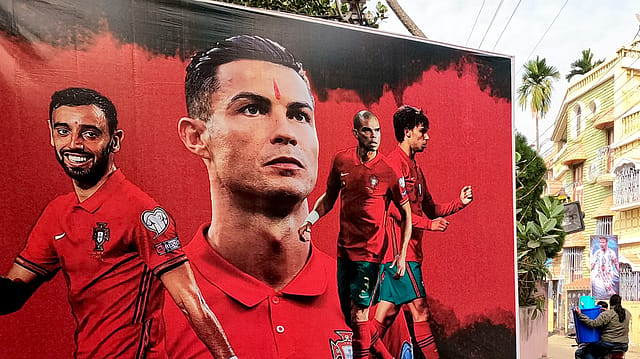
Ruben Neves heard the name of his dead friend.
He was standing over a free-kick during Al-Hilal’s Saudi Pro League match against Al-Taawoun when a section of the home support reportedly began chanting:
“Jota! Jota! Jota!”
The name ordinarily belongs to football’s happier vocabulary. Diogo Jota was a Premier League and international star, a husband, a father, a Liverpool forward and Neves’ teammate for Wolverhampton Wanderers and Portugal.
In this stadium, his name was allegedly being used for another purpose.
It was meant to hurt.
Neves applauded sarcastically. He raised a thumb, pointed towards the sky and gestured towards his eye and the section from which the chanting appeared to originate.
Al-Hilal won 6–0.
The scoreboard had become irrelevant.

Zeroing In on ECI
09 Oct 2026 - Vol 05 | Issue 41
Constitutional legitimacy versus political opportunism
“I just hope they don’t go to pray later after what they did,” Neves said after the match, according to ESPN.
Cristiano Ronaldo then entered the argument.
“The league must take action and punish this kind of fan behaviour,” Ronaldo wrote on Instagram. “This is no longer football, and there have to be limits. People who behave like this should never be allowed to enter a stadium again.”
Al-Hilal filed a formal complaint. Al-Taawoun condemned the chanting and promised to cooperate with the authorities. The Saudi Arabian Football Federation and Saudi Pro League announced an investigation, describing the exploitation of personal tragedy for provocation as unacceptable, according to Reuters.
Ronaldo’s verdict was immediate: identify them and ban them for life. The larger question is whether football is prepared to do that consistently—not only when one of its greatest players is watching.
Why Were the Jota Chants So Cruel?
Because the supporters were not merely invoking a deceased footballer. They were allegedly locating Neves’ most intimate grief and turning it into a terrace weapon.
Jota and his brother André Silva were killed in a car crash in Spain in July 2025. Jota was 28. His death devastated Liverpool, Portugal and teammates who had shared dressing rooms and lives with him.
Few were closer to him than Neves. The two Portuguese players developed together internationally and became teammates at Wolves. Neves helped carry Jota’s coffin at his funeral. He later inherited Jota’s No. 21 shirt for Portugal, carrying his friend symbolically whenever he represented their country.
Liverpool permanently retired Jota’s No. 20 across the club’s teams. What one club treated as sacred memory, some supporters at another ground reportedly treated as psychological pressure. The chant itself did not contain an insult. Its cruelty came from its target, timing and intention. A name associated with mourning was repeatedly directed at the man known to have been profoundly affected by the death.
Context turned remembrance into abuse. Neves understood the message. So did Ronaldo.
What is Tragedy Chanting?
Tragedy chanting is football-related abuse that references deaths or disasters connected with a player, club or group of supporters. It can take the form of songs, gestures, banners, images or shouted references. The words may differ, but the strategy remains the same: reach beyond sporting rivalry and exploit bereavement, trauma or collective loss.
It is distinct from aggressive but legitimate support. Booing a former player is football. Mocking an opponent’s defeat is football. Questioning a referee’s eyesight has nearly become footballing tradition. Invoking a dead child, a fatal plane crash or supporters crushed inside a stadium belongs elsewhere.
The Football Association in England defines tragedy-related abuse broadly enough to include chanting, gestures and other behaviour referencing football disasters or deaths. Its “Love Football. Protect the Game” framework warns that offenders can face stadium bans and criminal prosecution. The FA, Premier League, EFL and police have attempted to build a common response because the abuse is not confined to one club or rivalry.
The Jota chants show how quickly the phenomenon can migrate. This was not Liverpool versus Manchester United. It was not an inherited English rivalry carrying decades of resentment. It appeared during a Saudi league match involving a Portuguese player and the memory of his Portuguese friend. Tragedy abuse no longer needs history. Social media can supply the wound. A crowd only needs to press it.
How Have Hillsborough and Munich Been Weaponised?
The darkest chants in English football have repeatedly targeted two disasters. On February 6, 1958, 23 people died following the Munich air disaster, including eight Manchester United players. The tragedy destroyed the heart of the young team known as the Busby Babes.
On April 15, 1989, 97 Liverpool supporters suffered fatal injuries because of the Hillsborough disaster. The families then endured years of institutional failure and false allegations before official investigations established how policing failures and the subsequent response had compounded their suffering.
Yet rival supporters have used “Munich” and Hillsborough references as abuse. The logic is particularly perverse. Supporters who demand solemn respect for their own club’s dead may mock another club’s dead during the next fixture.
Liverpool and Manchester United—one of English football’s fiercest rivalries—have repeatedly issued joint appeals. Managers Jürgen Klopp and Erik ten Hag urged supporters to show restraint ahead of matches between the clubs. Arrests have nevertheless continued.
During an FA Cup quarterfinal between Manchester United and Liverpool in March 2024, police arrested two people over alleged tragedy chanting. The same year, three Arsenal supporters received three-year football banning orders after pleading guilty to tragedy-related abuse during a match against Liverpool.
Football has held silences for the dead. Parts of football have then turned those same deaths into songs.
Was Emiliano Sala’s Death Also Turned Into a Chant?
Yes. Argentine striker Emiliano Sala died in January 2019 when the aircraft carrying him from Nantes to Cardiff crashed into the English Channel. He was 28 and had just completed a transfer to Cardiff City.
In May 2022, a section of Nice supporters sang a chant mocking Sala during a match against Nantes.
The cruelty stunned French football. Both clubs condemned it. Nice apologised and announced a zero-tolerance position, saying the chant insulted Sala’s memory and violated the club’s values. The official OGC Nice statement also made an important distinction: the behaviour belonged to the people who performed it, not automatically to an entire support base.
That distinction matters. Crowds can create anonymity, but they should not erase individual responsibility. Punishing an entire stadium because several people behaved appallingly may be operationally convenient. It can also penalise thousands of supporters who neither joined nor supported the abuse.
The better outcome is harder: identify the individuals.
What Happened in the Bradley Lowery Case?
Bradley Lowery was not a footballer. He was a six-year-old Sunderland supporter who became closely associated with the club and striker Jermain Defoe while being treated for neuroblastoma. Bradley died in 2017.
During Sunderland’s match at Sheffield Wednesday in September 2023, two men were photographed appearing to laugh while displaying an image of the child towards Sunderland supporters.
The photograph travelled rapidly across social media. One of the men, Dale Houghton, admitted a public-order offence. A judge described his conduct as appalling. He received a suspended sentence, unpaid work and a five-year football banning order, according to Sky News.
The case demonstrated both the ugliness of tragedy abuse and the modern mechanism for confronting it. A mobile-phone camera captured the act. Social media distributed the evidence. The offender was identified. The club and police acted. A court imposed the ban. The same digital environment that enables abuse to spread can also destroy the crowd’s protection of anonymity.
Can Supporters Be Arrested for Tragedy Chants?
It depends on the country, its laws and the precise conduct. In England and Wales, tragedy-related abuse may lead to prosecution under public-order legislation. A conviction can also result in a football banning order.
Those orders are not symbolic. They can prohibit attendance at regulated matches, require the surrender of passports during international tournaments and impose other restrictions designed to keep offenders away from football.
Government figures recorded thousands of active football banning orders in England and Wales in recent seasons. The precise duration depends on how the order is obtained and the underlying offence, but criminally imposed orders generally last several years rather than permanently. The UK government’s football-related arrests and banning-orders data illustrate how policing, courts and clubs operate together.
Clubs can separately impose their own bans under ticketing rules and conditions of entry. That creates two different forms of punishment: A court order backed by law. A private stadium ban enforced by a club or competition Ronaldo’s proposed lifetime exclusion would probably depend on the latter unless Saudi law or football regulations provide a route for a permanent, system-wide prohibition.
The Saudi investigation will therefore matter. Condemnation is straightforward. Identification, evidence, due process and enforcement will reveal whether the response possesses teeth.
Are Lifetime Stadium Bans the Answer?
Emotionally, Ronaldo’s demand is easy to understand. A person who enters a stadium and deliberately exploits a death to torment the deceased’s closest friend appears to have surrendered any claim to remain part of the occasion.
A lifetime ban also carries enormous symbolic power. It tells supporters that admission to a stadium is conditional, not an unconditional right. Football can be noisy, tribal and provocative without becoming inhuman. But permanent punishment creates practical questions.
Was the individual correctly identified? Did that person participate actively or merely stand beside those chanting? Was the behaviour sustained and intentional? Is there an appeals process? Should a teenager who commits an appalling act be barred at 70? Can remorse, rehabilitation or education ever matter?
These questions do not excuse the behaviour. They determine whether punishment is credible.
A lifetime ban imposed during public outrage but built on weak evidence could collapse under challenge. A shorter mandatory ban, criminal consequences where applicable, compulsory education and severe penalties for repeat offenders may sometimes be easier to enforce consistently. Permanent exclusion should remain available for the clearest and gravest cases. The standard of proof should be as serious as the punishment.
How Can Stadiums Identify Abusive Supporters?
Modern football grounds already contain much of the infrastructure required. High-definition CCTV can isolate particular sections. Numbered seating and digital tickets can connect a location to a purchaser. Stewards can preserve evidence. Supporters can report abuse through text lines, apps or club hotlines. Broadcast and mobile-phone footage can help confirm what occurred.
Facial-recognition technology may improve identification but raises privacy, proportionality and error concerns. A technology powerful enough to locate an abusive supporter is also powerful enough to track thousands of innocent spectators.
The most effective system does not depend on one tool. It connects ticketing records, video evidence, steward reports, witness accounts, club investigators and police where an offence may have occurred.
There is another obstacle: collective silence. Supporters often know who began a chant. Some refuse to cooperate because identifying another fan violates an unwritten terrace code. That code deserves to be broken. Reporting racist abuse, violence or tragedy chanting is not betraying the club. It prevents a small group from borrowing the club’s badge to legitimise cruelty.
Why Do Supporters Cross the Line?
The stadium changes individual behaviour. Anonymity expands. Responsibility dissolves. Words that might feel monstrous when spoken alone can feel permissible when absorbed into a chant performed by hundreds.
Rivalry also encourages moral exceptionalism. Supporters defend abuse from their own side as “banter” while recognising the identical behaviour from opponents as disgusting. The target becomes less human because he is wearing the wrong shirt. Social media intensifies the cycle. Offensive clips earn attention. Outrage gives anonymous supporters a strange form of visibility. The more forbidden the reference, the greater its power to provoke.
For some, that reaction is the entire objective. The chants directed at Neves reportedly followed Al-Taawoun’s humiliation on the pitch. Al-Hilal were scoring freely. If supporters could not hurt the team through football, they could try to hurt one player through memory. They could not stop Neves from winning. They could try to stop him from forgetting.
Does Football Encourage the Behaviour It Condemns?
Football does not encourage tragedy abuse explicitly. It does, however, commercialise hostility.
Broadcasters promote matches through language of war, hatred and revenge. Clubs sell rivalry as identity. Social-media teams ridicule opponents for engagement. Supporters are celebrated for creating intimidating atmospheres and demonstrating unconditional tribal loyalty.
Most fans understand the boundary. Some treat escalation as authenticity. The industry then confronts a contradiction of its own making: it wants tribal passion because passion sells tickets, subscriptions and shirts, but it cannot completely control the forms that tribalism assumes.
That does not make abusive chanting inevitable. It makes the boundary important. Football authorities must define prohibited conduct before a scandal, publicise the punishment, provide simple reporting systems and enforce the rules regardless of the offender’s club or the prominence of the victim. Zero tolerance cannot mean zero tolerance only when the video trends.
What Should Happen After the Neves Incident?
The Saudi authorities must first identify what happened and who participated. Video and audio should be reviewed. Al-Taawoun’s ticketing and security records should be examined. Neves, match officials, stewards and witnesses should be consulted. Any accused supporter must be given an opportunity to respond.
If individuals are reliably identified as having deliberately used Jota’s death to abuse Neves, substantial stadium bans are justified. Whether those bans should last for life must depend on the evidence, the offenders’ conduct and the disciplinary authority available. But a token punishment would render the joint condemnation meaningless.
Al-Taawoun should also communicate directly with Neves and Jota’s family. The club’s supporters should not collectively be branded by the actions of a section, but the club must demonstrate that its stadium cannot be used to deliver personalised cruelty without consequence.
The Saudi Pro League is investing heavily in global players, broadcast reach and international legitimacy. Its standards of supporter protection must grow with its ambitions.
Can Football Ever Eliminate Tragedy Chanting?
Probably not completely. No regulation can remove cruelty from every crowd. No camera can capture every voice. No lifetime ban can prevent an unidentified person from returning under somebody else’s ticket.
But football has reduced other forms of disorder when clubs, leagues, police and supporters have treated enforcement as a sustained project rather than a public-relations response.
The objective is not perfection. It is consequence. The supporter considering the chant must know that the crowd is no longer guaranteed camouflage. The spectator beside him must know how to report it. The club must act even if the offender belongs to its own fan base. The league must publish the outcome instead of allowing an investigation to disappear after the news cycle moves on.
Ronaldo’s demand matters because of who made it. His stature guarantees attention. His relationship with Jota and Neves gives his intervention emotional legitimacy. His presence in Saudi football makes it difficult for the league to dismiss the episode as an external attack on its reputation.
But the most powerful moment still belonged to Neves. He heard his friend’s name and looked towards the sky. Perhaps the gesture was for Jota. Perhaps it was a message to the crowd. Perhaps it said that the person they were trying to reduce to a taunt remained beyond their reach. Football frequently tells us that rivalry makes the game meaningful.
Ruben Neves’ expression revealed the limit of that defence. A rival is someone you want your team to defeat. A dead friend is not a weapon. And a stadium should never become the place where grief is forced to play away from home.
With inputs from ANI & agencies