Trump Backs a United Ireland. Can He Help Erase a 105-Year-Old Border?
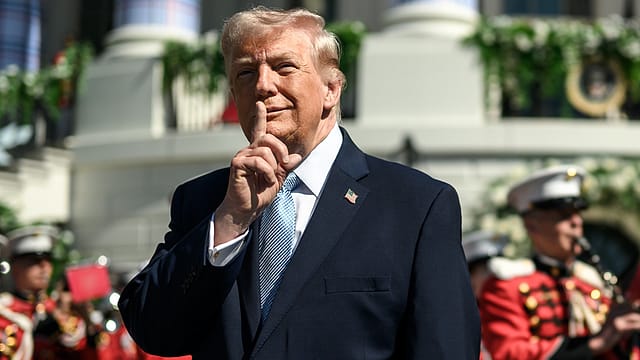
Donald Trump was standing at a golf course in western Ireland when he wandered onto one of Europe’s most sensitive political borders. There is the Republic of Ireland, he observed. Then there is Northern Ireland.
Why not put them together? “It just seems to me that you have Northern Ireland and you have Ireland, and it would seem to me that one of the naturals of all time is put them together,” the US President said while attending the Irish Open at his Doonbeg resort.
A day earlier, Trump had described a united Ireland as “fantastic”. He said he would “love” to see it and suggested it might as well happen now. On Sunday, he clarified that this was only his opinion but added that he had received considerable support.
The remark sounded casual. Its subject is anything but. For approximately 105 years, a border has separated Northern Ireland’s six counties from the rest of the island. For around three decades, the argument over that border helped fuel The Troubles, a conflict that killed about 3,600 people. Since 1998, the border’s future has rested on an ingenious but deliberately unresolved promise: Northern Ireland will remain in the United Kingdom for as long as a majority wants it to, but may join the Republic of Ireland if majorities on both sides consent.

Zeroing In on ECI
09 Oct 2026 - Vol 05 | Issue 41
Constitutional legitimacy versus political opportunism
Trump cannot erase that border. He may have made it harder to ignore.
Why Did Trump’s United Ireland Remarks Cause Such a Stir?
American presidents generally approach Northern Ireland as custodians of a peace process, rather than advocates for one constitutional outcome.
The United States played a significant role in the negotiations that produced the 1998 Good Friday Agreement. Former US senator George Mitchell chaired the talks, while President Bill Clinton’s administration invested political capital in bringing nationalists, unionists, London and Dublin into the same process.
Subsequent presidents largely defended the agreement while avoiding an explicit declaration that Northern Ireland should leave the UK. Joe Biden frequently celebrated his Irish ancestry and once joked that he was worried the BBC might beat him up for being Irish. Yet as president, he emphasised consent, peace and the Good Friday Agreement rather than formally campaigning for unification.
Trump stepped across that diplomatic line. He did not merely say that the people of Ireland should be free to decide. He said putting the two jurisdictions together appeared “natural” and “fantastic”. That was welcomed by Irish nationalists and Sinn Féin but angered unionists, who regard Northern Ireland as an integral part of the United Kingdom. Democratic Unionist Party leader Gavin Robinson responded that Northern Ireland’s future would be decided by its people—not by commentary from London, Dublin or Washington. UK Prime Minister Andy Burnham’s office reiterated that Britain remained committed to the Good Friday Agreement and did not believe the conditions for a referendum had been met.
Irish Prime Minister Micheál Martin attempted to lower the political temperature. Although his Fianna Fáil party supports Irish unity as a long-term aspiration, Martin said some reactions to Trump had gone too far. He also acknowledged that a reunification referendum would probably not pass in Northern Ireland at present. Trump’s opinion therefore changed no law. It changed the volume of the conversation.
Why Is Ireland Divided?
The island’s division emerged from centuries of British rule, resistance, competing national identities and religious and political conflict.
The Government of Ireland Act 1920 created two self-governing jurisdictions. Partition took effect in 1921. Twenty-six counties eventually became the Irish Free State and later the Republic of Ireland. Six counties in the northeast, where unionists constituted a majority, remained within the United Kingdom as Northern Ireland.
The border produced two contrasting political projects.
The Republic developed as an independent, predominantly Catholic state. Northern Ireland remained part of the UK, governed for decades by a Protestant and unionist majority.
Catholic nationalists in Northern Ireland faced discrimination in housing, employment and political representation. Civil-rights demonstrations beginning in the late 1960s met violence, and the crisis developed into The Troubles.
Republican paramilitary organisations, principally the Irish Republican Army, sought to end British rule and unite Ireland. Loyalist paramilitaries fought to preserve the union. British troops were deployed. Civilians, soldiers, police officers and paramilitary members were killed in shootings, bombings and assassinations.
The conflict crossed borders and reached British cities. About 3,600 people died. The border was never simply a line on a map. It became a marker of sovereignty, religion, security, memory and belonging. That is why saying “put them together” can sound logical from a golf course and incendiary from Belfast.
What Did the Good Friday Agreement Actually Decide?
It decided that the border could change—but only through consent.
Signed on April 10, 1998, the Good Friday Agreement largely ended The Troubles by replacing competing claims of absolute sovereignty with a democratic mechanism.
Britain acknowledged that it had no “selfish strategic or economic interest” in Northern Ireland. Ireland amended the territorial claim contained in its Constitution. Unionists accepted that Irish unity could occur if a majority supported it. Nationalists accepted that Northern Ireland would remain British while that represented the majority will.
People born in Northern Ireland gained the right to identify as British, Irish or both.
The agreement also established power-sharing government in Belfast and institutions linking Northern Ireland, the Republic and the two sovereign governments.
Its constitutional core is the principle of consent.
If Northern Ireland votes to remain within the UK, it stays. If Northern Ireland votes for unity, the British and Irish governments are obliged to implement that choice. Consent for reunification must be “freely and concurrently given” in the North and South. The agreement ended the idea that Ireland’s future would be decided through armed struggle. It did not settle what that future would be.
Who Can Call a Border Poll?
This is where the apparent clarity becomes ambiguity.
Under the Northern Ireland Act 1998, the UK’s Northern Ireland Secretary possesses the authority to call a referendum—commonly known as a border poll—at any time.
The Secretary is legally required to order one when it appears likely that a majority of voters in Northern Ireland would support joining a united Ireland.
But neither the legislation nor the Good Friday Agreement defines exactly how that judgement must be made.
Must several opinion polls show majority support? For how long? Should election results count? Does Sinn Féin becoming the largest party provide evidence? Should demographic change influence the decision? What happens if one poll shows 51% support and another shows 45%?
The law does not provide a mathematical trigger. It leaves the decision to the Secretary of State, subject to political pressure and possible legal scrutiny.
If a border poll rejected reunification, another could not be held for at least seven years. If voters approved unity, the British and Irish governments would have to negotiate and legislate for the transition.
A successful vote in Northern Ireland would not complete the process alone. The Republic would also have to provide its consent through a referendum, including the constitutional changes required to absorb the North.
One island would need two yeses. Trump controls neither ballot.
Is Northern Ireland Moving Towards Reunification?
Politically, it is closer than at any previous point in its history. That does not mean a majority is ready to vote yes.
In the 2022 Northern Ireland Assembly election, Sinn Féin became the largest party. It was the first time a nationalist party had won the most seats since Northern Ireland was created. Michelle O’Neill subsequently became its first nationalist First Minister.
Sinn Féin then became Northern Ireland’s largest party at Westminster following the 2024 UK general election, winning seven of its 18 seats while the DUP fell to five.
Those results carried enormous symbolic weight. A jurisdiction designed with a durable unionist majority was now led by a party committed to ending the union.
Demography also changed.
Northern Ireland’s 2021 Census found that 42.3% of residents described themselves as Catholic, compared with 37.3% identifying as Protestant or another Christian denomination. Measured by religion or religion of upbringing, those from a Catholic background outnumbered those from a Protestant background for the first time.
But religion is not a referendum result.
Catholic does not automatically mean nationalist. Protestant does not invariably mean unionist. A growing group identifies as Northern Irish rather than exclusively British or Irish. The non-sectarian Alliance Party has also expanded, demonstrating that many voters do not wish to organise their lives around the old constitutional camps.
A Catholic plurality may weaken the demographic certainty on which unionism once relied.
It does not create a guaranteed majority for unity.
What Do the Polls Say About a United Ireland?
They say that the question can influence the answer. Traditional polls asking how people would vote in an immediate border referendum have generally shown Northern Ireland remaining in the UK, although the margins vary.
A 2026 European Movement Ireland survey attracted attention by finding 63% support in Northern Ireland for “a united Ireland in the EU”.
That result sounded transformative.
The wording was also transformative.
The survey did not ask only whether respondents wanted a united Ireland. It linked unification directly to EU membership. Independent analysis by FactCheckNI warned that such framing matters because people may be expressing support for a return to the European Union as well as support for Irish unity.
Northern Ireland voted to remain in the EU in the 2016 Brexit referendum but left because the UK as a whole voted to leave.
For some voters, reunification is consequently no longer only a nationalist project. It may be a route back into the European Union.
The European Council has already acknowledged that if Ireland reunifies under the Good Friday Agreement, the entire territory of the united country would form part of the EU.
Change the question to include taxation, healthcare disruption or the possible cost of absorbing Northern Ireland, however, and support may move again.
There is no single number capable of settling the issue.
Before any referendum, voters would need to know what they were being asked to join.
How Did Brexit Change the United Ireland Debate?
Brexit reopened a geographical argument the peace process had carefully softened. While Britain and Ireland were both members of the European Union, the border became increasingly invisible. Goods and people crossed freely. Shared EU membership reduced the practical significance of competing sovereignty.
Brexit created a dilemma. If Northern Ireland followed Great Britain out of the EU customs and regulatory system, checks might be required along its land border with the Republic. A hard border risked becoming both a security target and a political symbol of division.
To avoid that outcome, post-Brexit arrangements kept Northern Ireland aligned with certain EU rules, moving some checks to goods crossing the Irish Sea from Great Britain.
Nationalists argued that the arrangement demonstrated Northern Ireland’s distinct economic position and the benefits of all-island integration. Unionists saw a border in the Irish Sea separating them from the rest of their country.
Brexit, therefore, strengthened mutually hostile arguments. To nationalists, it made reunification more practical. To unionists, it revealed how easily their British identity could be bargained over.
Would a United Ireland Simply Mean the North Joining the Republic?
Legally, reunification would join Northern Ireland with the sovereign Irish state. Politically, treating it as an acquisition could be disastrous.
Nearly two million people live in Northern Ireland. A substantial section considers itself British and would experience reunification as the loss of its country. A sustainable settlement would have to determine whether a united Ireland retained the Republic’s present institutions or created a genuinely new constitutional arrangement.
Questions would include: Would Northern Ireland retain a devolved assembly? What protections would British citizenship receive? Would the Union Jack have any official status? Would the Irish flag and national anthem change? Would policing structures be redesigned? Would the Republic retain its current name and Constitution? How would former unionist communities be represented? Could Ireland join the Commonwealth? What would happen to the British monarchy’s cultural place for unionists?
The Good Friday Agreement allowed people to be British, Irish or both. Reunification could not morally mean that one identity had defeated and replaced the other. It would have to construct a state in which Britishness could survive after British sovereignty ended. That may be the hardest part of the entire project.
Could the Republic of Ireland Afford Reunification?
Nobody can answer confidently without knowing the final settlement.
Northern Ireland currently depends on a substantial fiscal transfer from the UK government. Public spending exceeds the revenue raised within the region.
Critics of reunification argue that replacing this support could burden taxpayers in the Republic, require spending cuts or produce difficult negotiations over pensions and public-sector commitments.
Supporters counter that headline estimates often assume London would immediately withdraw every financial responsibility, economic policy would remain unchanged and Northern Ireland would receive no productivity benefit from greater integration with the more prosperous southern economy.
A 2025 peer-reviewed study associated with Dublin City University estimated an initial cost of around €3 billion under certain assumptions, with the burden potentially disappearing within a decade. Other studies have produced much larger estimates.
The gap exists because the calculations answer different questions. Would Britain continue paying pensions already earned? How quickly would public salaries and welfare rates converge? Would Northern Ireland adopt the euro immediately? How much transitional assistance would the EU provide? Could investment and productivity rise? Would duplicated government services be combined?
A border poll held without credible answers would ask voters to choose an emotion and discover the price later.
That would be reckless.
What Would Happen to Healthcare and Everyday Life?
Healthcare could become a decisive referendum issue. Northern Ireland uses the UK’s National Health Service, which is primarily tax-funded and generally free at the point of use. The Republic has a mixed system involving public provision, private insurance and charges for some services.
A united Ireland would need to decide whether Northern Ireland entered the Republic’s existing structure, whether systems remained separate for a transitional period or whether the entire island created a new universal model.
The same problem applies to education, welfare, taxation, policing, pensions and currency.
Would salaries continue to be paid in sterling before shifting to the euro? Would homeowners’ mortgages be converted? Would British qualifications remain recognised? Could students keep existing fee arrangements? Would cross-border workers pay different taxes?
Constitutional campaigns thrive on flags and historical memory. Referendums are often decided by pensions, hospitals and household bills.
Could Irish Unity Destabilise the Peace?
A careless process could. The Good Friday Agreement did not eliminate sectarian division. It created democratic institutions capable of containing it.
Belfast still contains physical barriers separating some nationalist and unionist communities. Housing and schooling remain substantially segregated. Paramilitary influence has not vanished completely. Families continue to carry memories of deaths, imprisonment and displacement.
A narrow reunification victory without preparation could leave almost half of Northern Ireland feeling that its state had disappeared.
A narrow vote to remain could leave nationalists believing that an historic opportunity had been postponed through an opaque decision about timing and question design.
That is why the process before the referendum may matter as much as the result.
London and Dublin would need to agree what unity actually means before asking people to endorse it. Citizens’ assemblies, expert commissions and detailed policy papers could test possible models. Unionists would need a meaningful role in designing an outcome many of them oppose.
A border poll cannot become the beginning of the conversation. It should come after the options are understood.
Does Trump’s Support Make Irish Unity More Likely?
Not directly.
Trump cannot compel the UK government to call a vote. He cannot define the referendum question. He cannot negotiate the structure of a united Ireland or deliver the required majority in either jurisdiction.
His intervention may even produce opposing effects.
Nationalists can cite the support of an American president and argue that reunification has moved into mainstream international discussion.
Unionists can portray the same remarks as irresponsible foreign interference from a president offering an opinion without confronting the consequences.
The United States nevertheless retains unusual influence. Irish America remains politically significant. Washington is invested in the survival of the Good Friday Agreement. A future American administration could use diplomacy to encourage London and Dublin to prepare seriously for constitutional change.
But preparation differs from endorsement.
The most constructive US position would be to defend the process, press both governments to clarify it and insist that any outcome protects the identities guaranteed in 1998.
Trump has declared where he thinks the journey should end.
He has not explained how Ireland gets there.
Is a United Ireland Inevitable?
No. It is more imaginable, more discussable and perhaps more plausible than it was a generation ago.
That is not inevitability. Sinn Féin’s rise has altered political symbolism. Unionism no longer commands its former numerical dominance. Brexit has given reunification an economic and European dimension. Younger voters may be less attached to inherited sectarian loyalties.
Yet constitutional preference remains distinct from party vote, religion and dissatisfaction with Brexit.
Some Catholic voters may prefer the UK’s welfare and healthcare arrangements. Some Protestants may consider unity if the economic offer is persuasive. Many voters may refuse both traditional identities and decide according to the settlement placed before them.
Ireland’s border survived a war, a peace agreement and Brexit.
It will not disappear because Donald Trump described its removal as natural. But his intervention has illuminated an uncomfortable truth. The Good Friday Agreement did not preserve the United Kingdom permanently. It made Northern Ireland’s membership conditional upon continuing consent.
For decades, that condition appeared theoretical. Demographic change, political realignment and Brexit have made it operational. Trump cannot erase the 105-year-old border. He has reminded Britain that the people living beside it eventually might.
With inputs from ANI & agencies