EXPLAINED | Habibi, America & ‘Arab America’
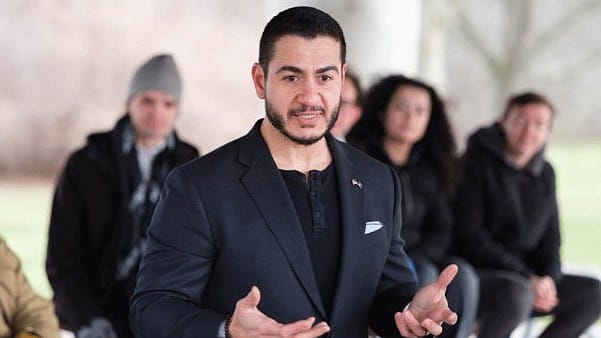
“JD, habibi.” That was how Abdul El-Sayed addressed the US vice president from a stage in Detroit early on November 4. The Michigan Democrat, who had just beaten Republican Mike Rogers to become the first Muslim elected to the US Senate, used the Arabic term of affection to tease JD Vance about swearing him in come January. Two days later, speaking at an Arab American summit in Chantilly, Virginia, El-Sayed made a bigger claim for his home state. “Michigan is the capital of Arab America.”
To see what he meant, look at Dearborn. A century ago, auto jobs drew Arab immigrants to the Detroit area. In this year’s Senate race, Dearborn gave El-Sayed 82.2 per cent of its vote in the city’s unofficial tally. The story between those two points runs through factory gates, family networks and immigration laws that changed who could come to America.

The Era of Forever Wars
30 Oct 2026 - Vol 05 | Issue 44
Coping with an explosive Middle East
Why did El-Sayed say “habibi”?
It means “my dear” or “my beloved” in Arabic. El-Sayed used it as a playful address to a political opponent. He relished the prospect that Vance, who had attacked him during the campaign, might be the person to administer his oath. He followed the jab with a nod to the Michigan–Ohio State rivalry, scoring it one for the Wolverines and zero for the Buckeyes. The Senate says the vice president typically administers the oath at the start of a new Congress. In the vice president’s absence, the senator chosen to preside in their absence, known as the president pro tempore, can do it.
What does “Arab America” mean?
It’s a collective name for Americans with roots in the Arab world, including immigrants and families that have lived in the US for generations. El-Sayed, the Michigan-born son of Egyptian immigrants, is part of that story. So were many of the first arrivals from what is now Lebanon and Syria, who were Christian. In Hamtramck, another city in the Detroit area, the city’s own planning documents describe both Yemeni and Bangladeshi migration. Arab identity and Muslim faith can overlap. They describe different things.
Why did so many families settle near Detroit?
There was work, and the pay stood out. In 1914, Henry Ford introduced his $5 workday. One early destination was Highland Park, where Ford made the Model T. The factories gave people a reason to come. The congregations and relatives already in the area gave later arrivals people they could turn to.
The Arab American National Museum in Dearborn has one family’s story. In 1923, Sara Abdalla and her daughter Rose were sent back to France after Sara failed an eye exam on arrival in the US. Her husband, already in Detroit, asked his congressman for help. Sara and Rose crossed the Atlantic three times before they finally made it to America. Congress tightened immigration quotas in 1924. The 1965 immigration law ended the national-origins quota system and gave preference to family ties and job skills. Later arrivals included people fleeing Lebanon’s civil war.
Is Michigan really the capital?
It has a case as a cultural and political centre. Dearborn is home to the Arab American National Museum. About 54.5 per cent of the city identified as Middle Eastern or North African in the 2020 census data released in 2023. That category is broader than Arab identity and includes groups such as Iranians. The census does not ask about religion. California recorded the largest Middle Eastern or North African population of any state. Michigan’s case rests on the concentration around Detroit and the institutions those communities built.
What did Dearborn’s vote tell us?
El-Sayed’s 82.2 per cent is striking because Dearborn had seen the same Republican on a Senate ballot two years earlier. In 2024, Democrat Elissa Slotkin took 41.4 per cent against Rogers in the city. That same year, Donald Trump carried Dearborn in the presidential race with 42.5 per cent. Those are different races, and the city totals cannot tell us how individual Arab American voters voted. They do show how dramatically the same city can respond to different candidates. Axios found that El-Sayed also improved on Slotkin’s share across Wayne, Oakland and Macomb counties. His support reached well beyond Dearborn.
Arab Americans have served in Washington for decades. James Abourezk, the son of Lebanese immigrants, entered the Senate from South Dakota in 1973. Detroit-born Rashida Tlaib entered the House in 2019. The new milestone is that a Muslim candidate won a statewide election to the Senate after speaking openly about his faith throughout the campaign.
Did Canada’s Arab communities grow the same way?
Montréal’s story also begins in the 1880s with migrants from what is now Lebanon, many of them Christian. Later, French-speaking Quebec drew immigrants from Algeria, Morocco and Tunisia. Statistics Canada counted about 290,000 Arab residents in metropolitan Montréal using 2021 census data. That’s more than a third of the country’s Arab population under the study’s definition.
There’s an Indian connection in the earlier chapter. Canada’s 1908 continuous journey rule required immigrants to travel directly from their country. With few direct routes, the rule curtailed arrivals from Southwest Asia. It was also used to turn away most of the 376 passengers aboard the Komagata Maru, a ship carrying prospective South Asian immigrants that reached Vancouver in 1914.
When does El-Sayed take his seat?
The new Congress is due to convene on January 3, 2027. That’s when newly elected senators normally take the oath. His first votes will put two of his campaign positions to a practical test. He ran on expanding public healthcare and ending US military aid to Israel. In January he’ll have one of Michigan’s two Senate votes to put behind those promises.