Trumped By the Pope
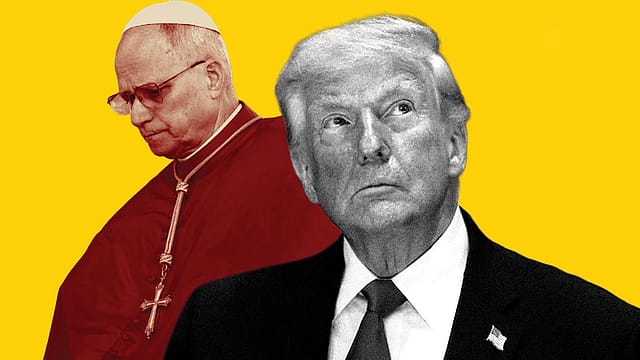
Donald Trump made and unmade himself in Christ’s image and Pope Leo refused to debate the US president. But the numbers and voices tell a story of spreading damage. The Pope has been a vocal critic of the Iran war, but then a pontiff won’t condone war. Calling Leo a political appointee, as Trump did, questions the sanctity of the papal conclave. Practising Catholics construe it as an attack on their faith. Saying the Pope should be “careful” when talking theology, as JD Vance, a Catholic, did, will call for heckling. The Catholic vote—which he won by a 12-point margin—was a key factor in swinging the 2024 election Trump’s way.
That vote has been moving away since he returned to office. Between February 2025 and January 2026, Trump’s approval among white Catholics dropped from 59 to 52 per cent while among Hispanic Catholics it fell from 31 to 23 per cent. No community has been hit as hard by the immigration crackdown as the Latino. Less than 40 per cent Catholics approve of Trump’s handling of the Iran war and that number is falling. With Catholics making up a fifth of voters in the mid-terms, a 5-7 per cent swing towards Democrats could cost Republicans the House. And the departure of loyal rightwing Catholics would hurt most. The Pope might prove mightier than the president.
Losing Memory
16 Oct 2026 - Vol 05 | Issue 42
The making of a medical and social emergency
Sweden Returns to Books

Since the early noughts, Sweden’s Social Democrats had aggressively pushed digital devices into the classroom. Not surprising in a country known for its high digital literacy. But 2012 onwards, Sweden began dropping on the Pisa rankings, the OECD benchmark for education. Maths competence and reading skills were crashing. Experts pointed at how even pre-school kids were compulsorily moved to tablets and an unnecessary number of devices forced upon teachers and students without clear goals. The current rightwing coalition government has been reversing course since 2025, doubling down on paper, pens and physical books. “Reading real books and writing on real paper, and counting with real numbers on real paper, is much better if you want kids to get the knowledge they need,” an education ministry spokesperson told BBC. But tech companies claim a return to an analogue model would harm students’ job prospects. More and more research shows heavy digital distractions are detrimental to cognitive development and children find it harder to process information when reading only on digital devices. Perhaps the problem is one of scale and not a mutually exclusive choice and digital resource distribution also needs to be attended to.
Family Secrets
If you are German or Austrian and born well after the war, you might want to know if that claim that none among your family was a Nazi is true. Or you may not, since coming to terms with the past is never easy even when institutionalised. German newspaper Die Zeit has recently created a tool in collaboration with the Bundesarchiv and the US National Archives to help people search online among Nazi party membership cards, saved against Hitler’s orders in the last days of the war and microfilmed in the 1990s. Well, relief and disappointment—a grandfather confirmed here or a father exonerated there—can come in equal measure. But it’s a triumph of the truth.