From Ukraine With a Message
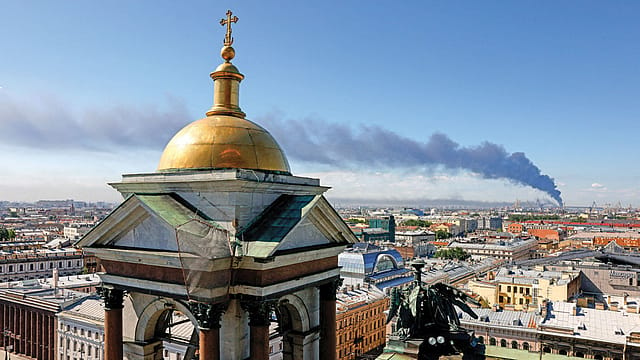
The Ukrainian defence industry has long emerged as a success story of a sad war. On the eve of Vladimir Putin’s showcase economic summit in his beloved Ïèòåð (Piter, the endearing nickname of St Petersburg), Ukrainian long-range drones flew all the way to strike an oil terminal outside the city as well as the Kronstadt naval base. Russia’s defence ministry claimed to have downed 354 Ukrainian drones but the strikes were more than symbolic: they demonstrated Ukraine’s persistent ability to hit targets deep inside Russia. While Kyiv keeps its focus on oil and energy infrastructure, Moscow insists on murdering civilians. On June 3, a massive strike killed 22 people as Russia launched 198 long-range drones.
There is no comparison in terms of material damage, with two-thirds of Ukraine’s energy production capacity destroyed, but the timed strike on St Petersburg wasahumiliation. Oncecalled the ‘Russian Davos’, the St Petersburg Economic Forum sees the return of the US with a low-key delegation, which includes Rodney Mims Cook Jr, the man supervising the construction of Donald Trump’s ballroom; far-right commentator Candace Owens; and Steven Segal, who happens to like Putin a lot. Russia, of course, has vowed “systemic” retaliation, for the umpteenth time in war it started.
The Hermeneutic Skills of AI

Libraries and archives across the world hold innumerable encrypted manuscripts still waiting to be decoded. From royal correspondence, diplomatic and war dispatches to medical remedies or even love letters, it’s estimated that about 1 per cent of all archival material is wholly or partially encrypted. AI is now helping crack open these ancient and medieval mysteries. Researchersarebeing helped by two projects, the Transkribus AI platform, which has more than 500,000 users and claims to have processed over 200 million pages in more than 100 languages, and the multinational DESCRYPT project led by Stockholm University, which combines computational linguistics, computer vision, and cryptology to interpret even rare and unknown languages, including personalised coding systems. The process involves several stages: the document has to be first laboriously transcribed into machine-readable text. After transcription, cipher-breaking algorithms use frequency analysis and pattern matching to crack the code. Researchers, for example, recently decrypted the famous Borg cipher in the Vatican library, 408 pages of secret medical remedies written in 500 symbols. The AI tool documents the process to make its interpretation credible while experts make corrections. The goal is turning transcriptionanddecipherment into a single process, capitalising on the scale, speed and pattern reading AI already brings to the task.
A Trumpista in Bogotá?
A Trumpista of sorts versus old leftwing anti-Americanism. Donald Trump has had his say on Colombia’ presidential election, which saw a candidate assassinated last year, with righwing outsider and Trump fan Abelardo de la Espriella leading the May 31 first round with 43.7 per cent votes against leftwing Iván Cepeda at 40.9 per cent. The centre-right candidate Paloma Valencia was knocked out with 6.92 per cent. With no candidate clearing the 50 per cent threshold, the two frontrunners head for a run-off on June 21. Cepeda represents continuity with outgoing leftist President Gustavo Petro. De la Espriella is Colombia’s own Javier Milei and has pledged to join Trump’s Americas Counter Cartel Coalition.