Trump Says Iran Strikes Possible Before Midterms; Tehran Warns of ‘Doomsday War’
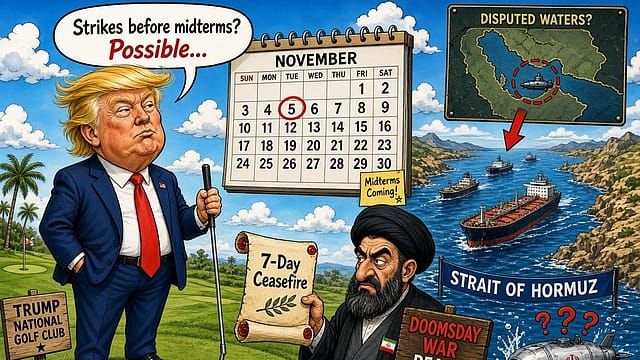
US President Donald Trump said fresh strikes on Iran before November’s midterm elections were “possible”, while Tehran warned it was prepared for a “doomsday war” following Washington’s rejection of its seven-day ceasefire proposal.
The competing statements on Sunday left the prospect of renewed fighting open even as Iranian Foreign Minister Abbas Araghchi said diplomacy remained an option. A separate dispute over Iran’s claim of seizing an American underwater drone added to tensions in the Strait of Hormuz.
Speaking to Fox News on the sidelines of the PGA Tour Presidents Cup, Trump predicted that the conflict would be won “very soon” and that oil prices would then fall sharply.
“I think what’s going to happen is we’re going to win this war very soon, and as soon as we win it, the oil will go down, way down to what it was before the war,” he said.

Zeroing In on ECI
09 Oct 2026 - Vol 05 | Issue 41
Constitutional legitimacy versus political opportunism
Trump Leaves Timing of Strikes Open
Asked whether military strikes could resume before the midterms, Trump declined to rule out the possibility.
“I don’t want to say that. I don’t want to say that. I mean, it’s possible, but I just don’t want to say that,” he said.
His comments followed a Wall Street Journal report, citing US officials, that he had told aides he expected bombing to resume after the elections. The latest remarks left open an earlier resumption without specifying a timetable.
Trump reiterated that preventing Iran from acquiring a nuclear weapon remained Washington’s central objective.
“And the key is, Iran will not have a nuclear weapon,” he said.
He also claimed that military and economic pressure were succeeding, describing Iran’s economy, currency and armed forces as severely weakened. His assertions included an inflation figure of more than 300%, which he said he had heard that morning.
Iran Says It Is Ready for War—and Diplomacy
Araghchi told NBC News’ Meet the Press that Iran was prepared for renewed hostilities and would not base its decisions on the American electoral calendar.
“We are fully prepared for the war to be resumed. We stand firm in the face of any new aggression, even if it comes to a doomsday war. We don’t care about U.S. midterm elections. We care about our national interests,” he said.
“At the same time, we stand ready for diplomacy. It is up to President Trump to choose.”
Araghchi said Trump’s public rejection of Tehran’s proposal had not been formally conveyed through the designated diplomatic channels.
He maintained that Iran was willing to reopen Hormuz as part of a negotiated settlement, linking an agreement to access to frozen assets and the ability to sell oil.
“We want our monies, our assets, which are illegally frozen, to be released. We want to be able to sell our oil,” he said.
Why Washington Rejected the Proposal
Iran’s seven-day framework sought to end the fighting, reopen Hormuz and restart comprehensive talks on its nuclear programme.
Araghchi described the terms as similar to a June memorandum of understanding for a temporary ceasefire that subsequently collapsed following reciprocal strikes.
US Ambassador to the United Nations Mike Waltz, appearing on Meet the Press before Araghchi, said Washington rejected the proposal for several reasons, including its demand for access to billions of dollars in frozen funds.
“I think this was a pretty cynical attempt to put something on the table that they knew was unacceptable, to ask for the release of the blockade, the sanctions, international sanctions, and access to billions in assets,” Waltz said.
He also accused Tehran of violating earlier understandings by attacking commercial vessels and questioned who was directing Iranian policy.
Araghchi, meanwhile, said he continued to pursue talks despite his doubts about the process.
“But I am still trying diplomacy because I think we shouldn’t miss any chance for peace,” he said.
US Denies Iran’s Underwater Drone Claim
Separately, US Central Command rejected an Iranian claim that its forces had captured an American autonomous underwater vehicle in Hormuz.
CENTCOM spokesperson Captain Tim Hawkins told Al Jazeera that the United States maintained “positive control of all of our operational drone assets”. He described Iran’s assertion as “clearly desperate”.
Iran’s Islamic Revolutionary Guard Corps Navy had earlier claimed it seized a REMUS 600 underwater vehicle. A subsequent statement identified the alleged capture as a Mk 18 Mod 2 Kingfish.
The IRGC said intelligence and electronic warfare capabilities had enabled the operation and claimed specialists were examining the vehicle to recover stored information. Washington’s denial directly disputed that account.
Hormuz Remains a Flashpoint
In a statement carried by Iranian state broadcaster IRIB, the IRGC Navy declared Hormuz closed and threatened action against unauthorised traffic.
The warning underscored the gap between Tehran’s offer to reopen the shipping route through negotiations and its continuing threats against maritime movements.
With Washington rejecting the proposed terms and both sides signalling readiness for further military action, neither the timetable for renewed talks nor the prospect of a ceasefire was settled.
With inputs from ANI