Trump Administration Caught Off Guard by Iran’s Hormuz Pressure Tactic: Report
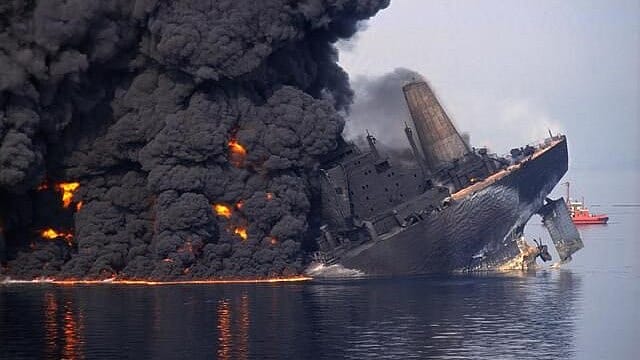
The administration of Donald Trump reportedly underestimated the likelihood that Iran would move to close the strategic Strait of Hormuz in response to US military strikes, according to a report by CNN citing multiple sources familiar with internal planning discussions.
Sources told CNN that while planning for the ongoing military operation, the Pentagon and the United States National Security Council did not fully anticipate that Iran would attempt to close the waterway despite long-standing contingency plans developed by the US military for such a scenario.
Officials from the US United States Department of Energy and the United States Department of the Treasury attended some planning meetings before the operation began.
However, CNN sources said the detailed economic forecasts and interagency analysis that typically shape major decisions were not central to the discussions.
Earlier, Iran's new Supreme Leader Mojtaba Khamenei indicated that the closure of the Strait would remain a pressure tactic, according to remarks broadcast on Iranian state television.

Open Minds 2026
26 Jun 2026 - Vol 05 | Issue 26
The power of ideas and arguments in 50 portraits
Khamenei said Iran had identified sites which he claimed were vulnerable for future strikes from the Islamic Republic.
"Studies have been conducted regarding the opening of additional fronts in areas where the enemy has negligible experience and would be highly vulnerable, and their activation will be carried out if the state of war persists and in accordance with the observance of interests," he said.
Why did Iran’s UN envoy say Tehran has no intention to close the Strait of Hormuz?
Later, Iran's UN Ambassador Amir Saeid Iravani said Tehran has no intention to close the Strait of Hormuz amid the West Asia conflict but added that it is their "right to preserve the peace and security in this waterway."
"We are not going to close the Strait of Hormuz, but it is our inherent right to preserve the peace and security in this waterway, and it is our right," he said while speaking at the UN stakeout.
"Iran has no choice but to exercise its inherent right to self-defence under the UN Charter and international law," he said.
"Iran fully respects and remains committed to the principles of freedom of navigation under the law of the sea. However, the current situation in the region, including in the Strait of Hormuz, is not the result of Iran's lawful exercise of its right of self-defence," he added.
In recent days, Iran has intensified its restrictions on the passage of ships through the Strait of Hormuz amid ongoing US Israeli strikes.
Tehran has said vessels not serving the interests of the United States and Israel can sail through safely.
Amid the tensions, the United States has allowed countries to purchase Russian oil currently stranded at sea in a temporary move aimed at easing pressure in global energy markets.
Why did the US allow countries to buy Russian oil stranded at sea?
According to Scott Bessent, US Treasury Secretary, the decision is part of efforts by the administration of Donald Trump to stabilise global oil markets and contain rising fuel prices.
In a social media post, Bessent said the measure would help increase the global availability of oil supply amid geopolitical tensions affecting energy markets.
"@POTUS is taking decisive steps to promote stability in global energy markets and working to keep prices low as we address the threat and instability posed by the terrorist Iranian regime," Bessent said.
He added that the United States Department of the Treasury has issued a temporary authorisation allowing countries to buy Russian oil that is already in transit and currently stranded at sea.
"To increase the global reach of existing supply, @USTreasury is providing a temporary authorization to permit countries to purchase Russian oil currently stranded at sea," he said.
Bessent said the measure would apply only to oil shipments that are already in transit.
"This narrowly tailored, short-term measure applies only to oil already in transit and will not provide significant financial benefit to the Russian government, which derives the majority of its energy revenue from taxes assessed at the point of extraction," he said.
How high did Brent crude oil prices rise during the market surge?
The move comes as global crude oil prices remain elevated due to escalating geopolitical tensions in the Middle East that have raised concerns over disruptions to energy supply routes.
Benchmark Brent crude oil prices briefly surged toward USD 120 per barrel, marking a multi year high amid fears that conflicts in the region could threaten oil supplies.
Currently, crude oil prices are trading around USD 100 per barrel, approximately 35 per cent higher than pre war levels.
Bessent also said that the US administration's energy policies have contributed to strong domestic oil and gas production.
He said President Trump's pro energy policies have helped push US oil and gas output to record levels, which in turn has supported lower fuel prices for consumers.
"The temporary increase in oil prices is a short-term and temporary disruption that will result in a massive benefit to our nation and economy in the long term," Bessent said.
(With inputs from ANI)