Pete Hegseth Warns Iran of Strikes as Asim Munir Pushes Diplomacy in Tehran
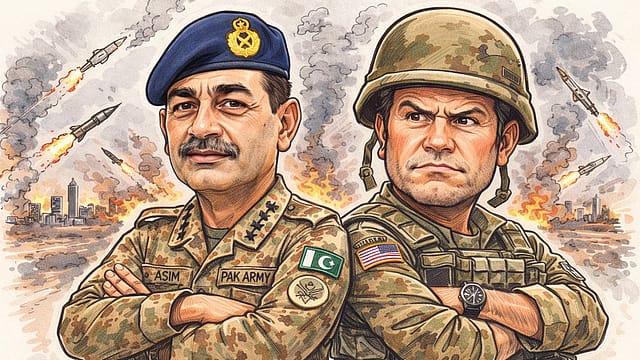
Tensions in West Asia have reached a critical inflection point as the United States escalates military pressure on Iran, even as behind-the-scenes diplomacy intensifies. A stark warning from Washington now coincides with urgent regional mediation efforts led by Pakistan, signalling both the risk of conflict and the possibility of a breakthrough.
Is the US preparing for war, or forcing a deal?
The United States has issued one of its strongest warnings yet to Iran, making it clear that the current blockade and economic pressure are only the beginning if Tehran refuses to strike a deal.
At a Pentagon briefing, US Secretary of War Pete Hegseth cautioned that Iran faces a stark choice. “We know which military assets you have moved and where you have taken them,” he said, directly addressing both the Iranian Army and the Islamic Revolutionary Guard Corps.
Flood and Fury
04 Sep 2026 - Vol 05 | Issue 36
Devighat, Nepal, August 29, 2026
The warning comes as the US blockade of the Strait of Hormuz enters its third day, disrupting maritime traffic and isolating Iran’s economy by choking its primary trade routes. American forces have claimed full control over movement in and out of Iranian ports, maintaining what officials describe as a high state of readiness.
Hegseth underscored the pressure campaign, stating, “In the meantime, and for as long as it takes, we will maintain this successful blockade. But if Iran chooses poorly, then they will have a blockade and bombs dropping on infrastructure and power and energy.”
He added that the Treasury Department is simultaneously “maximizing economic pressure” to further weaken Tehran’s position.
Highlighting US naval dominance, he said, “The US Navy controls the movement in and out of Hormuz, which we are doing with just 10 per cent of US naval capacity,” calling the current approach restrained. “This blockade is the polite way that this can go,” he warned, adding bluntly, “You (Iran) don't have a navy or real domain awareness. You can't control anything.”
Despite the hardline stance, Hegseth left the door open for diplomacy: “I pray you (Iran) choose a deal which is within your grasp, for the betterment of your people, for the betterment of the world.”
Reinforcing the warning, Chairman of the US Joint Chiefs of Staff, General Dan Caine, stressed military readiness: “I'd like to emphasize during this pause that the United States joint force remains postured and ready to resume major combat.”
But Pakistan bats on…
Even as military pressure mounts, diplomatic channels remain active, with Pakistan emerging as a key intermediary.
Pakistan’s Army Chief Asim Munir met Iranian Parliament Speaker Mohammad Bagher Ghalibaf in Tehran, amid what officials describe as intensive efforts to revive stalled negotiations between Washington and Tehran.
The visit follows Islamabad’s outreach aimed at de-escalating the crisis, with Pakistani officials expressing hope for a “major breakthrough,” particularly on Iran’s nuclear programme. According to reports, Munir’s delegation is carrying messages from Washington, signalling ongoing back-channel engagement.
The diplomatic push comes after the inconclusive “Islamabad Talks,” with a second round of negotiations now being explored. However, significant hurdles remain.
Key disagreements persist over the duration of a potential uranium enrichment freeze, with proposals ranging from five to twenty years. Another contentious issue is the fate of Iran’s estimated 440 kilograms of highly enriched uranium, with options including transferring it to a third country or reducing enrichment levels.
Munir’s visit is seen as a crucial attempt to bridge these divides. He is also expected to travel to Washington after Tehran, underscoring Pakistan’s role in shuttling between the two sides in a high-stakes mediation effort.
And what happens if talks fail?
The convergence of military escalation and diplomatic urgency highlights a narrowing window for resolution.
On one hand, the US has demonstrated its willingness to intensify pressure, signalling that the current blockade could quickly evolve into direct military action. On the other, ongoing negotiations suggest that both sides are still exploring a path to avoid conflict.
The situation now hinges on whether Iran responds to Washington’s ultimatum or continues to resist under mounting economic and military strain.
With both bombs and backchannels in play, the region stands at a decisive moment, where the next move could determine whether West Asia moves toward war or a fragile peace.
(With inputs from ANI)