The Houthis’ Next Target: Saudi Arabia’s Oil Escape Route
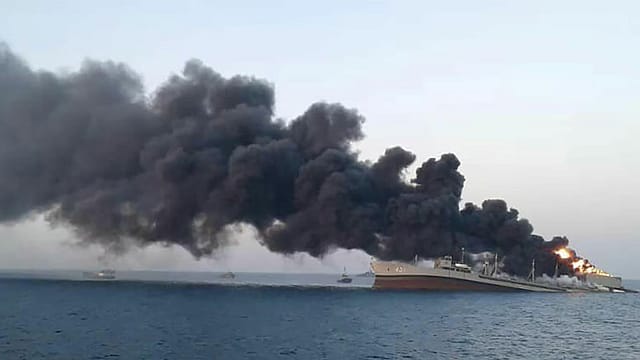
An oil producer can build a pipeline around a dangerous strait. The harder task is keeping the route beyond that pipeline safe. Saudi Arabia’s East-West pipeline carries crude across the kingdom to the Red Sea, allowing exports to avoid the Strait of Hormuz. But tankers sailing south from its Red Sea terminals towards Asian buyers must pass through another narrow waterway: Bab el-Mandeb, beside Yemen.
That is where the Houthis’ latest advances acquire significance far beyond the territory captured. The group’s seizure of Mokha, also spelt Mocha, has been confirmed to the Associated Press by officials on both sides of Yemen’s conflict. The port lies about 80 kilometres from the strait. The advance brings an armed movement already capable of attacking merchant ships closer to a critical passage between the Indian Ocean and the Red Sea.

Zeroing In on ECI
09 Oct 2026 - Vol 05 | Issue 41
Constitutional legitimacy versus political opportunism
Meanwhile, Saudi Arabia has shut its East-West pipeline following drone attacks. Two separate vulnerabilities are now interacting: damage to the infrastructure carrying oil across land, and threats to the ships supposed to carry it onwards. The Houthis’ growing influence rests on that interaction. Their capacity to impose costs extends well beyond the territory they govern.
Who are the Houthis, and where did they come from?
The Houthis are a Yemeni political and armed movement formally called Ansar Allah, usually translated as “Supporters of God”. Their roots lie in a Zaydi Shia religious revival in northern Yemen during the 1990s.
They emerged amid local grievances over marginalisation, political power and religious identity. Hussein Badreddin al-Houthi became a central figure in the movement’s politicisation. Confrontation with President Ali Abdullah Saleh’s government escalated into armed conflict in 2004; Hussein was killed that year. The movement survived and expanded through repeated wars with the Yemeni state. Council on Foreign Relations’ historical explainer, Brookings’ account of the movement’s origins
Its leader today is Abdul Malik al-Houthi. The group combines religious mobilisation, military organisation and governing authority over much of northwestern Yemen. Its domestic ambitions remain central even as its attacks increasingly shape regional politics. Reuters’ Houthi explainer
Understanding those Yemeni roots matters. Describing the Houthis only through their relationship with Iran leaves out the local conflicts that made them powerful.
How did a northern insurgency become a regional military force?
Yemen’s political breakdown gave the movement room to grow. The Houthis seized the capital, Sanaa, in 2014 and subsequently advanced south. In March 2015, a Saudi-led coalition intervened in support of Yemen’s internationally recognised government. The intervention failed to remove the Houthis from the capital.
Over time, their cross-border attacks became more sophisticated, supported by expanding military capabilities and Iranian assistance. Their arsenal came to include ballistic and cruise missiles, drones and unmanned maritime systems. A UN-brokered truce in 2022 substantially reduced fighting, but left the underlying struggle for power unresolved. Congressional Research Service’s background report Years of conflict therefore produced an entrenched armed authority with experience of surviving external military pressure. That history helps explain why another round of strikes cannot be assumed to deliver a quick political settlement.
Are they controlled by Iran?
Iranian support is substantial. American officials have documented weapons supplies, military advice and targeting assistance. The Congressional Research Service also notes that the Houthis have developed capabilities of their own, making their resilience more complex than dependence on an external supplier alone.
The relationship gives Tehran an ally positioned beside an important shipping corridor. It gives the Houthis access to support that strengthens their military and diplomatic position. However, alignment does not establish that Tehran orders every operation. Reuters describes the movement as driven substantially by domestic objectives, with a relationship to Iran’s leadership different from that of Hezbollah. Claims about responsibility for individual attacks still require evidence.
What has changed in the latest offensive?
The Houthis have expanded their territorial presence along Yemen’s western coast. Beyond Mokha, their capture of Mayun, also known as Perim, was confirmed to AP by a Yemeni government military official and a Houthi official.
Mayun sits within Bab el-Mandeb. Its location makes the reported takeover particularly consequential for maritime security. Separately, Saudi Arabia blamed the pipeline attack on drones coming from Iraq, and Iraqi authorities said the launch originated from their territory. The supplied ANI report’s reference to drones originating in Iran therefore needs correction. The ANI dispatch also carries a Houthi claim of strikes on military facilities in Saudi Arabia’s Sharurah region. That remains an attributed claim; it does not independently establish the targets hit or the damage inflicted.
Why does Bab el-Mandeb matter so much?
Bab el-Mandeb connects the Gulf of Aden with the Red Sea.
Ships using the Suez route between the Indian Ocean and the Mediterranean pass through it.
Its importance is visible in historical energy flows. According to the US Energy Information Administration, about 9.3 million barrels a day of crude and petroleum products passed through the strait in 2023. That fell to 4.1 million barrels a day in 2024, after attacks prompted rerouting. These are historical figures, rather than a measurement of today’s traffic. They demonstrate how sharply insecurity can alter the use of an established route. The economic effect can begin before a ship is struck. Owners, charterers, insurers and crews must decide whether a voyage remains acceptable. A credible threat can be enough to change that decision.
Does this mean all Saudi oil exports are trapped?
No. The direction of travel is crucial. Saudi crude transported to Red Sea terminals can sail north towards Egypt’s Suez Canal or SUMED pipeline and onward to Mediterranean markets. It can also sail south through Bab el-Mandeb towards the Indian Ocean and Asia. A threat at Bab el-Mandeb directly compromises the southern option. It does not, by itself, seal the northern route. Damage to the East-West pipeline is a separate problem because it affects delivery of crude to the Red Sea in the first place. Reuters reported on September 13 that the pipeline had been moving roughly four million to five million barrels daily before the shutdown. Its operating status and repair timeline are therefore critical. Calling the situation a complete blockade would obscure these distinctions. The danger is an accumulating loss of reliable options.
Can the Houthis actually close the sea?
Capturing territory near a waterway does not establish continuous control over every ship passing through it. But commercial disruption requires less than complete military control. Repeated attacks, uncertain targeting and rising insurance costs can persuade operators to avoid a route that remains physically navigable. That has already happened. UN Trade and Development documented ships diverting around Africa’s Cape of Good Hope during the earlier Red Sea crisis. In an April 2024 assessment, it estimated that rerouting could add about 12 days to an Asia–Europe journey, although the delay varies by voyage. The distinction is between preventing passage and making passage commercially unacceptable. Both can have economic consequences.
Why did they start attacking merchant ships?
The Houthis linked their campaign against shipping after November 2023 to the war in Gaza, presenting it as pressure on Israel. But the risks spread well beyond vessels with an identifiable Israeli connection.
AP reported that, between November 2023 and December 2024, the group targeted more than 100 merchant vessels, sank two and killed four sailors. These figures describe that period, rather than the cumulative toll through September 2026. In the renewed confrontation with Saudi Arabia, the Houthis have also linked attacks on Saudi shipping to demands to lift the Saudi-led blockade. Their stated political objectives do not make merchant crews parties to the conflict. A ship’s flag, ownership, charterer, cargo and crew can connect it to several countries at once.
Why haven’t powerful militaries stopped them?
Protecting ships during individual attacks and eliminating a movement’s capacity to threaten shipping are different military tasks. US forces have intercepted projectiles, prevented attempted vessel seizures and attacked Houthi targets. Washington launched another air campaign in March 2025, followed by a US-Houthi truce in May. The Congressional Research Service records both the intervention and the persistence of the underlying maritime threat.
Defence also imposes continuing demands: ships, aircraft, intelligence, interceptors and crews must remain available. Reuters’ September 12 analysis describes a US military already stretched by the Iran conflict and facing difficult choices over further commitments against the Houthis. For Saudi Arabia, escalation carries the possibility of further retaliation against energy infrastructure. Restraint carries the risk of additional Houthi gains. Neither guarantees a swift restoration of secure trade.
What does this mean for India?
India faces exposure through energy prices, shipping costs and delivery schedules. The most immediate risk is a higher cost of moving goods and oil. A longer voyage requires more fuel and keeps the vessel occupied for longer. Insurance surcharges add another expense. Importers may need to finance cargo for additional days before it arrives, while exporters face uncertainty over delivery commitments. UNCTAD’s earlier analysis illustrated the capacity problem using an India–Europe shipping service: extending a round trip from 56 to 63 days would require an additional vessel to maintain the same frequency. India’s exposure also extends beyond Saudi supplies.
The EIA notes that substantial Russian oil flows shifted towards Asian buyers, particularly India, through the Suez–Bab el-Mandeb corridor after 2022. That does not mean every Indian cargo uses the threatened passage. It means diversification of suppliers cannot remove every shared transport risk. Even cargo travelling elsewhere can become more expensive when disruption tightens global oil and shipping markets.
What is happening to Yemenis while the world watches the tankers?
The country facing this renewed escalation already has enormous humanitarian needs. UNICEF’s 2026 appeal estimates that approximately 19.7 million people require assistance. Around 4.5 million children remain out of school, and approximately 500,000 children are projected to suffer severe wasting during the year. Further displacement, damaged infrastructure and interrupted aid delivery would deepen those pressures. Humanitarian access is already constrained by funding shortages, restrictions and the detention of UN and aid workers, particularly in Houthi-controlled areas. For Yemenis, the consequences arrive as lost shelter, interrupted treatment and unaffordable food. Those costs deserve the same attention as the price of a barrel.
What should we watch next?
The pipeline’s reopening is one test. The movement of commercial ships is another: which vessels continue through Bab el-Mandeb, which divert, and whether insurers and shipping companies revise their conditions.
The durability of the Houthis’ territorial gains will also matter, alongside the Saudi response and any diplomatic effort to contain the escalation. The central question is whether commerce can recover confidence in the route. A ceasefire announcement or a successful interception may help, but operators need sustained evidence that crews and cargo can pass safely. Saudi Arabia’s pipeline was designed to provide another way out. The Houthis’ expanding reach shows why an alternative route is only as dependable as the journey that follows it.
With inputs from ANI & agencies