Looking Ahead in Anger
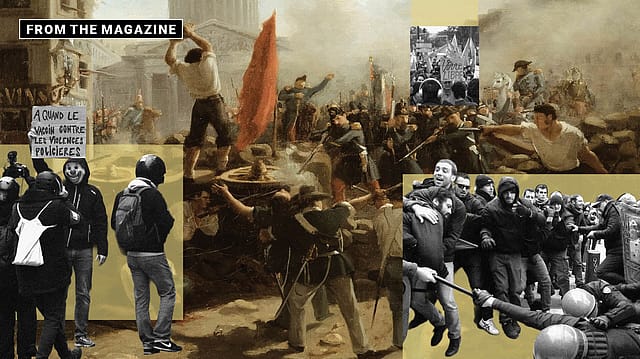
Here we sit in chilly Blighty, watching European cities fill with protesters while our own streets remain calm, even deserted. We might like to change our prime ministers a little too often over here, but thus far we haven’t displayed anything like the same appetite for havoc that seems currently to prevail in France, Italy and Spain. It’s like 1848 all over again.
Nevertheless, UK podcasts and alternative media are filled with dire warnings about how we are headed for popular revolt or even civil war. So, what is going on in Europe, and are we in danger here?
First, the facts. For the last month or so there have been violent disturbances across Europe, from Portugal and Albania to Belgium and Ireland, with the bulk of the trouble occurring in France, where there is a long and hallowed tradition of similar protests.
Next, the guesswork. What has been causing such widespread discontent? The simplest answer is that Europeans are facing a connected set of deep, long-term issues that have recently come to a head within a wider global context of war and economic downturn.
Most importantly, all major European states have pressing issues with government debt. France is out ahead on any measure and has been unable to control public spending for more than a decade. The annual deficit is not being reduced, bond markets are nervous, and President Emmanuel Macron seems unable to address, let alone fix, any of the underlying causes of the impending financial crisis facing his government.
Chief among these is a chronic problem that afflicts all major European countries, namely a demographic imbalance between old and young; the unproductive parts of the population are relentlessly increasing relative to the productive part. This is not good for government finances; in France the age of retirement is set at 63, while life expectancy hovers around 78, and pensions are paid directly out of annual taxation. This sets wage earners directly against pension receivers, while the money available for public services is constantly reducing. Result, unhappiness.
Age imbalances, combined with high labour costs and a lack of investment, have also led to a productivity crisis all across the continent. The leader in this is Germany, whose economy has been driving the prosperity of Europe and holding the finances of the European Union (EU) together for decades. But now that mighty engine is faltering, as the once all-powerful German automotive industry is slowly being replaced on a global level by the Chinese. So far in 2026, one hundred thousand jobs have been lost, and industrial output is down by 10 per cent.
Where twenty-five years ago the European economy made up one quarter of the world’s GDP, it now constitutes barely 13 per cent, while China has moved up from 7 to 20 per cent. Europe will not recover the advantages in productivity it once had because most of the factors that created them—cheap energy, easy access to capital, superior education—have disappeared.
Attempts to create and maintain a single European market have also restricted Europe’s scope for growth. The EU contains 500 million of the richest and most well-educated people in the world, but trying to standardise 27 economies with multiple different languages and local requirements has proved formidably difficult. The EU has always been committed to a regulatory regime that protects citizens in ways they are not protected in parts of the world that are more capitalist or more totalitarian. This has come at an undeniable cost.
The hard truth is that neither the European industrial base nor the welfare budgets of Europe’s national governments can now be expected to grow, which is bringing real pain to ordinary people; there is no generosity now to be found in either the private or the public sector.
Long story short, Europe is getting poorer and will not get rich again anytime soon.
This is something of a disappointment to those in the older generation who still cling to memories of the age of European colonialism and the supremacist attitudes it generated. But to the younger generation, it represents a catastrophic blow to their hopes of a better, or even a comfortable life. Youth unemployment is now a severe problem, and there is apocalyptic talk of the end of the ‘social contract’ that once held our societies together.
THERE HAVE BEEN VIOLENT DISTURBANCES FROM PORTUGAL AND ALBANIA TO BELGIUM AND IRELAND, WITH THE BULK OF THE TROUBLE OCCURRING IN FRANCE, WHERE THERE IS A LONG TRADITION OF SIMILAR PROTESTS. EUROPEANS ARE FACING A SET OF LONG-TERM ISSUES THAT HAVE COME TO A HEAD WITHIN A WIDER GLOBAL CONTEXT OF WAR AND ECONOMIC DOWNTURN
That contract had two main elements. First, that governments would look after us, in sickness and in health, and would ensure that our living standards continued to rise. Second, that parents could assume with confidence that their children would have a better life than their own, as had been the case with the previous three generations. On every side there are now ominous signs that these promises can no longer be honoured.
This has all contributed to a pervasive sense of betrayal that has driven disaffected youth onto the streets, following the example of French students who, since mid-September, have been protesting against government underfunding of education. So far, it is reckoned that damage costing over a billion euros has been done in France, which has seen the worst violence and the most arrests. But the French have not been alone in their resentments, and lack of job opportunities, high living costs, meagre welfare provision and governmental incompetence are points of grievance across all European countries.
In some regions there is also a massive housing crisis. Young people are finding that they cannot afford either to buy or rent, and while this is a serious problem in major cities, including London, it has become an existential crisis in parts of Spain where it portends not only homelessness but also the collapse of the middle class, which for generations has been inducted into the holding of capital via home ownership. If the housing ladder collapses, one of the main pillars of capitalist society goes with it. This is a silent crisis of the bourgeoisie, and it threatens to demoralise an entire generation.
Meanwhile, a parallel struggle about interpretation is being fought across the media landscape, as an equally contentious set of disputes about the true meaning of current events has developed.
Rightwing populist parties—the National Rally in France, the Alternative für Deutschland in Germany, Reform UK in Britain, the League in Italy and Vox in Spain—are reducing the discontent to the single issue of immigration, which again reduces to the single issue of Muslim minority populations. It is concern about the size of these populations that forms the background to fears about civil strife and civilisational collapse.
A fair amount of intellectual engineering is required to make Muslims responsible for the over-representation of old people in the population or the collapse of German manufacturing, but rightwing leaders and media outlets have chosen their line of attack and are sticking to it.

Boiled down, their argument is that the political class, whatever that is, is no longer on the side of native Europeans, whoever they are, and have decided for reasons, which remain unspecified, to surrender the entire continent to a group of people recently arrived from a region stretching from West Africa to Afghanistan, who have no identifiable leaders and share little but a historical religious tradition.
How minority populations who constitute the poorest and least educated parts of our societies could conceivably take them over is not explained. Instead, an alternative narrative is spun, whereby all immigrants are sexual predators, and our native young people have been so brainwashed by socialist education that they cannot see what is happening around them. Indeed, they are complicit in it, because they go out and demonstrate against the policy of the Israeli government in Gaza. Oh, and they’ve all been hoodwinked by the formidable Greta Thunberg to hate capitalism and believe in a bogus theory of environmental destruction.
This narrative neatly joins local issues to global problems, and is much easier to understand than complex leftwing arguments about how capitalism has become increasingly oligarchical, and how the prosperity that Europeans once enjoyed has not been shared sufficiently equally to maintain the internal balance of our societies. But these apocalyptic messages from the far-right resonate all too easily with the despair that a great many young people are currently feeling. Their sense of hopelessness can be summed up in two words—no future.
RIGHTWING POPULIST PARTIES—THE NATIONAL RALLY IN FRANCE, THE ALTERNATIVE FÜR DEUTSCHLAND IN GERMANY, REFORM UK IN BRITAIN, THE LEAGUE IN ITALY AND VOX IN SPAIN—ARE REDUCING THE DISCONTENT TO THE SINGLE ISSUE OF IMMIGRATION, WHICH REDUCES TO THE SINGLE ISSUE OF MUSLIM MINORITY POPULATIONS
This pessimism is real and contagious, and is being used to convince angry young people that their government is not on their side, because such state aid as they do receive is also extended to migrants, meaning that they are effectively being equalised with people they are told are the least deserving in their communities. If you can believe that your government has such contempt for you, and that there is no reasonable prospect of improvement, and that there is no way to change the system from within, then picking up a petrol bomb has a kind of logic to it.
But whenever protesters are asked what they are actually complaining about, they cite the economic concerns that we can measure. Few, if any, of the French students complain about immigration, but here we must make a clear distinction. The embattled French polity faces two sets of enemies, who are using different methods of protest.
The students, and the leftwing activists who have joined them, protest by day, using nonviolent mass demonstrations as their channel of expression. But there is another style of protest that runs by night, which consists of rioting and looting, assaulting the police and destroying property. This nighttime activity involves far fewer people and features anarchists and other ideological enemies of the French state, along with denizens of the outer conurbations—les banlieues—who are more interested in violence as entertainment and looting as informal entrepreneurship.
It is a matter of opinion whether these acts of disorder based in immigrant communities can be taken to stand for all the others across the continent, but rightwing commentators in Europe and the US are certainly prepared to do so, with enthusiasm.
Here in the UK, we have seen no copycat violence so far. So, will we?
Analysis coming from the British left has been scarce and, as ever, has emphasised economic issues, maintaining that the populism and disorder we are seeing is the backdraft of low growth, not immigration. By contrast, rightwing outlets have been almost obsessive in their coverage, largely because the idea of a wave of popular anger against repressive governments fits much more neatly into their worldview. The new buzzword is ‘anarcho-tyranny’, used to describe countries divided on an ‘elite versus street’ basis, with governments desperate to repress the natural and justified outrage that has followed upon mass immigration. But as yet, the streets of Britain are filled only with soggy autumn leaves. Mass resistance has yet to materialise.
We did see serious street violence here in July 2024 after three young girls were killed in a knife attack in Southport.
FRANCE HAS ISSUES WITH GOVERNMENT DEBT AND HAS BEEN UNABLE TO CONTROL PUBLIC SPENDING FOR MORE THAN A DECADE. THE ANNUAL DEFICIT IS NOT BEING REDUCED, BOND MARKETS ARE NERVOUS, AND PRESIDENT EMMANUEL MACRON SEEMS UNABLE TO ADDRESS ANY OF THE UNDERLYING CAUSES OF THE IMPENDING FINANCIAL CRISIS FACING HIS GOVERNMENT
Serious riots then followed, encouraged by a campaign of disinformation on rightwing social media which insisted that the culprit was a Muslim who had recently arrived on a small boat from France. This was wrong; the perpetrator was born in the UK, the child of immigrant parents, and was, at least nominally, a Christian. Now we have a similar incendiary campaign here and in Europe to misrepresent literally hundreds of thousands of people who are alleged to be demonstrating against immigration when they are, in fact, protesting against their own lack of prospects, and demanding what is now called intergenerational justice.
But you can’t keep a good conspiracy theory down, and the best of the current crop is that the protests are being directly engineered by governments who are aware that they have failed their people and are now pushing them onto the streets so that they can crack down on freedom of speech and the right of assembly.
Things never get so mad, it seems, that somebody somewhere cannot find a way to make them look even madder.
Roderick Matthews, a historian based in London, is the author of Jinnah vs Gandhi and Mountbatten and the Partition of British India