Tehran's Sky Is Literally Raining Oil: But Somehow the Air Is Still Cleaner Than Delhi's

All eyes are on crisis-ridden Iran.
Since US-Israeli airstrikes began targeting the Iranian capital’s oil infrastructure in late February 2026, residents have watched their skies turn black, smelled burning fuel in the air, and experienced something most people have only read about in history books: black rain.
Scientists have called the pollution “unprecedented.”
And yet, in a twist that says as much about chronic urban pollution as it does about war, Tehran’s AQI on several of these days has been cleaner than Delhi's.
As of March 11, 2026, air quality in New Delhi was significantly worse than in Tehran. Delhi’s AQI frequently falls in the “poor to unhealthy” range, often exceeding 150–200, while Tehran has reported comparatively cleaner conditions, with AQI levels typically ranging between 33 and 70, classified as “good to moderate.”
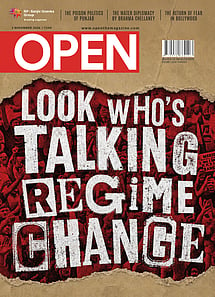
Look Who's Talking Regime Change
23 Oct 2026 - Vol 05 | Issue 43
What happened to Tehran's air after the strikes?
US-Israeli strikes have hit at least four major oil facilities around Tehran since 28 February 2026, including the Shahran oil depot, the Fardis oil depot, and the Tehran oil refinery. Satellite images captured on March 9 showed multiple facilities still burning.
Residents of the nearly 10-million-strong city reported skies so choked with smog they could no longer see the sun, with a heavy, acrid smell of burning hanging over large parts of the city.
What is black rain, and why did Tehran experience it?
Black rain is rainfall contaminated with pollutants - soot, oil droplets, and other airborne particles - that turns it visibly dark. Tehran residents reported it falling on March 9.
According to BBC Verify, Dr Akshay Deoras of the University of Reading explained that raindrops effectively acted like "sponges or magnets, collecting whatever was in the air as they fell." Large burning oil facilities release enormous quantities of particulate matter, and when rain passes through that polluted column of air, it picks up the contamination on its way down.
What about acid rain - is that also a risk?
Yes. Burning oil releases sulphur dioxide and nitrogen oxides. When these dissolve in atmospheric water droplets, they form sulphuric and nitric acid - the building blocks of acid rain. Reportedly, Professor Eloise Marais of University College London said this level of pollution is typically only seen in a "very, very severe industrial accident where an entire refinery explodes."
Why do scientists call this situation “unprecedented”?
Because it is. Most city smog builds up gradually from vehicles and industry. What hit Tehran came from missiles. Dr Akshay Deoras described it as "definitely unprecedented because it's all coming in from missiles dropping in and airstrikes on oil refineries."
The mix of heavy hydrocarbons, metallic compounds, oil droplets, carbon monoxide, and sulphur oxides is, according to experts, entirely unlike routine urban pollution.
What are the health risks for Tehran's residents?
Serious and long-term. WHO Director-General Dr Tedros Adhanom Ghebreyesus warned that strikes on oil facilities risk "contaminating food, water and air," with severe impacts especially on children, the elderly, and those with pre-existing health conditions.
Professor Anna Hansell of the University of Leicester reportedly warned of immediate lung damage as well as elevated cancer risk over the years ahead.
What do Tehran's AQI numbers actually show?
Despite everything, the numbers are surprising. On March 9, 2026, Tehran’s AQI was recorded between 33 and 42 -- firmly in the “good” category. The overall daily average for the city held steady in a healthier range even as fires raged at oil depots on its outskirts. A combination of atmospheric instability and rainfall helped disperse pollutants relatively quickly, preventing a sustained citywide spike.
Why is Delhi's air so much worse than a city under bombardment?
Because Delhi’s pollution is not an event -- it is a condition. Unlike Tehran's acute, localised crisis, Delhi's poor air quality is driven by a relentless combination of factors: large-scale stubble burning across the northern plains every season, one of the world's densest concentrations of vehicular traffic, heavy industrial output in surrounding areas, and wind patterns that trap pollutants over the city for days at a time.
Tehran, despite burning oil depots, lacks this structural, year-round pollution burden entirely.
Does this mean the Tehran bombings caused no lasting environmental damage?
Absolutely not. The AQI comparison is a snapshot, not a verdict. Reportedly, pollutants washed down by black rain can seep into rivers, soil, and groundwater. Once the ground dries, settled particles can be picked up by wind and re-enter the atmosphere.
The long-term toll - toxic soil, contaminated water, and elevated cancer risk for communities near the strike sites - is a slow-burning crisis that a single day's AQI reading simply cannot capture.
(With inputs from yMedia)
(AQI was tracked via https://www.iqair.com/)