‘Still Feels Like Science Fiction’: Sundar Pichai Hails SpaceX’s First Starship Catch From Orbit
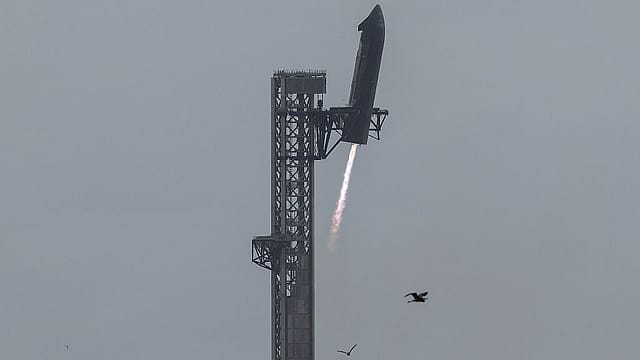
SpaceX caught its Starship spacecraft upright in the mechanical arms of its launch tower in Texas on Saturday, completing the first tower catch of a rocket upper stage returning from orbit. Google CEO Sundar Pichai, who watched the manoeuvre live, said it “still feels like science fiction”.
The catch came on Starship’s 15th flight, about 22 and a half hours after it lifted off from the same site at Starbase. The upper stage reached orbit, deployed 26 satellites and returned to the Texas coast, where the launch tower, nicknamed Mechazilla, caught it as it descended.
“Watching it live was incredible. Upwards!” Pichai wrote on X. SpaceX CEO Elon Musk congratulated the team behind the flight. NASA Administrator Jared Isaacman called the catch “almost magic” and described it as “one step closer to the moon”.
Super Heavy diverts offshore as Starship reaches orbit
The mission began on Friday at Starbase’s Pad 2. According to SpaceX, all 33 Raptor engines powered the Super Heavy booster at liftoff. Starship then fired its own engines as the two stages separated, a manoeuvre known as hot staging. The upper stage continued towards orbit under the power of six Raptor engines.

The Wealth Issue 2026
06 Nov 2026 - Vol 05 | Issue 45
Portraits of Dreamers and Doers under 35
After separation, Super Heavy flipped and reignited 32 of the 33 engines planned for the burn that would send it back towards the launch site. That burn ended early because the booster had too little fuel remaining, SpaceX said. The company was investigating why.
The booster’s guidance system triggered an automatic abort and redirected it offshore. Super Heavy performed a landing burn over the Gulf before its flight termination system activated, SpaceX said.
Starship continued into orbit and released 26 Starlink V3 satellites. SpaceX said it established contact with all 26 shortly after deployment and that the satellites began climbing towards their operating orbits. The spacecraft stayed in orbit for more than 20 hours as flight controllers monitored its systems and prepared for re-entry.
Three engines fired for the final flip
To begin the journey back, Starship reignited a single sea-level Raptor engine for its deorbit burn. It descended through the atmosphere towards the Texas coast, made a final manoeuvre over the Gulf and approached the launch site from which it had departed the previous day.
After the spacecraft emerged from the clouds, three Raptor engines ignited to flip it upright and slow its descent. That brought Starship within reach of Mechazilla’s mechanical arms, which caught it above the ground.
Why the upper-stage catch matters
SpaceX has already recovered and reused first-stage boosters. Starship is designed to extend that approach to the upper stage, the part of the rocket that carries payloads into orbit. Upper stages are generally discarded once their missions are complete.
Saturday’s flight showed that the upper stage could deploy satellites, return from orbit and be recovered at its launch site. The next test for reusability is whether a recovered Starship can be prepared and flown again. Recovering and repeatedly flying both stages would allow SpaceX to retain more of the hardware it currently has to replace between missions.
With inputs from ANI