‘Stay Indoors’: Bahrain Issues Advisory After Blaze in Muharraq
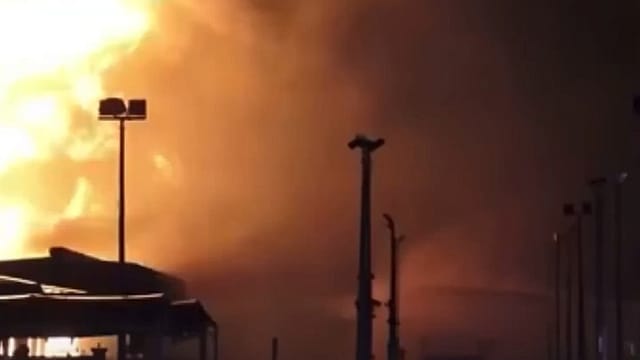
Bahrain's Ministry of Interior has issued an urgent advisory to the public following a significant blaze in the Muharraq Governorate.
The advisory instructed citizens and residents in Hidd, Arad, Qalali and Samaheej to "remain in their homes, close windows and ventilation openings" while emergency services work to contain the fire.
According to the ministry, the directives were issued as a "precaution against potential effects of smoke" resulting from the blaze.

The Vanguard
21 Aug 2026 - Vol 05 | Issue 34
BJP Rearmed for 2029
The local emergency follows an earlier report by Al Jazeera stating that Bahrain was responding to an Iranian attack on fuel storage tanks in the Muharraq Governorate.
A separate Iranian strike on Bahrain killed one person amid a wider wave of missile and drone interceptions across Saudi Arabia, Kuwait, Qatar and the United Arab Emirates.
The Bahraini Ministry of Interior confirmed on Tuesday that a 29-year-old woman was killed and eight others were injured after a strike hit a residential building in the capital, Manama.
The incident followed a previous drone attack on the island of Sitra that wounded two people, including children.
How Many Missiles And Drones Has Bahrain Neutralised?
Authorities said Bahrain’s air defences had neutralised 105 missiles and 176 drones launched by Tehran. The General Command of the Bahrain Defence Force said its systems remain active in responding to what it described as "heinous" Iranian attacks.
Across the region, the conflict has intensified. In the United Arab Emirates, sirens were activated in Dubai while officials in Abu Dhabi responded to a fire at the Ruwais industrial complex caused by a drone strike.
Saudi Arabia also reported fresh interceptions. The Saudi Ministry of Defence said it had neutralised three additional drone strikes after earlier bringing down 18 unmanned aerial vehicles across the country’s "eastern territories".
In a series of updates on X, the ministry said its forces intercepted two drones over the "Empty Quarter" desert that were targeting the "Shaybah oil field" before they were destroyed. It later confirmed that two more drones had been brought down in the eastern region.
Amid the growing regional crisis, diplomatic efforts have intensified. Russian Foreign Minister Sergey Lavrov held a telephone conversation with Saudi Foreign Minister Faisal bin Farhan to discuss ways to prevent further escalation.
Why Did the US Warn Russia Against Involvement in the Iran Conflict?
In a post on X, the Russian Ministry of Foreign Affairs said the ministers "emphasised the need to consolidate the efforts of the international community" to prevent the situation from deteriorating further.
The diplomatic exchanges follow a warning from Washington. US Secretary of War Pete Hegseth cautioned Russia against intervening in the ongoing conflict in West Asia, particularly as tensions involve Iran, the United States and Israel.
During a Pentagon briefing, Hegseth referred to a recent "strong call" between US President Donald Trump and Russian President Vladimir Putin.
He said the call suggested an "opportunity for some peace" regarding the war in Ukraine but also included a firm "recognition" that Russia "should not be involved" in the Iran conflict.
Russia’s presidential aide Yuri Ushakov described the conversation as "businesslike, open and constructive". Reports said Trump initiated the call to discuss recent international developments, including the Iran crisis and possible trilateral talks between Washington, Moscow and Kyiv.
Following his discussion with Trump, Putin also held talks with the Saudi Crown Prince and Prime Minister Mohammed bin Salman Al Saud.
The two leaders addressed the "escalation in the Middle East", which the Kremlin attributed to "the United States' and Israel's armed aggression against the Islamic Republic of Iran."
The discussions come after earlier consultations between Moscow and Riyadh. On March 9, Lavrov and Faisal bin Farhan "compared notes" on several regional issues including the situations in Syria, Yemen and the Palestinian-Israeli settlement.
Both countries agreed to maintain "close coordination" aimed at achieving a "sustainable settlement" through dialogue based on the "stakeholders' legitimate interests and concerns".
(With inputs from ANI)