Solo Table Theory: The Art of Sitting Alone, and Why the World Cannot Stop Looking
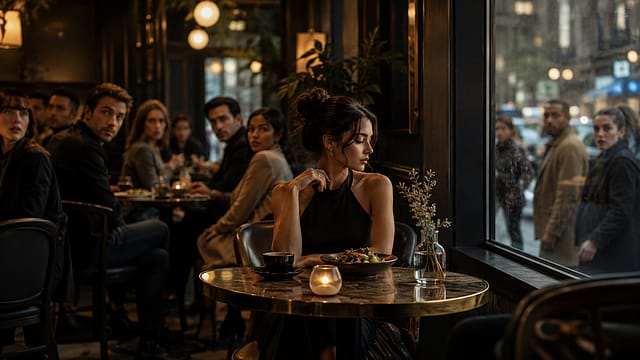
It takes a certain kind of nerve to walk into a restaurant and ask for a table for one. A viral Instagram trend says that nerve is precisely the point.
Most of us, if we are honest, would reach for the screen almost immediately if we were alone in a restaurant or a public space. But when a person sits alone at a café with no phone to hide behind and no companion to lean on, they are tapping into the Solo Table Theory.
The theory, currently making its rounds on Instagram, argues that people who are content with eating alone in a public space are among the most interesting people in any room.

The Health and Wellness Issue
25 Sep 2026 - Vol 05 | Issue 39
At its core, the theory holds that deliberately spending time alone in a public space, whether that means dining solo at a restaurant, nursing a coffee at a corner table, or simply sitting with your own thoughts in a crowded room, builds something intangible but significant: self-confidence, presence, and a sense of completeness that does not depend on external company.
Rather than viewing a table for one as something sad or isolating, the theory flips the narrative entirely, framing solitude as a deliberate choice and a sign of secure self-worth.
What has turned this into a talking point is a secondary claim that is, perhaps, more provocative than the first.
According to the theory, a person who is visibly comfortable alone in public tends to attract more attention than they might expect. Not because onlookers are forming unfavourable judgments, but because self-confidence, in a world calibrated around company and constant connectivity, simply stands out.
Researchers studying social behaviour have long noted that people are wired to notice deviations from the expected. In most social settings, individuals arrive in pairs or clusters.
Someone sitting alone, therefore, naturally registers as different, and the eye is drawn to difference.
Yet being noticed and being judged are not the same thing, and this is where the theory does some of its most useful work.
Studies on social anxiety have consistently found that people overestimate how much attention others are actually paying to them. In reality, most individuals in a café or restaurant are absorbed in their own meals, their own conversations, and their own phones.
The spotlight we imagine trained on us is, more often than not, largely a product of our own apprehension.
Supporters of the theory go further, arguing that when attention does land on a solitary diner, it is frequently coloured not by pity or criticism but by a kind of quiet curiosity, perhaps even admiration, for someone who appears entirely at ease without the usual props.
Supporters argue that people may be curious about someone who seems completely comfortable without needing constant company, entertainment, or validation from others.
One reason the Solo Table Theory has gone viral is because it speaks directly to a common and rarely examined insecurity.
A great many people feel a genuine unease about going to restaurants, cinemas, or cafés by themselves, not because they object to solitude at home, but because they worry about how public aloneness is perceived.
The theory does not dismiss that worry. It turns it on its head. If people are looking, the theory says, it may well be because you have something worth looking at.
Content creators across Instagram have picked up the thread, sharing their personal accounts of dining alone, working from a café table unaccompanied, or simply choosing to spend leisure time in public without a group around them.
These posts have fed a broader conversation about confidence, independence, and a cultural tendency to conflate solitude with loneliness, two states that are, at root, entirely distinct.
For some, the shift in perspective can be quietly empowering. It offers an alternative to the common pattern of waiting for a friend, a family member, or a partner to be available before allowing oneself to go somewhere or do something.
Whether one subscribes to every claim the theory makes is, in the end, less important than the conversation it is opening.
There is value, in any era, in questioning why we find solitude uncomfortable, why we reach for our phones the moment we are left without company, and what it might feel like to simply be in a place, quietly, without the need for distraction or an audience of friends to make that presence feel legitimate.
The Solo Table Theory, at its best, is asking exactly that question. Whether you order a coffee and sit with it is, of course, entirely up to you.