Trump Invokes India’s 646-million Voters; MEA Says Election System’s Credibility is Globally Established
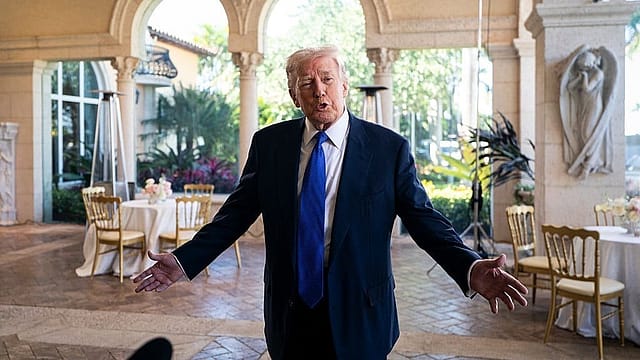
India has found itself at the centre of Donald Trump’s latest battle over how Americans should vote.
The US President invoked India’s 646 million voters, limited use of postal ballots and photo-identification requirements while demanding that Congress pass the Safeguard American Voter Eligibility Act, or SAVE America Act.
New Delhi avoided entering the American political debate. It defended the system Trump had chosen as his example. “I have no specific comments to make on these remarks. However, I can say that the credibility and robustness of India’s election machinery are well-established facts globally,” Ministry of External Affairs spokesperson Randhir Jaiswal said.
Rise of the Pivotal Power
18 Sep 2026 - Vol 05 | Issue 38
The BRICS declaration is a strategic victory for Modi
The response was carefully drawn. The MEA neither endorsed Trump’s proposed law nor challenged his comparison. It placed India’s electoral record on the table and stopped there.
Former Chief Election Commissioner TS Krishnamurthy went further. “We have reasons to be proud,” he said, welcoming the US President’s reference to India and arguing that photo identity cards, electronic voting machines and indelible ink have built multiple layers of protection against impersonation and fraudulent voting.
The remarks have turned an American legislative fight into an unexpected endorsement of India’s ability to conduct elections on a scale unmatched anywhere else.
WHY TRUMP BROUGHT INDIA INTO THE ARGUMENT
Trump renewed his demand for the SAVE America Act through a post on Truth Social, citing remarks he attributed to Chief Election Commissioner Gyanesh Kumar. “Earlier this month, India’s Chief Election Commissioner, Gyanesh Kumar, asked our Administration: How can you have elections in the US without a valid photo ID?” Trump wrote.
He then reached for the size of India’s last general election. “India’s last election had 646,000,000 voters! Less than 1 per cent voted by mail, and every single voter had to have a valid photo identity document.”
For Trump, India serves two political purposes. Its enormous electorate shows that strict voter identification can operate at scale. Its preference for in-person voting supports his long-running attack on widespread mail-in ballots. “We need to pass the SAVE America Act, now,” he wrote.
The White House says the legislation would require documentary proof of US citizenship when registering for federal elections, direct states to remove non-citizens from electoral rolls and introduce voter-identification requirements. It has also argued that countries such as India and Brazil use stronger identity safeguards while the United States relies heavily on applicants declaring their citizenship themselves.
WHAT MAKES INDIA’S SYSTEM DIFFERENT?
India’s election machinery operates through one central constitutional authority, the Election Commission of India. The American system is far more decentralised, with states controlling major parts of voter registration, identification, balloting and counting. “Every state has a different system of management,” Krishnamurthy said, cautioning that the two models cannot be treated as identical.
India began introducing the Elector Photo Identity Card, or EPIC, in 1993. Krishnamurthy said the card was intended primarily to prevent impersonation and voting by ineligible persons. The identity check is reinforced at the polling station by indelible ink applied to a voter’s finger. The mark is designed to prevent the same person from returning to cast another ballot.
“Our identification, apart from the fact that we have a photo identity card, is ink that is not dissolvable,” Krishnamurthy said. “That ink mark also ensures the identity of the voter so that he does not come back again to vote.”
India’s model therefore combines the electoral roll, photographic identification, physical verification at the booth and indelible ink.
DOES EVERY INDIAN VOTER HAVE TO PRODUCE A VOTER ID CARD?
Trump’s broader point about photographic identification is correct, but the Indian rule is more flexible than his post suggests.
An Indian elector must establish identity before voting, but the EPIC card is not the only document accepted. The Election Commission of India permits voters who cannot produce their EPIC to use alternative photographic documents. During the 2024 Lok Sabha election, these included an Aadhaar card, passport, driving licence, PAN card, MGNREGA job card, pension document, bank or post-office passbook with a photograph and Unique Disability ID card.
The voter’s name must appear on the electoral roll. The document establishes that the person standing at the booth is the elector listed there. Therefore, India requires valid photographic identification at the polling station, but it does not insist that every voter produce the same voter ID card.
IS INDIA’S VOTER ID TIED TO A BIOMETRIC DATABASE?
The White House says India ties voter identification to a biometric database. That description needs qualification.
Aadhaar uses biometric information, and Indian law allows electoral authorities to collect Aadhaar numbers to authenticate entries and identify duplicate registrations. However, linking Aadhaar to a voter’s electoral record is voluntary. The Election Commission’s official FAQ states that failure to provide Aadhaar details cannot be used to reject a voter-registration application. The government has also clarified through the Press Information Bureau that consent is required for Aadhaar authentication and that no electoral-roll linkage targets have been imposed.
An Indian voter can therefore register and vote without linking an EPIC to Aadhaar, provided the person is eligible, appears on the electoral roll and establishes identity through an accepted document.
WHY DOES INDIA USE SO FEW POSTAL BALLOTS?
India builds its elections around physical polling booths, electronic voting machines and in-person verification.
Postal voting exists, but it is restricted to specified categories such as service voters, election-duty personnel and certain eligible absentee voters. India also permits some service voters to appoint proxy voters under prescribed rules.
That differs sharply from the United States, where postal and absentee-voting rules vary by state and some jurisdictions allow voting by mail without requiring a specific excuse. The SAVE America campaign presents India’s limited postal voting as evidence that large democracies can conduct predominantly in-person elections. Critics in the US, however, argue that stricter documentary requirements could make registration harder for eligible citizens who lack ready access to passports, birth certificates or other prescribed documents.
Krishnamurthy sees the comment as recognition of the system rather than support for any Indian individual or political party. “Although this has received some political criticism from some parties, I think we must confine ourselves to the fact that it is a comment on the system, not on any individual,” he said.
That distinction matters.
India’s election processes remain the subject of fierce domestic contests over electoral rolls, electronic voting machines, voter deletions and the conduct of polling. Krishnamurthy’s argument is that such criticism should not erase the institutional achievement of registering, identifying and processing hundreds of millions of voters.
Trump reached for India to strengthen his campaign for new American voting rules. The MEA’s answer was less political and more pointed: India’s electoral machinery does not need Washington’s certificate, but Washington’s attention underlines how far its reputation travels.
(With inputs from ANI)