Trump’s Weekend of War Warnings, AI Ambitions and a Supreme Court Showdown
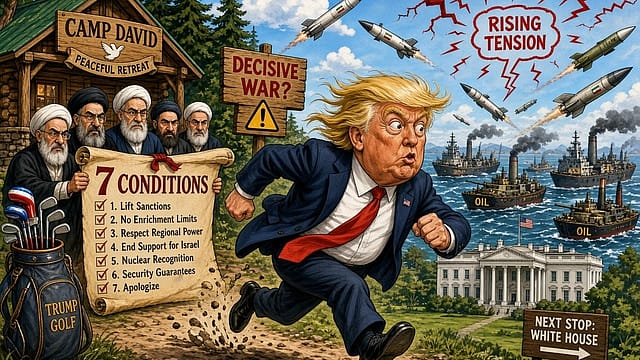
Donald Trump cut short his weekend stay at Camp David and returned to the White House on Saturday evening as Iran pressed Washington to accept conditions for negotiations and warned that it was prepared for a “decisive war”.
The return came amid fresh tensions across West Asia, including a reported Houthi missile attack on Saudi Arabia and a US security alert warning Americans that the conflict could escalate rapidly. Tehran said its demands had been delivered through Qatar and that it was awaiting the US President’s response.
Trump was also setting out ambitions on another front. In posts on Truth Social, he announced plans for an “AI Force”, promised to appoint an “AI Czar” and asked the public whether artificial intelligence needed a grander name. Separately, he accused the US Supreme Court of damaging his trade and immigration agenda.

Zeroing In on ECI
09 Oct 2026 - Vol 05 | Issue 41
Constitutional legitimacy versus political opportunism
Together, the developments placed military escalation, technological competition and the limits of presidential authority at the centre of a crowded weekend for the White House.
Tehran Sets Its Terms
Iran said it had conveyed seven conditions to Washington for beginning negotiations to end the conflict. In the remarks reported by Al Jazeera, Iranian security official Mohsen Rezaei publicly identified three: an end to the war on all fronts, the release of frozen Iranian funds and the lifting of the naval blockade.
“We remain in contact with the mediator Qatar, which has conveyed our conditions to Washington with the aim of ending the war. We are awaiting President Trump’s response,” Rezaei said.
He coupled that diplomatic opening with a warning.
“It is in Washington’s interest to accept these conditions. Trump’s threats will not achieve any results. We are prepared for a decisive war.”
In a separate post on X, Rezaei reiterated that Tehran had submitted seven conditions, arguing that Washington would have to accept Iran’s rights and demands to avoid becoming further entangled in the conflict. The supplied account did not detail all seven conditions.
According to Al Jazeera, Qatar and Pakistan have been working to revive negotiations since a memorandum of understanding expired last month. Regional governments have also sought an end to the conflict, which the report said began after US and Israeli strikes on Iran in late February.
Trump had earlier indicated that Iran was seeking a deal, even as he weighed further military action against Tehran. His return to Washington added to the attention on the crisis, although the reported developments did not establish that a fresh US strike had been ordered.
Missiles, Warnings and a Region on Alert
The immediate regional backdrop was increasingly tense.
Saudi Arabia said its forces intercepted ballistic missiles launched towards Riyadh by Iran-backed Houthi rebels. The Houthis said they had targeted “sensitive sites”, without identifying them.
A US security alert urged Americans to exercise caution across several countries in the region, including Iraq, Bahrain, Oman, Saudi Arabia, Iran, Qatar, Lebanon, Kuwait and Jordan.
“This military conflict has the potential to escalate rapidly,” the alert said, advising travellers to monitor airport and airline operations.
It also warned that US diplomatic facilities, including those beyond West Asia, had been targeted, and that Iran and groups supportive of it could threaten American interests, businesses and institutions elsewhere.
Rezaei, meanwhile, said another US strike remained “very much on the cards” according to Iranian military assessments. He claimed Tehran had revised its planning following two earlier rounds of fighting and was now focused on US naval assets across the Gulf, the Gulf of Oman and the Arabian Sea.
He also claimed that Iran had recently test-fired a multi-warhead anti-ship missile near an American vessel or aircraft carrier. That claim was not independently established in the supplied reports.
Any future Iranian response, he warned, could extend to US bases and American commercial interests in the region.
“In practical terms the war is still going on,” Rezaei said, while maintaining that Tehran wanted to bring it to an end “as soon as possible”.
A Diplomatic Window in New York
The confrontation is set to draw attention as world leaders gather for the UN General Assembly in New York.
According to Anadolu News Agency, the US State Department issued visas to Iran’s delegation for the UNGA High-Level Week. That allows Iranian representatives to attend the gathering, though the supplied reports did not announce a meeting with US officials.
Rezaei also addressed the nuclear and maritime questions surrounding the conflict.
He said Iran had not decided to withdraw from the Nuclear Non-Proliferation Treaty, while warning that Washington’s actions could push it towards such a step. He maintained that Iran’s nuclear doctrine remained unchanged and that Tehran continued to honour a religious decree prohibiting nuclear weapons.
On the Strait of Hormuz, he said Iran and Oman had come close to announcing an agreement before shelving it. The framework remained ready, he added, but might require regional endorsement before being made public.
He rejected speculation about an Iranian closure of the Bab al-Mandeb Strait, describing it as a Yemeni matter linked to the Houthis.
Trump Wants an ‘AI Force’
Alongside the foreign-policy crisis, Trump used Truth Social to announce plans for an “AI Force”, invoking the Space Force established during his first term as a point of comparison.
He said the administration would support the expansion of artificial intelligence and use existing criminal and civil justice mechanisms to address harmful applications.
“We will not in any way hinder or stifle the Growth of this incredible Industry,” he wrote. “Rather, we will cherish it, help it, and watch over it, as it grows!”
Trump said he would announce an “AI Czar” in the near future, adding: “Only High I.Q. individuals need apply!”
His post did not spell out the proposed force’s structure, powers, budget or relationship with existing government agencies. The Space Force comparison therefore offered a political reference point rather than a detailed institutional blueprint.
Trump described AI as the next industrial revolution or internet, arguing that its impact could be even greater. He suggested it could account for as much as 25 per cent of US GDP, without providing a timeframe or supporting calculations in the quoted remarks.
“We are leading China, and the rest of the World, and I intend to keep it that way!” he said.
Artificial? Trump Would Prefer ‘Supreme’
Trump’s interest extended to the technology’s name.
In a separate Truth Social post, he described “Artificial Intelligence” as inaccurate and “ineloquent”, and invited the public to choose among “Superior Intelligence”, “Extreme Intelligence” and “Supreme Intelligence”.
“This is a Poll, and I would appreciate everybody voting!” he wrote.
The naming exercise accompanied a much larger argument about AI’s economic promise. Tesla and SpaceX chief Elon Musk recently predicted on X that AI could roughly double US GDP growth next year, from about 2 per cent to 4 per cent, adding: “Maybe even more.”
Those projections come as technology companies pour money into data centres, computing infrastructure and increasingly advanced models.
A brokerage report cited by ANI, however, identified a harder commercial test: whether revenue from AI can justify the investment required to build and operate it.
The report warned that higher borrowing costs and rising bond yields could increase the funding burden. Falling token costs, improving model efficiency and rapid technological change could also reshape returns.
For the industry Trump wants to accelerate, the next phase will depend on how quickly companies convert investment into revenue, as well as the cost of financing that expansion.
The Supreme Court Comes Under Fire
Trump also turned his attention to the Supreme Court, accusing it of obstructing his agenda through decisions concerning tariffs and birthright citizenship.
“Unfortunately, the United States Supreme Court has lacked the Courage to MAKE AMERICA GREAT AGAIN,” he wrote.
He described its decisions over the preceding six months as “faulty, political, and ridiculous”, claiming they had cost the country trillions of dollars and damaged the way citizenship was granted. Those were the President’s assertions; the supplied report did not substantiate the claimed losses.
According to ANI’s account, the court in February struck down most of Trump’s sweeping tariff measures, ruling that the International Emergency Economic Powers Act did not authorise the extensive import duties.
The decision triggered a major refund exercise for importers. ANI cited a US Customs and Border Protection court filing stating that around $100 billion in refunds had been completed and sent to the Treasury for disbursement by July 31. Approximately $128.68 billion in potential and certified refunds had been accepted for processing.
Trump has continued to defend tariffs as a means of protecting American industry, strengthening manufacturing and addressing trade imbalances.
His administration has also faced challenges to its attempt to restrict birthright citizenship. The supplied account referred to disputes over the interpretation of the 14th Amendment but did not specify the citizenship ruling targeted in his latest post.
“It has been a sad chapter in the life and times of America, but we will prevail!” Trump wrote.
As the weekend unfolded, the most immediate question remained Washington’s response to Tehran. Iran had put conditions on the table, regional security warnings were widening, and Trump was back at the White House.
With inputs from ANI