‘Hormuz is now United Strait of America’
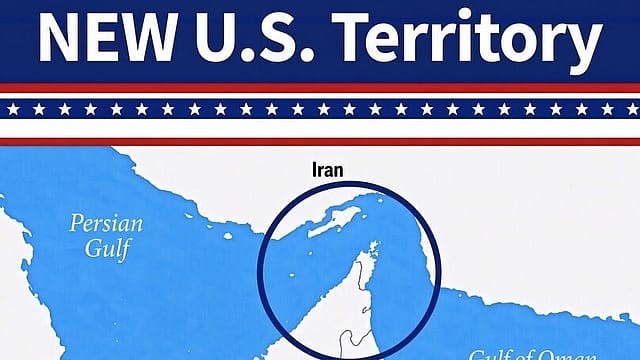
Look at the map for a moment.
There is the narrow strip of water between Iran and Oman. One of the world's most important maritime chokepoints. A route through which a huge share of global oil supplies normally passes.
Now imagine that map stamped with three words in bold: “NEW U.S. Territory.”
That is the image US President Donald Trump shared on his Truth Social platform on Tuesday, escalating his rhetoric over the Strait of Hormuz as tensions with Iran continue to simmer. The graphic depicts the waterway highlighted on a blue map, surrounded by a frame carrying the provocative label.
It is only an image. But the argument behind it is very real.
Rise of the Pivotal Power
18 Sep 2026 - Vol 05 | Issue 38
The BRICS declaration is a strategic victory for Modi
Trump had already suggested declaring the Strait of Hormuz US territory. On Monday, he doubled down, saying he liked the idea and claiming Washington had “total control” of the strategic waterway through its naval blockade.
So, does Trump actually control the Strait?
That is where the rhetoric meets reality. Trump told reporters that the US blockade had been effective, that the Strait was open and that oil prices were coming down.
He added that Iran is in big trouble, noting, "they have 300 per cent inflation, the country's a mess, and their military is totally defeated."
"I think it's a great idea. I mean, we control it with the blockade. I like the idea of declaring it a territory. We have total control over the Strait. Now, they can be a nuisance; they can put a mine in the water, and people don't like having mines hit their billion-dollar ships. But the blockade has been very effective. Now, maybe that will stop, or maybe it'll open up even further, but we're taking out millions of barrels of oil a week if you look at the kind of numbers that we're doing," Trump said.
"The Strait is open, and the oil prices are coming down, and they will continue to come down unless we decide to do something far more drastic than what we're doing. Iran is in big trouble. They have 300 per cent inflation, the country's a mess, and their military is totally defeated," he added.
But Tehran is telling a very different story.
Iran says: Not until our conditions are met
Iranian Parliament Speaker Mohammad Bagher Ghalibaf said on Tuesday that the Strait would remain closed until the United States fulfils conditions agreed under a June memorandum of understanding.
Those conditions, according to Reuters, include lifting the US maritime blockade, removing oil sanctions, releasing frozen Iranian assets and ending military threats and operations. The June agreement has since unravelled, with Washington and Tehran accusing each other of failing to honour its terms.
"Until America's commitments in the memorandum of understanding--including lifting the blockade, releasing frozen assets, lifting oil sanctions, ending threats and military operations on all fronts, and other conditions to which America committed--are implemented, the "Strait" will not be opened," Ghalibaf said.
That is not exactly the language of a country accepting Washington's claim of “total control”.
Ghalibaf also warned that Iran was "ready to impose a heavier defeat on the enemy in proportion to its actions and aggressions." And he said the moment had come for Iran's military and diplomatic tracks to work together.
"As we predicted, the enemy - who had accepted the ceasefire agreement out of desperation -quickly reneged on its commitments to compensate for its heavy political defeat in practice. Therefore, the time has come for the military field to once again stand alongside the diplomatic field and provide a practical response to the enemy's breach of covenant," Ghalibaf said.
Then a ship was hit
The argument over who controls Hormuz is not happening on a quiet stretch of water. On Tuesday, a vessel travelling outbound through the Strait was struck by an unknown projectile, according to the UK Maritime Trade Operations centre.
The impact damaged the ship's engine room and caused a crew casualty. The remaining crew were being assisted by the Omani Coast Guard, while authorities investigated. No environmental impact had been reported.
"The impact caused damage to the engine room and resulted in a crew casualty," it added. "Authorities are investigating," UKMTO said, while advising vessels in the area to proceed with caution.
No group immediately claimed responsibility for the incident.
And that is precisely what makes the Strait so important — and so dangerous.
Why does everyone care about this narrow strip of water?
Because Hormuz is not just another shipping route. It is a global energy artery.
Oil tankers moving between the Persian Gulf and the wider world pass through this narrow waterway. When traffic is disrupted, the consequences do not stay in the Gulf. They can reach refineries, shipping markets, fuel prices and consumers thousands of kilometres away.
That is why every threat involving the Strait gets attention. And why a map calling it “NEW U.S. Territory” is more than an unusual social-media post.
A deal that was supposed to keep the Strait moving
The latest confrontation follows the collapse of the June US-Iran understanding.
The memorandum was intended to create a 60-day window for negotiations and help address the crisis surrounding Hormuz. But the framework broke down amid mutual accusations of non-compliance. Trump said on Monday that he was not seeking an extension of the agreement as the deadline expired.
Now the two sides are back to competing claims.
Washington says it has control.
Tehran says the Strait stays closed until its conditions are met.
And ships are still trying to navigate the waterway.
That is the uncomfortable reality underneath the political theatre. A social-media graphic can redraw a map in seconds. A real-world border, however, is a very different thing.
For now, the Strait of Hormuz remains less a piece of claimed territory than a pressure point between two countries whose rhetoric is getting sharper, whose agreement has collapsed and whose next move could affect far more than the waters between Iran and Oman.
(With inputs from ANI)