Trump, Trumpet & Trump TV: When the President Becomes the Channel
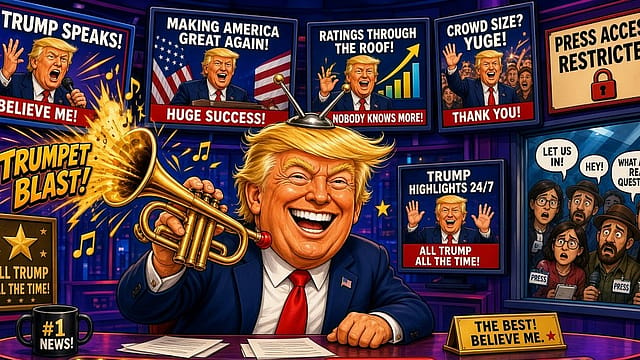
Donald Trump has found a channel whose star is unlikely to complain about the coverage.
Himself.
On September 21, the White House launched Trump TV, a round-the-clock stream of presidential speeches, administration announcements and selected moments from the Trump years. The official launch message promised the “latest and greatest” from the administration. There would be past highlights, fresh updates and a place for moments viewers might have missed on their television screens. The White House’s own website now lists a dedicated Trump TV feed alongside its live-event service.
Trump. Trumpet. Trump TV.
The joke almost writes itself. The politics requires a closer look.
Because the revealing part is the timing. A White House fighting news organisations over their access is simultaneously expanding its capacity to supply the pictures and the story itself. The president is becoming the subject, the brand and the organising principle of a permanent broadcast.

Zeroing In on ECI
09 Oct 2026 - Vol 05 | Issue 41
Constitutional legitimacy versus political opportunism
Other leaders have travelled parts of this road. Some spoke into a radio microphone. Some hosted marathon television shows. One built a commercial broadcasting empire.
The global precedents help explain both the attraction of Trump TV and the questions its launch should provoke.
The president’s cut
Trump TV is a White House streaming offering, including a YouTube feed, rather than evidence that Trump has suddenly acquired a conventional television network. Its announced menu includes archival speeches and administration updates. Twenty-four-hour availability does not mean twenty-four hours of new reporting.
That distinction matters. Governments have perfectly defensible reasons to publish complete speeches, preserve official footage and let citizens watch proceedings without waiting for a broadcaster’s selection. Anyone who has watched a short clip stripped of its context understands the value of the longer record.
But a government choosing its own highlights is still making editorial decisions. Someone selects the speech, the achievement, the replay and the omission. The filter has moved to the institution being covered.
Trump TV’s pitch makes that choice unusually explicit. The promise of the administration’s best moments establishes the service as a showcase. Viewers should assess it accordingly: a source of official material whose claims and omissions remain open to scrutiny.
The name adds another layer. The White House is an institution that outlasts its occupants. Trump TV puts the occupant on the masthead. Government communication becomes another surface for the personal brand.
The press dispute changes the picture
According to ANI, CNN, MS NOW and Politico have challenged restrictions on their journalists’ White House access in federal court. Trump defends the restrictions by accusing outlets of unfair coverage and “fake news”. The administration argues that the right to publish does not guarantee particular organisations access to White House facilities or the presidential pool. The organisations contest the government’s ability to condition access on their reporting.
These are competing legal positions; the launch of a streaming service does not settle them.
The dispute has also disrupted shared television coverage. Major networks suspended participation in the White House television pool in solidarity with the excluded organisations.
Here the editorial concern becomes concrete. An official feed can provide useful footage. It cannot, by itself, supply an independent witness who chooses what to observe, asks an unwelcome question or follows a claim beyond the event.
If restrictions leave journalists more dependent on government-supplied images, the administration gains influence over the raw material of coverage as well as its own presentation. That is the potential consequence to watch. A new streaming channel and a press-access restriction deserve to be examined together.
Chávez: the president as presenter
Hugo Chávez went further than replaying speeches. He hosted the programme.
Venezuela’s Aló Presidente, which began in 1999, became a sprawling blend of political address, entertainment and public administration. Chávez sang, told stories, challenged opponents and announced decisions. Reuters reported that a January 2012 edition lasted six hours and included an announcement concerning Venezuela’s dispute with Exxon Mobil. The programme aired live on state media.
The analytical lesson is about the fusion of governing and performance. A president who announces decisions on his own show can make the programme itself feel like a place where government happens. Viewers are invited to experience power through the leader’s personality.
There is no basis to claim that Trump TV already operates like Aló Presidente. Its launch format relies on selected presidential content. Chávez’s example shows how far a leader’s broadcast can travel once it becomes a political institution in its own right.
Mexico: own the morning, shape the day
Andrés Manuel López Obrador’s mañaneras offered a different method: make the presidential appearance a daily habit.
The former Mexican president’s morning news conferences regularly ran beyond three hours. Reuters described a mix of policy updates, political theatre and attacks on opponents, giving him an early opportunity to shape the day’s agenda. These were press conferences, with journalists present, rather than a continuous channel of selected recordings.
His successor, Claudia Sheinbaum, has continued the morning briefing format.
The comparison reveals a second source of media power: routine. A scheduled appearance gives reporters, supporters and critics a common starting point. Even those who reject the president’s account may spend the day responding to it.
Trump TV offers a different rhythm—permanent availability. Whether it can build a habit comparable to a daily live encounter remains unproven.
Putin’s phone-in, Berlusconi’s empire
Russia’s Vladimir Putin has used lengthy televised question-and-answer events to display presidential reach. In the December 2025 edition, more than 2.5 million questions were submitted, according to Reuters. Selected questions covered war and everyday problems; critical messages also appeared on a screen.
Such events can project the leader as the ultimate problem-solver: the person to whom ordinary grievances must eventually travel. This is a useful comparison of presentation, not evidence that the American and Russian media systems are interchangeable.
Italy’s Silvio Berlusconi illustrates another arrangement altogether. His family’s Mediaset empire included major commercial television channels, creating a longstanding conflict-of-interest controversy alongside his political career. He denied controlling programmes at Mediaset or state broadcaster RAI.
Berlusconi’s power involved ownership of commercial broadcasting infrastructure. Trump TV’s launch involves an official stream. Conflating them would obscure the actual question: how does each arrangement affect the independence of the information citizens receive?
Roosevelt’s microphone—and the limit of the analogy
An American precedent helps keep the argument honest.
Franklin D. Roosevelt used his fireside chats to explain government action during the Great Depression and the Second World War. Radio brought his voice directly into people’s homes, building a sense of familiarity that formal statements could struggle to achieve. The White House Historical Association records both the conversational appeal and the large public response in letters.
Direct communication can serve the public. A leader explaining a banking crisis and a leader promoting a highlights reel are making different editorial choices, even when both bypass a newspaper editor.
The useful tests concern transparency, the completeness of the record, opportunities for questioning and the continued ability of independent reporters to do their work. The mere possession of a microphone proves very little.
A trumpet still needs listeners
There is also a practical limit to the ambition. Launching a channel establishes supply. It does not establish demand, persuade undecided voters or demonstrate public trust.
The launch material does not tell us whether Trump TV will attract a sustained audience beyond people already interested in the president. Nor does it establish how often viewers will return or whether watching will change their minds.
One plausible role is as a reservoir of shareable material: speeches and moments that supporters can circulate elsewhere. Another is reassurance, giving existing followers a familiar account of the administration. Those are possibilities to test against audience evidence, rather than achievements to award on launch day.
For now, the sharpest question concerns editorial power. A president can make his case at any length on his own platform. Journalists must remain able to examine what the platform leaves out.
Trump has the trumpet. Trump TV gives it a permanent stage. The public still needs someone who can interrupt the performance.
With inputs from ANI & agencies