Saudi Air Defences Intercept Wave of Drones as Iran Claims Strikes on US Bases Across Region
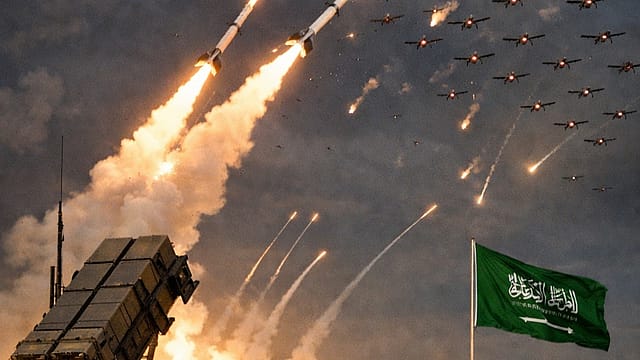
Saudi Arabia’s air defence forces intercepted and destroyed multiple drones targeting key regions of the kingdom over the weekend, amid a widening regional confrontation involving Iran, Israel, and the United States.
The Saudi Ministry of Defence announced the interception and destruction of 10 drones targeting the Riyadh and eastern regions.
The announcement followed an earlier statement made an hour prior in which the ministry confirmed it had successfully destroyed two other drones in the east of the country.
Before these incidents, the ministry reported that its forces had already destroyed seven drones across the same regions.
Further north, the ministry confirmed on Saturday that its air defence forces successfully neutralised another threat.
Which critical locations in Saudi Arabia are at risk amid the rising drone attacks?
In a formal statement, officials confirmed the "interception and destruction of a drone" after it was detected entering the airspace over the "Al-Jawf region in the north of the country".
The sequence of events follows a massive wave of hostilities earlier in the week. Saudi Arabia reported that its systems intercepted nearly 50 drones within a span of just a few hours early Friday.

Survival Instinct
22 May 2026 - Vol 04 | Issue 72
India navigates global economic turmoil with austerity and smart diplomacy
According to Euro News, officials noted that the sheer volume of drones represents an "unusually high level of aerial threats for Saudi Arabia".
Critical locations in the kingdom, including the United States Embassy in Riyadh, key oil infrastructure, and a military base hosting American troops, are facing heightened risks.
At the same time, a series of verified visual reports has shown the impact of Iranian drone strikes and interceptions across seven countries, revealing a persistent threat to US military assets and regional stability, NBC News reported on Sunday.
Which US bases were reportedly targeted in the latest Iranian drone strikes?
According to the analysis, the drones successfully reached their intended targets in 21 out of 26 recorded instances.
The strikes reportedly focused on transportation hubs, diplomatic centres, energy infrastructure, and military installations.
The weapon frequently used by Tehran is the Shahed-136 unmanned aerial vehicle, which can travel approximately 1,200 miles while carrying warheads weighing up to 110 pounds.
NBC News noted that these "cheap exploding drones" are pre-programmed to strike specific coordinates without a pilot, functioning as what experts describe as "the ultimate symbol of asymmetric warfare."
Iranian naval forces also claimed to have successfully struck key targets within American bases, including Al Dhafra, Sheikh Isa, and Al-Udeid.
What did the IRGC say about the damage caused at Al Dhafra, Sheikh Isa, and Al-Udairi bases?
Commander of the IRGC Navy Rear Admiral Alireza Tangsiri wrote in a post on his X account that US Patriot radar systems, control towers, aircraft hangars, central ramps, and aircraft fuel depots were among the facilities that were struck.
The IRGC public relations office said in a statement that Iranian missile and drone units struck the Patriot radars, control tower, and air defence hangars of the Al Dhafra base with devastating kamikaze drones and pinpoint ballistic missiles.
The statement added that the Sheikh Isa base's early warning radars, aircraft hangars, central ramps, and American aircraft fuel depots were destroyed and set ablaze.
According to the statement, equipment hangars, gathering sites, and helicopter maintenance hangars were destroyed at the Al-Udairi helicopter base.
Iran’s Islamic Revolution Guards Corps later announced the execution of the 51st wave of Operation True Promise 4, launching missile strikes against US military installations across the region.
Why did the IRGC target the US Al Kharj Air Base in Saudi Arabia?
The IRGC said the latest wave was carried out using a combination of liquid-fuel and solid-fuel missiles against US forces at the Al Kharj Air Base in Saudi Arabia.
According to the IRGC statement, Al Kharj base served as the "origin of aggressions against the Islamic homeland," functioning as the staging ground for US F-35 and F-16 fighter jets involved in attacks on Iran.
The spokesman for the Khatam al-Anbiya Central Headquarters confirmed that the fiftieth wave of the operation struck multiple US bases.
They include the Al Dhafra Air Base and Fujairah in the UAE, Jufair in Bahrain, Ali Al Salem Air Base in Kuwait, Al Azraq Air Base in Jordan, as well as early warning radar systems positioned throughout the region that served as protective shields for the Zionist regime.
The Israeli military confirmed it launched a new wave of strikes in Tehran on Friday morning.
Why did Israel strike the Al-Zrariya Bridge in Lebanon used by Hezbollah?
"The IDF has just begun a wide-scale wave of strikes targeting infrastructure of the Iranian terror regime across Tehran," the military stated.
Israel also extended its operations into Lebanon by striking the Al-Zrariya Bridge on the Litani River.
The IDF said Hezbollah used the bridge to move forces from the north to the south to prepare for combat.
US President Donald Trump signalled Washington's intention to intensify its campaign against the Iranian regime.
In a post on Truth Social, he asserted that the US was winning the conflict, claiming Iran's navy and air force are being decimated.
"We have unparalleled firepower, unlimited ammunition, and plenty of time - watch what happens to these deranged scumbags today," Trump said.
"They've been killing innocent people all over the world for 47 years, and now I, as the 47th President of the United States of America, am killing them. What a great honour it is to do so,” he added.
Despite the show of force, concerns regarding regional stability persist.
A CNN report suggested that the Trump administration may have underestimated the likelihood of Iran closing the strategic Strait of Hormuz in response to military strikes.
CNN sources revealed that while planning for the ongoing operation, the Pentagon and the National Security Council did not fully anticipate that Tehran would attempt to close the waterway, despite long-standing US military contingency plans for such a scenario.
(With inputs from ANI)