Israel strikes over 200 targets in Iran; Saudi Arabia intercepts drones
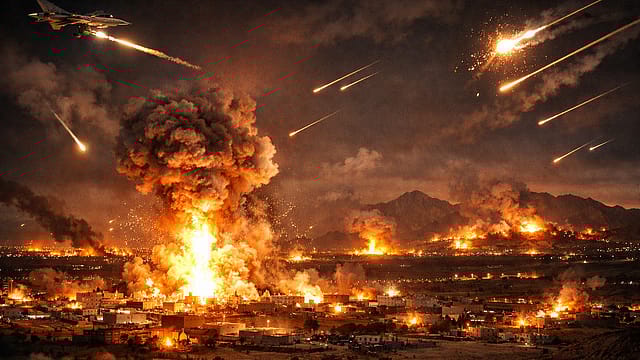
Israel intensified its military campaign against Iran over the past 24 hours, while tensions across West Asia escalated with drone interceptions in Saudi Arabia and debris from an intercepted aerial threat causing minor damage in Dubai.
The Israeli Air Force said it had struck more than 200 targets in western and central Iran during extensive operations.
"Since the launch of Operation "Roar of the Lion," the Air Force has completed hundreds of strike sorties targeting a variety of infrastructures of the Iranian terror regime, with the aim of reducing as much as possible the scale of fire toward the territory of the State of Israel," the IAF added.

Losing Memory
16 Oct 2026 - Vol 05 | Issue 42
The making of a medical and social emergency
Earlier, the Israel Defence Forces said the 'Taleghan' compound, which it claimed was used by the Iranian regime to advance nuclear weapons capabilities, had been destroyed.
Which Hezbollah and Iran-linked commanders did the IDF claim to have eliminated in Lebanon?
According to the IDF, the compound was used to develop advanced explosives and conduct sensitive experiments as part of the covert 'AMAD' project in the 2000s.
On the Lebanon front, the IDF said it had eliminated several senior figures linked to Iran and Hezbollah.
It claimed that Abu Dharr Mohammadi, operations commander in the IRGC's missile unit within Hezbollah in Beirut, had been killed.
According to the IDF, Mohammadi was a central figure coordinating between Hezbollah and the Iranian regime and played a key role in rehabilitating Hezbollah's missile programme following Operation Northern Arrows.
The Israeli military also said it had eliminated Ali Muslim Tabaja, a senior commander of the Iranian Imam Hossein Division.
What did the IDF say about eliminating Radwan Force fighters and destroying its command centres?
The IDF said Tabaja held several military roles both within Hezbollah and the division, which it described as a force used by the Iranian Quds Force to strengthen the Iranian axis and to operate against the IDF and Israeli civilians.
The IDF also reported killing Abu Ali Riyan, commander of Hezbollah's 'Radwan Force' southern Lebanon unit.
According to the Israeli military, Riyan was responsible for coordinating operations, recruiting operatives and managing the unit's weapons supply chain.
The IDF added that more than 100 fighters had been eliminated and over 60 command and control centres of the 'Radwan Force' destroyed.
Israeli Prime Minister Benjamin Netanyahu also issued a warning directed at Iran's new supreme leader Ayatollah Mojtaba Khamenei, suggesting that Israel could consider targeting him in the same way it targeted his father.
What did Netanyahu say about targeting Iran’s Supreme Leader?
Asked if Israel would go after Khamenei's son and successor, Mojtaba Khamenei, Netanyahu replied, "I wouldn't issue life insurance policies on any of the leaders of the terrorist organizations. This is their patron of terrorism. And I don't intend to provide an exact report here about what we are planning or what we are going to do."
Netanyahu described the younger Khamenei as a "puppet" of Iran's Revolutionary Guard Corps who "cannot show his face in public."
Meanwhile, security concerns spread across the Gulf region. Dubai authorities confirmed that debris from an intercepted aerial threat caused minor damage to a building in the city centre.
"Authorities confirm that debris from a successful interception caused a minor incident on the facade of a building in central Dubai. No injuries have been reported," the Dubai Media Office said.
Saudi Arabia's Ministry of Defence said its air defence systems intercepted and destroyed several drones targeting areas across the country.
How many drones did Saudi Arabia intercept as tensions linked to the Israel-Iran conflict escalated?
The official spokesperson for the Ministry of Defence said, "Two drones were intercepted and destroyed in Al-Kharj Governorate."
The spokesperson added that two additional drones were intercepted and destroyed in the eastern region of the country.
Earlier, the ministry had also confirmed that three drones were intercepted and destroyed in the eastern and central regions. Authorities said no casualties or damage were reported.
The Saudi MoD also said it had shot down a hostile drone while it was attempting to approach the Embassies District.
Iran warned of severe consequences if its energy infrastructure were attacked.
The spokesperson for Iran's Central Headquarters Khatam al-Anbiya said, "The slightest attack on Iran's energy infrastructure and ports will result in our crushing and devastating response."
"In the event of such an attack, all the oil and gas infrastructure in the region, in which the United States and its Western allies have interests, will be set on fire and destroyed," the statement added.
What happened in Iraq’s Erbil region as the Israel-Iran conflict escalated?
The conflict also affected security in Iraq. A French soldier was killed and several others were injured in an attack in the Erbil region.
Italy said it had begun organising the return of troops stationed at its military base in Erbil. The Italian ANSA news agency, citing Italian Defence Minister Guido Crosetto, reported that the withdrawal of the remaining contingent had already been planned before a missile struck the facility.
"A missile hit our base in Erbil. There are no casualties or injuries among the Italian personnel. They are all safe," Crosetto said, cited by ANSA.
Crosetto added that Italy had already started reducing its military presence in the region due to security concerns.
According to the minister, 102 personnel have already returned to Italy, while about 40 others have been relocated to Jordan.
Why is Italy planning to withdraw 141 troops from its Erbil base?
"A return of the current 141 was already being planned," he said, explaining that the operation was logistically complex because troops could not be flown out directly and would likely have to leave by land, probably via Turkiye.
Crosetto also confirmed that the facility in Erbil hosts several US military installations and forms part of a NATO presence in the region.
The latest developments come amid intensified operations by the United States and Israel against Iran. The strikes have reportedly killed more than 1,300 people and injured over 10,000 others.
Iran has responded with drone and missile attacks targeting Israel, Iraq and several Gulf countries hosting US military assets.
What did US Central Command say about the KC-135 aircraft incident in western Iraq?
Iranian state media earlier reported that resistance groups in western Iraq had shot down a US military refuelling aircraft. The United States Central Command later confirmed the loss of a KC-135 refuelling aircraft over Iraq while supporting operations but denied that hostile fire was involved.
"Two aircraft were involved in the incident. One of the aircraft went down in western Iraq, while the second aircraft was able to land safely," the release said. "This was not due to hostile fire or friendly fire," CENTCOM posted on X.
Tensions in the Gulf have remained high since joint US-Israeli military operations killed Iran's former Supreme Leader Ali Khamenei on February 28.
Iran's new Supreme Leader Mojtaba Khamenei said the country would continue using the strategic Strait of Hormuz as leverage during the conflict.
"Dear fighter brothers! The desire of the masses of the people is the continuation of effective and regret-inducing defence. Furthermore, the leverage of blocking the Strait of Hormuz must certainly continue to be used," he said.
Khamenei also said Iran had identified additional locations that could be targeted if the conflict continued.
What restrictions has Iran imposed on ships passing through the Strait of Hormuz?
"Studies have been conducted regarding the opening of additional fronts in areas where the enemy has negligible experience and would be highly vulnerable, and their activation will be carried out if the state of war persists and in accordance with the observance of interests," he said.
However, Iran's Ambassador to the United Nations Amir Saeid Iravani later said Tehran had no intention of closing the Strait of Hormuz while maintaining its right to safeguard security in the waterway.
"We are not going to close the Strait of Hormuz, but it is our inherent right to preserve the peace and security in this waterway, and it is our right," he said.
"Iran has no choice but to exercise its inherent right to self-defence under the UN Charter and international law," Iravani said.
"Iran fully respects and remains committed to the principles of freedom of navigation under the law of the sea. However, the current situation in the region, including in the Strait of Hormuz, is not the result of Iran's lawful exercise of its right of self-defence," he added.
Iran has also imposed tighter restrictions on ships passing through the Strait of Hormuz in recent days amid the ongoing US-Israeli strikes.
Tehran has said vessels not serving the interests of the United States and Israel can sail through safely.
(With inputs from ANI)