‘Ridiculous, Dumb’ Ruling: Donald Trump Rants Against US Supreme Court Over Tariffs
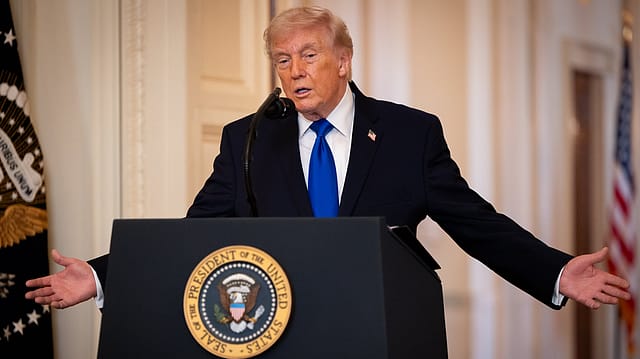
US President Donald Trump launched a sharp attack on the Supreme Court of the United States on Monday over last week’s ruling on his administration’s tariffs, calling the verdict “ridiculous (and) dumb” and claiming it had, in effect, increased his powers.
In a series of posts on Truth Social, Trump said he could “use Licenses to do absolutely 'terrible' things to foreign countries, especially those countries that have been RIPPING US OFF for decades”.
He did not offer a clear explanation of how the ruling might be interpreted as granting him “extraordinary powers” and added that he would “be using lower case letters (to refer to the Supreme Court) based on a complete lack of respect”.
What Rahul Gandhi Wants
28 Aug 2026 - Vol 05 | Issue 35
He is desperately courting the angry youth. That won't be enough to credibly challenge Modi
The post then moved into a rambling explanation about presidential trade licenses, those a US President can issue in an economic emergency, as a roundabout way to impose penalties on foreign trade instead of levying tariffs on imports of goods and services.
How does Trump interpret the court’s tariff decision on trade licenses?
Laws like the IEEPA, the 1971 International Emergency Economic Powers Act, can be used to force foreign countries to seek special permission, that is, licenses, to trade with the US.
Trump appeared to object to the court’s view that while he could still require exporting countries to queue up for such licences, he could not charge a fee.
“For one thing, I can use Licenses to do absolutely "terrible" things to foreign countries, especially those countries that have been RIPPING US OFF for many decades, but incomprehensibly, according to the ruling, can't charge them a License fee - BUT ALL LICENSES CHARGE FEES, why can't the United States do so? You do a license to get a fee!”
“The opinion doesn't explain that, but I know the answer!” Trump claimed.
He also asserted that the ruling had validated other tariffs.
Why did Trump call the Supreme Court incompetent while praising the dissenting justices?
“The court has also approved all other Tariffs, of which there are many, and they can all be used in a much more powerful and obnoxious way, with legal certainty, than the Tariffs as initially used,” the President claimed.
Trump described the court as “incompetent” except for “the Great Three”, referring to the dissenting conservative-leaning justices Brett Kavanaugh, Clarence Thomas, and Samuel Alito.
“Any Country that wants to "play games" with the ridiculous supreme court decision, especially those that have "Ripped Off" the U.S.A. for years, and even decades, will be met with a much higher Tariff, and worse, than that which they just recently agreed to. BUYER BEWARE!!! Thank you for your attention to this matter. President DONALD J. TRUMP,” he wrote in a subsequent post.
His criticism then shifted to birthright citizenship, the automatic grant of US citizenship to those born on American soil, which stems from the 14th Amendment clause stating, “All persons born or naturalized in the United States, and subject to the jurisdiction thereof, are citizens”.
In January last year, Trump issued an executive order seeking to exclude children of undocumented immigrants or those on temporary visas, arguing the clause, written after the Civil War, was meant only for “babies of slaves”.
Did Trump accuse the Supreme Court of favouring China on birthright citizenship interpretation?
“The next thing you know they will rule in favor of China and others, who are making an absolute fortune on Birthright Citizenship, by saying the 14th Amendment was NOT written to take care of the "babies of slaves," which it was as proven by the EXACT TIMING of its construction, filing, and ratification, which perfectly coincided with the END OF THE CIVIL WAR,” he declared.
He further alleged that China and other countries “use” the citizenship clause to “infiltrate” the US by sending women in the final stages of pregnancy as tourists or on other visas, and warned that the court could reach “the wrong conclusion”.
“But this supreme court will find a way to come to the wrong conclusion, one that again will make China, and various other Nations, happy and rich. Let our supreme court keep making decisions that are so bad and deleterious to the future of our Nation - I have a job to do.”
Trump rejected media reports suggesting that General Daniel Caine had cautioned Washington against a war with Iran.
In another Truth Social post, he described the reports as “100 per cent incorrect” and said they failed to reflect Caine’s “vast wealth of knowledge”.
Did Trump deny reports that General Daniel Caine opposed a war with Iran?
“Numerous stories from the Fake News Media have been circulating stating that General Daniel Caine, sometimes referred to as Razin, is against us going to War with Iran. The story does not attribute this vast wealth of knowledge to anyone, and is 100% incorrect. General Caine, like all of us, would like not to see War but, if a decision is made on going against Iran at a Military level, it is his opinion that it will be something easily won,” Trump said.
“He has not spoken of not doing Iran, or even the fake limited strikes that I have been reading about, he only knows one thing, how to WIN and, if he is told to do so, he will be leading the pack. Everything that has been written about a potential War with Iran has been written incorrectly, and purposefully so,” he added.
Trump also warned Iran to reach terms with the US on a nuclear deal, saying failure to do so would have severe consequences.
“I am the one that makes the decision, I would rather have a Deal than not but, if we don't make a Deal, it will be a very bad day for that Country and, very sadly, its people, because they are great and wonderful, and something like this should never have happened to them,” he said.
The remarks followed media reports that Caine had cautioned Trump and senior American officials that a military campaign against Iran could carry serious risks, including the possibility of becoming entangled in a prolonged conflict.
Why is the United States strengthening military presence amid Iran tensions?
Meanwhile, the United States is strengthening its military presence in the region, raising concerns about a broader conflict with Iran.
The New York Times reported that hundreds of servicemen have been transferred from the Al Udeid Air Base, citing Pentagon officials.
Similar logistical shifts have been observed across American facilities in Bahrain, the headquarters of the Navy’s 5th Fleet, as well as in Iraq, Syria, Kuwait, Saudi Arabia, Jordan, and the United Arab Emirates.
Government officials are reportedly concerned that the 30,000 to 40,000 US troops deployed in the region could become primary targets of the Islamic Republic in the event of an all-out war.
Iran’s Foreign Minister Abbas Araghchi has said he is likely to meet a US delegation in Geneva on Thursday for the next round of talks over the country’s nuclear programme, following two rounds of negotiations held earlier this month aimed at reaching a deal.
(With inputs from ANI)