Poll Violence, Rival Accusations Test Bangladesh On Election Day
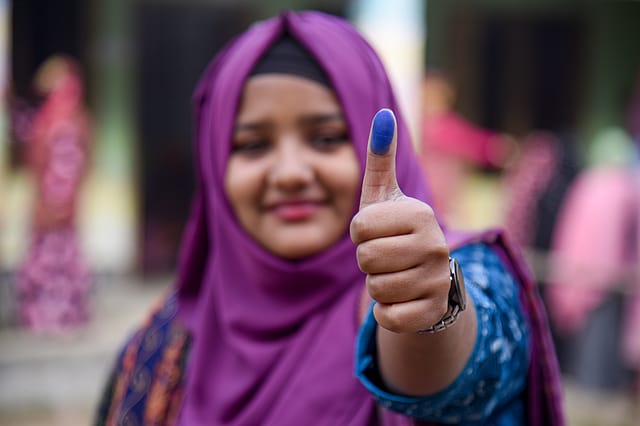
Bangladesh went to the polls on Thursday in a highly consequential parliamentary election marked by sporadic violence, allegations of irregularities, competing political narratives, and concerns over democratic participation, as nearly 127 million eligible voters exercised their franchise.
The 13th national parliamentary election is being widely viewed as a defining moment for the country’s political future, particularly following the 2024 uprising that reshaped the political landscape, the death of former Prime Minister Khaleda Zia, and the continued absence of Sheikh Hasina’s Awami League from the electoral process.
What happened in Munshiganj, Gopalganj?
Tensions escalated in parts of the country after a crude bomb explosion disrupted voting at a polling centre in Munshiganj district. The blast occurred at the Makhati Gurucharan High School polling station in Mollakandi Union of Sadar upazila, triggering panic among voters and a temporary suspension of polling.

Losing Memory
16 Oct 2026 - Vol 05 | Issue 42
The making of a medical and social emergency
Officer-in-Charge Md Mominul Islam of Munshiganj Sadar police station said the blast was followed by a “chase and counter-chase” between rival groups. “Supporters of BNP-backed candidate Kamruzzaman (Sheaf of Paddy symbol) and independent candidate Mohiuddin were involved,” he said, adding that investigations were underway.
Sadar upazila Nirbahi Officer Masudur Rahman downplayed the incident, calling it a “minor incident” and confirming that voting had resumed. “Voting is continuing,” he said.
Presiding Officer Md Titumir said multiple explosions caused fear among voters. “It has now started again and people are casting their ballots,” he said, after security forces reinforced the area.
Captain Zobaed of the Bangladesh Army said efforts were underway to identify those responsible. A similar incident in Gopalganj earlier in the day injured two Ansar members and a teenage girl, underlining persistent security challenges.
Despite such disruptions, election authorities maintained that polling was continuing at most centres.
Irregularities at some polling centres in Bangladesh?
Amid voting, Jamaat-e-Islami candidate Khaleduz Zaman alleged serious irregularities at some polling centres.
“The situation is not good because without a polling agent, in a separate room, someone is sealing the papers. It is totally disappointing. I have seen this in some places. We were hopeful that Jamaat-e-Islami would win the election, but if this happens, how can we have hopes...” he said.
However, former BNP Minister Sarwari Rahman offered a contrasting assessment after casting her vote.
“Everything went very well, and everything is very organised... Women are voting freely... I am feeling very happy. After so many years, proper elections are taking place,” she said.
Expressing optimism, she added, “I hope the result will be fine and the parliament will sit... What we seen for so many years, I think now everything will be fine.”
BNP’s student wing member Zubair accused Jamaat-e-Islami of attempting to disrupt voting.
“The situation is actually two-sided. We are trying to control it, but the other large party, Jamaat-e-Islami, is trying to disrupt it... They are casting illegal votes also,” he said.
“In my opinion, they do not have the right to participate in the National Assembly,” he added.
What was the voter turnout by 2pm?
According to Election Commission's Senior Secretary Akhtar Ahmed, voter turnout across 36,031 polling stations stood at 47.91 per cent as of 2:00 pm (local time), Daily Star reported. However, a total of 42,651 polling centres were set up for Thursday's national election.
Voters began lining up as early as 6 am, with long queues observed in several urban and rural areas, reflecting high public engagement.
Interim Chief Adviser Muhammad Yunus cast his vote at the Gulshan Model School and College in Dhaka, while BNP Chairperson Tarique Rahman voted at the Gulshan Model High School and College in Gulshan-2.
Rahman said the country had been waiting for this day to exercise its democratic rights.
Did Absence of Awami League Raise Regional Concerns?
The absence of the Awami League, which ruled Bangladesh four times before being barred from participation, has emerged as a central concern among observers.
Former diplomat Surendra Kumar said Bangladesh’s stability is crucial for India, given the extensive shared border.
“This country with which we enjoy the longest border, 4096 kilometers, we have border in five states, is very important for us,” he said.
He expressed concern over the political climate. “Atmosphere was full of violence, hatred, anti-India feeling, anti-Sheikha Hasina feeling... I mean it's a little pity that the party which has ruled four times is not in the frame. But we have to accept the reality,” Kumar said.
Despite tensions, he expressed cautious optimism. “This election will at least put this phase into an end and bring about elected government which will much more responsible,” he said.
On regional ties, Kumar reaffirmed India’s stance. “Whichever party is elected by the people, we accept them. We will do business with them... Dhaka will remain mindful of India's security concerns, India's economic concerns, and the welfare of people in the region,” he said.
What are the key concerns in Bangladesh?
Bangladesh’s elections are taking place amid economic pressures, rising inflation, unemployment, and demands for governance reforms. Corruption, development, and youth aspirations remain key voter concerns.
Nearly half of the electorate is aged between 18 and 37, with about 4.57 million first-time voters.
Of 59 registered parties, 51 are participating in the polls. A total of 1,981 candidates, including 249 independents, are contesting. Major parties include BNP, Jamaat-e-Islami, National Citizen Party, Jatiya Party factions, Left Democratic Alliance, and Amar Bangladesh Party.
Alongside parliamentary elections, voters are also participating in a referendum on the National Charter 2025, drafted by the interim government led by Yunus.
As Bangladesh concludes voting, the outcome is expected to shape domestic governance and regional dynamics. For South Asia, the election represents a test of democratic resilience and a potential turning point in restoring political stability.
Did India send poll observers to Bangladesh?
Despite receiving an official invitation from Dhaka to monitor the proceedings, India opted not to send official observers to avoid any perception of interference. Responding to queries during the weekly media briefing on Thursday, Ministry of External Affairs Official Spokesperson Randhir Jaiswal said, "We did receive an invitation for sending Observers, we have not sent our Observers to Bangladesh to observe the elections."
By staying away from the polling stations, New Delhi ensured that the "credibility" of the election remains a matter for the Bangladeshi people and the international community to judge, rather than being "validated" by an Indian presence.
(With inputs from ANI)