PM Modi in Israel: Guard of Honour, Strategy and the Diaspora’s Emotional Welcome
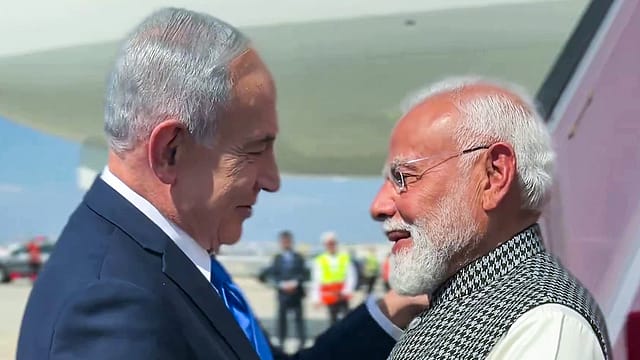
Prime Minister Narendra Modi arrived in Tel Aviv on Wednesday for a two-day State Visit to Israel, marking his first trip since the landmark 2017 visit that elevated bilateral ties to a strategic partnership.
At Ben Gurion Airport, Modi received a Guard of Honour and was personally welcomed by his Israeli counterpart Benjamin Netanyahu, accompanied by his wife Sara Netanyahu. The two leaders shared a warm embrace, reflecting what officials described as a close personal rapport. Israeli Ambassador to India Reuven Azar was also present.
Ahead of his departure, Modi described the visit as an opportunity to deepen the "robust and multifaceted Strategic Partnership" between the two countries.
"At the invitation of my dear friend Prime Minister Benjamin Netanyahu, I will be undertaking a State Visit to Israel from 25-26 February 2026," the Prime Minister said in his departure statement.

Zeroing In on ECI
09 Oct 2026 - Vol 05 | Issue 41
Constitutional legitimacy versus political opportunism
"India and Israel share a robust and multifaceted Strategic Partnership that has witnessed remarkable growth and dynamism in recent years," the statement added.
He further noted, "I look forward to my discussions with Prime Minister Netanyahu aimed at further strengthening our cooperation across various domains, including science and technology, innovation, agriculture, water management, technology, defence and security, trade and investment, as well as people-to-people ties. We will also exchange views on regional and global issues of mutual interest."
Why Is This Visit Being Seen as Historically Significant?
Beyond the ceremonial welcome, the visit carries substantial diplomatic weight. Modi is scheduled to meet Isaac Herzog, President of Israel, and will address the Knesset, becoming the first Indian Prime Minister to do so.
"I will also have the honour of becoming the first Indian Prime Minister to address the Israeli Parliament, Knesset, an occasion that would be a tribute to the strong parliamentary and democratic ties that bind our two nations," he said.
Israeli President Herzog expressed anticipation ahead of the visit. In a post on X, he wrote: "Prime Minister Narendra Modi, the State of Israel and the people of Israel look forward to welcoming you to Israel."
The streets of Jerusalem reflected the moment’s symbolism. Tricolours adorned shopfronts, community leaders coordinated welcome gatherings, and Hindi conversations echoed across neighbourhoods where the Indian diaspora forms a visible presence.
At a newspaper kiosk, an Israeli resident was seen reading The Jerusalem Post, whose front page carried a photograph of Modi waving. One headline read "Welcome, Modi," while another highlighted "New Delhi's burgeoning partnership with Jerusalem".
How Is the Indian Diaspora Shaping the Emotional Narrative?
For many members of the Indian-origin Jewish community and expatriates, the visit is as personal as it is political.
"I am very connected with our Indian Embassy, and we are very happy that Prime Minister Modi has come here. We are very proud that he has such a good relationship with our Israel, our fatherland. May this relationship continue and our friendship continue," said one community member. "We have been in Israel for many years, but our heart is still Indian."
Another resident stressed the shared strategic vision: "Because of the situation, Israel and India should be very strong friends. Whatever the Pakistan issues, we have to learn from Israel how to deal, how to fight."
Abraham Samson, who moved to Israel from Mumbai nine years ago, expressed admiration for the Prime Minister. "We are very, very proud of him, that he is a very good Prime Minister, and he's an honest man. God bless him," Samson said.
Ruth Greenfield, daughter of Joshua Moses Benjamin, the former Chief Architect of the Government of India, highlighted efforts to preserve Indian-Jewish heritage. "We represent an Indian-Jewish heritage centre that we are building here in Israel because of our proud heritage that we had in India. I'm from the Bene-Israel community from Delhi," she said.
Recalling historical ties, she added: "We have tracked down some of the Jews who were living here, who were at the camp where the Maharaja had saved them in Jamnagar. We have a very rich heritage. I've got children, grandchildren, but we can't forget India. You cannot take India out of us."
Deepankar Lama of the Bharatiya Gorkha Association of Israel also expressed gratitude. "I would like to thank our Prime Minister for the way you are working for the country. When we are sitting in Israel and making our country proud, you give us courage," Lama said.
As Modi’s meetings unfold and his address to the Knesset approaches, the visit stands at the intersection of statecraft and sentiment, a reflection of how India-Israel ties now span strategic cooperation, democratic symbolism and a diaspora that sees itself rooted in both nations.
(With inputs from ANI)