Oil Firms Losing ₹1,000 Crore Daily: Hardeep Puri Explains Fuel Crisis
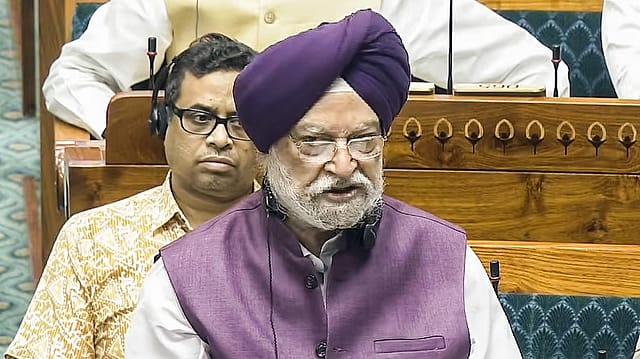
India’s oil marketing companies are currently under severe financial strain, with Union Petroleum and Natural Gas Minister Hardeep Singh Puri revealing they are losing nearly ₹1,000 crore every day. Speaking at the CII Annual Business Summit 2026, Puri attributed the losses to rising global crude oil prices and mounting under-recoveries.
Puri laid out the scale of the crisis, saying, “If you look at the fiscal situation, if you look at the fact that my oil companies are losing Rs 1,000 crores every day, the under recovery is going to be Rs 1,98,000 crores. The losses are Rs 1 lakh crore, if you look at the quarter. In that context, how long can you keep it like this? Where is the oil? It used to be around $64 or $65. It has gone up to $115 in that basket.”
The Modi Years
02 Oct 2026 - Vol 05 | Issue 40
A Nation Rebuilt
What is driving the surge in crude oil prices?
The sharp rise in global crude oil prices is at the heart of the problem. Prices have jumped from around $64–65 per barrel to nearly $115 per barrel, significantly increasing the cost burden on companies that sell fuel domestically at relatively stable prices.
The minister noted that the past 75 days have been particularly difficult due to global geopolitical developments, which have disrupted supply chains and pushed up prices.
How has India managed fuel supply despite global disruptions?
Despite these challenges, the government has maintained uninterrupted fuel supplies across the country. Puri emphasised that there has been no shortage of petrol, diesel, or LPG anywhere in India.
“Every petrol pump in the country has had petrol and diesel. LPG supply is more than enough,” he said, highlighting the resilience of India’s energy infrastructure.
Are there misconceptions about India’s energy imports?
Puri also pushed back against what he described as misinformation regarding India’s energy imports, particularly involving Russia.
“There are a lot of myths going around. I just read a piece which says India refused to import an LNG consignment from the Russian Federation. We've never imported LNG from Russia,” he clarified.
He reiterated that India remains a major player in the global energy ecosystem, being the world’s third-largest refiner and fourth-largest exporter of petroleum products.
Why haven’t fuel prices increased in India?
One of the most striking aspects of India’s energy policy, according to Puri, is the decision to keep fuel prices unchanged since 2022, despite rising global costs.
“If I remember correctly, we haven't raised prices for the last four years. We're the only country in the world,” he said, adding that fuel pricing decisions are not influenced by elections.
This approach, while shielding consumers, has contributed to the mounting financial pressure on oil companies.
How have global chokepoints like the Strait of Hormuz affected India?
Supply disruptions around the Strait of Hormuz have also played a significant role. A large portion of India’s LPG imports traditionally passes through this route.
“About 60 per cent of our LPG used to come from the Strait of Hormuz. Now we had to make arrangements,” Puri explained.
In response, India significantly boosted domestic LPG production, increasing output from around 35,000–36,000 metric tons per day to 54,000 metric tons per day.
“This by itself is a mind-boggling thing,” he stated.
What does this mean for India’s energy outlook?
Even amid global volatility and supply disruptions, India’s energy sector has remained stable, with no visible shortages and even a 6 per cent increase in petrol consumption during the crisis period. The government also managed to slightly reduce LPG consumption through supply-side measures.
Puri concluded by stressing that the sector has shown resilience despite global challenges and attempts by some to create panic through misinformation.
(With inputs from ANI)