Labour in Turmoil: Keir Starmer Faces Mounting Revolt After Devastating Local Election Losses
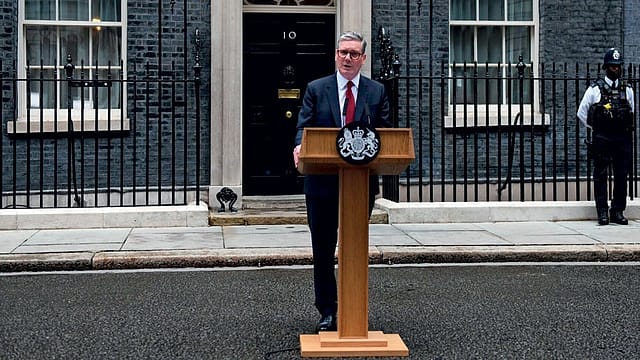
The results detonated. Within days of Labour’s crushing local election losses, Keir Starmer finds himself cornered—not by the opposition, but by his own party. What began as murmurs of concern has hardened into open dissent. More than 70 Labour MPs are now either calling for his resignation or pressing him to set a timeline for departure. Around him, the ground is shifting fast.
The scale of the setback is difficult to ignore. Across England, Labour lost more than 1,400 council seats in the latest round of local elections, a collapse that has shaken confidence in the party’s organisational strength and electoral strategy. The damage wasn’t contained to England alone. In Wales, Labour lost control of the devolved parliament, while in Scotland the party also struggled to hold its ground. These were not isolated losses—they formed a pattern, and that pattern has triggered alarm within the party.
Even more unsettling for Labour is who benefited.
On one side, Reform UK surged, consolidating support among voters disillusioned with mainstream politics. On the other, the Green Party of England and Wales expanded its footprint, drawing progressive voters away from Labour’s base. The result: Labour squeezed from both ends, losing not just seats, but narrative control.
Starmer has responded with defiance.
Speaking to party members in London, he acknowledged responsibility for the losses, but made it clear he would not step down. His argument leans heavily on recent political memory. The UK, he said, has already seen what constant leadership churn looks like—and paid the price for it. A Labour government, he warned, cannot afford to repeat that cycle of instability.

Exclusive: To the Heavens and Back
19 Jun 2026 - Vol 04 | Issue 76
Shubhanshu Shukla relives the space odyssey that put India into orbit
But inside the party, patience is thinning.
The backlash has not been limited to statements. Several MPs have resigned from ministerial aide roles, a symbolic but pointed act of protest. Others are working more quietly, building numbers and gauging support. The threshold is clear: 81 MPs—one-fifth of Labour’s parliamentary party—are needed to trigger a formal leadership contest. With over 70 already expressing discontent, the gap is narrowing.
And the criticism is no longer just about one election cycle.
Starmer’s leadership has been under scrutiny for months. Detractors within Labour point to a perceived lack of clarity on immigration policy, unease around economic positioning, and a broader complaint that the party is struggling to articulate a compelling, forward-looking vision. The landslide victory in the 2024 general election once provided insulation. That cushion is wearing thin.
The deeper worry inside Labour is strategic: whether Starmer is the right leader to carry the party into the next general election in 2029. Local elections are often treated as mid-cycle noise, but the scale of these losses—and the internal reaction to them—has elevated this moment into something more consequential.
Naturally, attention has turned to potential successors.
Among the names circulating, Angela Rayner stands out. The former deputy prime minister has not formally entered the race, but her public remarks have added to the pressure. Calling on Starmer to “meet the moment and set out the change our country needs,” she stopped short of direct confrontation—but in Westminster, such phrasing rarely goes unnoticed.
Starmer, for his part, is attempting to reset the narrative.
He has hinted at a shift in policy direction, including efforts to rebuild relations with the European Union after years of Brexit-driven friction. The suggestion signals a willingness to recalibrate, but specifics remain limited. What he has been more explicit about is the need for bolder action. Incremental change, he has said, will not be enough to address the country’s challenges.
Behind the scenes, tensions are spreading upward.
Reports indicate that unease is not confined to backbenchers. Discontent has begun to seep into senior levels of government, raising questions about cohesion at the top. A cabinet meeting scheduled at Downing Street is expected to address both the immediate political fallout and the broader direction of the government.
There are historical parallels. UK governments have weathered poor local election results before and recovered. But analysts suggest this moment carries a different weight. The scale of Labour’s losses, combined with the intensity of internal dissent, has created a pressure point that is harder to manage through routine political recalibration.
For now, Starmer remains in office. He is resisting calls to resign, holding his line on stability, and betting that a policy reset can steady the party.
But inside Labour, the question is no longer whether there is discontent.
It’s how far it will go.
(With inputs from ANI)