Israel Prepares for ‘Three More Weeks’ of Military Operations in Iran
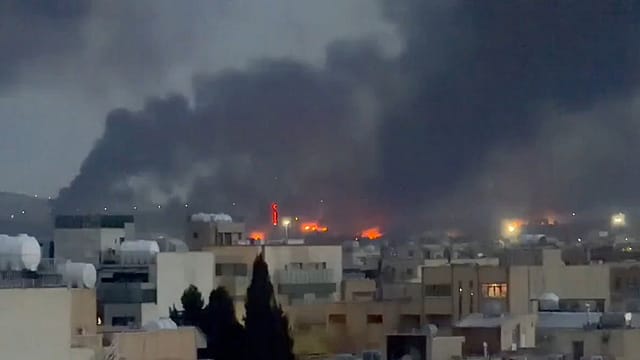
The Israel Defense Forces (IDF) said its offensive in the combined military campaign with the United States Armed Forces against Tehran is progressing "according to plan," moving faster than initial timelines, according to a report by The Times of Israel.
Military officials indicated on Sunday that strikes on the Iranian defence sector are set to "further ramp up," alongside persistent attempts to "reduce missile fire on Israel."
Despite the accelerated pace, the IDF remains prepared for at least "three more weeks of operations" within Iran.
The military cited the existence of "thousands more targets" yet to be neutralised across the capital and various provinces.

Losing Memory
16 Oct 2026 - Vol 05 | Issue 42
The making of a medical and social emergency
Why does Israel view the current Iran war as more extensive than the 2025 escalation?
He further added that the military is "ready, in coordination with our US allies," with operational strategies extending through the holiday of Passover and "deeper plans for even three weeks beyond that."
The report noted that following the initial "decapitation strikes" on February 28, which resulted in the death of Ali Khamenei and more than "40 top Iranian officials," the IDF shifted its primary focus.
Current efforts are concentrated on the total destruction of Iran's "military industry," targeting the production of ballistic missiles and air defence networks.
Officials compared the present conflict to the brief escalation in June 2025 and described the ongoing operation as "far more extensive."
While the previous engagement aimed to stop the development of a "nuclear weapon," the current war is viewed as a chance to eliminate Iran's "strategic threat" for the "foreseeable future."
How is the IDF working to systematically degrade Iran’s defence apparatus?
Consequently, the IDF is working to "systematically degrade" the entire Iranian defence apparatus.
This includes targeting missile firms linked to the Islamic Revolutionary Guard Corps (IRGC), along with private entities manufacturing "components" for naval weapons and "spy satellites," according to the report.
Military sources claimed that the strikes have already inflicted "significant damage," asserting that Tehran currently lacks the "ability to manufacture any new missiles."
Simultaneously, the Israeli Air Force (IAF) has continued to "hunt down" launchers and has reportedly disabled about "70 per cent" of the regime's 500 ballistic missile units.
The report added that the IDF has achieved "aerial superiority" across most of the country after the Israeli Air Force neutralised more than "100 air defence systems" and roughly "120 detection systems" during the early stages of the campaign.
Why is the IDF targeting Iran’s ‘centres of power’ and Basij command units?
Beyond military hardware, the IDF is also targeting "centres of power," particularly the command units of the internal security forces and the Basij.
The military estimates that between "4,000 and 5,000 Iranian soldiers" have been killed and reported a sharp decline in "morale" along with instances of "desertion" within the missile divisions.
The overarching objective of the joint US-Israeli mission is to "distance threats" and "create the conditions" for the local populace to eventually "topple the regime," the report said.
Meanwhile, the IDF has also announced the start of "limited and targeted ground operations" against key Hezbollah strongholds in southern Lebanon, marking a further escalation in regional hostilities.
In a statement posted on the social media platform X, the military said the manoeuvre is "aimed at enhancing the forward defence area."
Why have IDF’s 91st and 146th Divisions launched ground activity in Lebanon?
The initial phase forms part of a "broader defensive effort to establish and strengthen a forward defensive posture," specifically targeting the "dismantling of terrorist infrastructure and the elimination of terrorists operating in the area."
Further detailing the deployment, a second post originally shared in Hebrew by the IDF's official account (@idfonline) stated that "91st Division Forces" have begun "focused ground activity" to expand the designated defence zone.
The military said the expansion is essential "to remove threats and create an additional layer of security for the residents of the north."
To prepare the battlefield, the IDF disclosed that it "struck numerous terror targets in the area using artillery and the Air Force" before the entry of ground units.
The operations are being conducted "alongside the 146th Division," with a primary mission of "defending the Galilee settlements."
Visual material accompanying the Hebrew post included night vision footage and high contrast images showing IDF soldiers moving through dense Lebanese terrain under a green thermal tint.
One image showed a soldier inside a structure using a headlamp to inspect coiled wiring or equipment, highlighting what the military described as the "focused" nature of the mission to dismantle infrastructure.
The IDF said the action is a direct response to "the Hezbollah terror organisation, which decided to join the campaign and operate under the auspices of the Iranian terror regime."
It added that it "will not allow harm to the civilians of the State of Israel" as operations continue in southern Lebanon.
(With inputs from ANI)