Is Lula’s Last Stand Brazil’s Own?
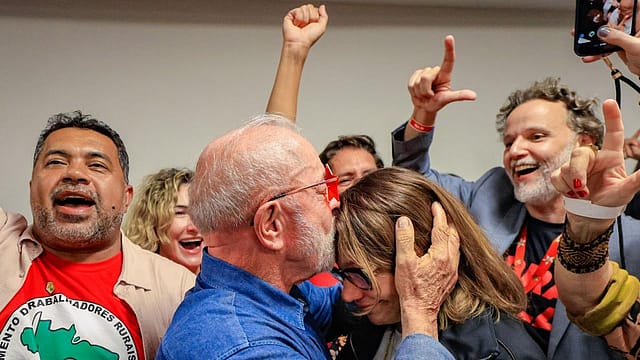
Brazil has just done what it never did before since direct elections resumed in 1989. It has let a man lose the first round of the presidential election and then win the second. On October 4, Flávio Bolsonaro led Lula 47 per cent to 45. But on Sunday, October 25, Lula took the runoff with 51.8 per cent, a margin of some 4.4 million votes. Now, at nearly 81, the leftist leader begins a fourth term.
The backstory will remain grim and continue to cast its shadow as long as Donald Trump is in the White House—at least. Jair Bolsonaro lost to Lula in 2022, refused to accept the outcome, and has been serving 27 years for masterminding a coup attempt. His son Flávio, 45, promised him amnesty while admitting he took some $12 million from a disgraced banker for a film about his father.

Look Who's Talking Regime Change
23 Oct 2026 - Vol 05 | Issue 43
But how did Lula win? The answer is fear, mostly, and arithmetic. The first round was a protest against a government blamed for prices and crime; Lula’s vote shrank even in his northeast heartland. Protest, however, is not a programme. As M.O. it has diminishing returns. Lula quickly rebuilt his campaign, courted the young, sweetened the electorate with small-business debt relief and free weekend transport, and recast the contest as a referendum on the Bolsonaro name. It seemed to pay off as nearly three million more Brazilians turned out.
So, who voted for him? The familiar coalition, of course: the poor northeast, Catholics, women, lower-income households. This time he also won the cities of São Paulo and Rio, though Flávio kept both states. The evangelical, affluent south stayed loyal to the Bolsonaros.

Bolosnaro Jr called the result “inexplicable” and wants it annulled. The irony is that his grievance is not wholly frivolous. A Supreme Court justice, Cristiano Zanin, Lula’s former lawyer, extended voting by two hours minutes before polls closed, after bus failures in Salvador and São Paulo. Both candidates may have asked so and Flávio cited rain in the south. But even as this merits scrutiny, it isn’t really fraud. A 4.4-million margin is not a rounding error, and a family that tried to overturn 2022 by rioting has little standing to cry foul without evidence again.
Brazil’s—and Lula’s—biggest concern would be that Washington and Trump loom. What happens now? Tariffs, gang designations and Lula’s own warnings of American meddling framed the race; Bolsonaro’s rallies flew Trump’s image. On the other hand, Lula’s victory keeps Brasília at arm’s length from the White House and close to Beijing. While thanking Brazilians who have “defended Brazilian democracy”, he called it a defeat for denialism and lies, and vowed that the country would not be anyone’s backyard. That’s effective politics. Sovereignty always sells.
Yet sovereignty sits oddly in Lula’s mouth. He has blamed Vladimir Putin and Volodymyr Zelensky equally; declined to sanction Moscow; and hosted Sergey Lavrov and embraced Nicolás Maduro. Independence from Washington cannot be deference to the Kremlin. At home, Lula’s corruption convictions were annulled over a biased judge, which was not exoneration, and he admitted in 2024 that his government had done little to earn its voters’ support. A fourth term at 81 may prove to be hubris as much as hope.
India was quick to cheer. Prime Minister Narendra Modi congratulated Lula on Monday on a “remarkable re-election victory”, calling him a dear friend and pledging to deepen the strategic partnership. Modi has visited Brazil four times in a decade, and on his state visit in July 2025 the two leaders set a $20 billion trade target for 2030, up from $12.2 billion, as Brazil awarded him its highest civilian honour. Lula skipped September’s BRICS summit in New Delhi to campaign; perhaps he will now have the time to make amends.
Brazil has chosen the familiar over the feared. That’s a verdict, not a mandate. Nearly half the country voted for a Bolsonaro, again, after everything. Democracy was spared on Sunday but it will not be spared forever on the strength of one old man.