Iran Fires Cluster Warhead Missiles at Central Israel, Civilian Deaths Reported
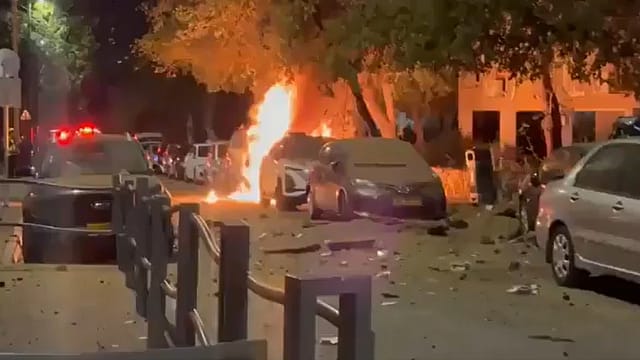
An Iranian ballistic missile targeting central Israel appears to have been equipped with a cluster bomb warhead, according to footage reviewed by the Times of Israel.
Cluster bomb warheads indiscriminately spread dozens of sub munitions, each carrying several kilograms of explosives, over a radius of around 10 kilometres.
Their use is banned under the 2008 Convention on Cluster Munitions, whose signatories do not include Israel, Iran or the United States.
The deployment of such weaponry resulted in several impact sites across central Israel. Emergency services responded to the affected areas, with local police securing multiple locations where debris and unexploded munitions were reported.

Losing Memory
16 Oct 2026 - Vol 05 | Issue 42
The making of a medical and social emergency
Direct damage to infrastructure was observed, including at least one instance where a submunition struck and damaged a road.
How did the Iran missile attack on central Israel turn fatal despite no initial injury reports?
Despite the visible destruction, medics initially confirmed that there were no calls regarding injuries.
However, the situation turned fatal in other parts of the region. Two people were killed in a ballistic missile attack in central Israel, according to Magen David Adom, as reported by CNN.
Paramedics declared the deaths of a man and a woman in the city of Ramat Gan, both of whom suffered severe shrapnel injuries. In Bnei Brak, just north of Tel Aviv, shrapnel from the missile lightly injured one person.
Israel’s Home Front Command emphasised the importance of adhering to safety alerts and guidelines, stating that such measures have proven lifesaving during ongoing hostilities.
Regular and reserve rescue and salvage forces were deployed to scan for survivors and assist residents.
Why are Iran’s cluster warhead missiles difficult for Israel to intercept?
The Israel Defence Forces said Home Front Command personnel were operating at multiple impact sites.
Following a situation assessment, authorities later permitted residents to exit protected spaces, while urging continued vigilance and avoidance of gatherings in affected areas.
Iranian state television reported that the missile strikes on Tel Aviv were carried out in retaliation for Israel’s assassination of Iran’s security chief Ali Larijani. Iran’s Supreme National Security
Council said Larijani’s son and his deputy, Alireza Bayat, were also killed in an Israeli attack on Monday night.
Israel has said that Iran has repeatedly used cluster warheads, which disperse into multiple smaller explosives mid air and spread over a wide area, making them difficult to intercept.
What risks emerged after strikes near Iran’s Bushehr nuclear facility during the conflict?
The overnight attack on densely populated Tel Aviv on Tuesday killed two people, bringing the death toll in Israel from the war to at least 14.
The conflict has also seen strikes inside Iran. A projectile hit an area near the Bushehr nuclear power plant on Tuesday evening, though Iran told the International Atomic Energy Agency that it caused no damage or injuries.
IAEA chief Rafael Grossi reiterated his call for maximum restraint to avoid the risk of a nuclear accident.
American aviators have flown more than 6,000 combat flights to maintain air superiority over Iranian skies.
US Central Command stated that strikes were carried out using multiple 5,000 pound deep penetrator munitions on hardened Iranian missile sites along the coastline near the Strait of Hormuz.
How are Iran’s attacks impacting global oil prices and inflation concerns?
These Iranian anti ship cruise missiles were described as a direct threat to international shipping, prompting the use of 2267 kg munitions to neutralise the risk.
The economic fallout from the conflict is becoming increasingly evident. Oil prices rose about 3 per cent on Tuesday after Iran renewed strikes on oil facilities in the United Arab Emirates, and are up around 45 per cent since the start of the war on February 28, raising concerns over global inflation.
The World Food Programme warned that tens of millions of people could face acute hunger if the conflict continues through June.
Global airlines have also raised alarms over soaring jet fuel prices, warning of hundreds of millions of dollars in additional costs, higher fares and potential route cuts.
Aviation across the Middle East has been severely disrupted, with flights cancelled, rescheduled or rerouted as much of the region’s airspace remains closed amid ongoing missile and drone threats.
(With inputs from ANI)