Trump’s Iran Strategy in Crisis: Larak Island Strike Exposes Risks to Strait of Hormuz and Global Oil Markets
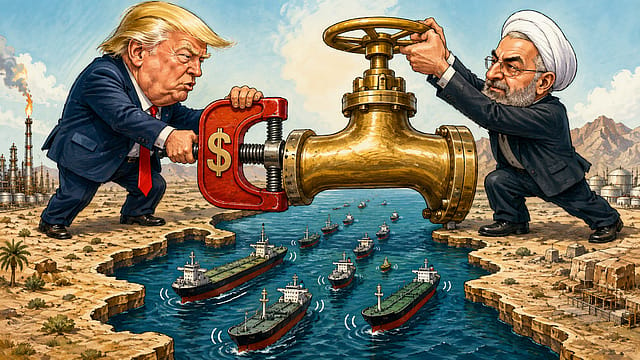
Donald Trump had changed the weapon, not the war.
After months of airstrikes, missile attacks, disrupted oil supplies and depleted American munitions, the US president was trying to move the confrontation with Iran away from continuous bombing. A naval blockade would obstruct its trade. Sanctions would chase its money. Foreign banks would be threatened with exclusion from the dollar system. Tehran would be slowly denied the economic oxygen required to sustain the regime and its military machine.
Then Larak Island exploded.
American forces struck two Iranian launchers on the island near the Strait of Hormuz on Sunday. Iran responded by firing ballistic missiles towards two Jordanian airbases used by US forces. Jordanian air defences reportedly intercepted the incoming missiles.
One small island has now exposed the dangerous contradiction inside Trump’s Iran strategy. Washington wants to enforce an economic siege without remaining trapped in an open-ended shooting war. Tehran wants to prove that the siege itself is an act of war.

Zeroing In on ECI
09 Oct 2026 - Vol 05 | Issue 41
Constitutional legitimacy versus political opportunism
The result is a pressure campaign in which every attempt to avoid escalation carries the ingredients for the next escalation.
Why Did the US Strike Larak Island?
Larak is a small Iranian island sitting close to the northern entrance of the Strait of Hormuz. Its military importance is considerably larger than its physical size.
The strait connects the Persian Gulf with the Gulf of Oman and the Arabian Sea. Before the conflict disrupted shipping, roughly one-fifth of global oil and petroleum-product consumption and about one-fifth of liquefied natural gas trade passed through it, according to the US Energy Information Administration.
Any missile launcher, fast-attack vessel or sea mine positioned near Larak therefore threatens more than an individual American warship. It can impede a maritime artery carrying energy from Saudi Arabia, Iraq, Kuwait, the UAE and Qatar to global markets.
A US official said the targeted launchers belonged to Iran’s Islamic Revolutionary Guard Corps and were preparing to fire rockets and deploy sea mines in the strait. The Sunday operation was the first known American strike against Iran since July, Reuters reported.
Iran presented a very different account. State media said the American attack came in two waves and caused deaths and injuries among IRGC personnel and civilians. The casualty claims could not immediately be independently verified.
The IRGC called the strike a “strategic and fatal error” by the Trump administration and promised direct retaliation.
It did not take long.
Iran subsequently said it had launched ballistic missiles at the King Hussein and Al-Azraq airbases in Jordan, both of which host American forces. Jordanian defences intercepted the attack, according to regional reports. Initial accounts offered no evidence of major damage or American casualties.
That distinction matters. Iran has claimed the attack, but its operational result remains uncertain. At this stage, the confirmed story is an exchange of fire and a serious expansion of risk, not a verified Iranian strike on American personnel or aircraft.
Why Iran Attacked US-Linked Bases in Jordan
Iran’s selection of targets was calculated.
By aiming at bases in Jordan rather than striking the American mainland or a large US installation elsewhere in the Gulf, Tehran could demonstrate that it possessed the range and willingness to attack American military infrastructure while retaining some control over the scale of retaliation.
But the choice also drags Jordan deeper into a war it did not start.
King Hussein Air Base and Muwaffaq Salti Air Base at Al-Azraq form part of the network supporting American operations across the Middle East. Jordan is a close US security partner and hosts thousands of American personnel, but it has repeatedly tried to protect its sovereignty and prevent its territory from becoming a battlefield between Washington and Tehran.
Iran has targeted Al-Azraq before during the present conflict. Each attack places Amman in an impossible position. If it allows Iranian missiles to cross its airspace, it risks casualties and appears incapable of defending its territory. If it intercepts them, Tehran can portray Jordan as an active participant in America’s war.
The Sunday missile launches therefore sent two messages.
The first was addressed to Trump: striking Iranian territory will produce a military response.
The second was directed at Arab governments hosting US forces: American bases make their countries vulnerable even when their governments want no part in Washington’s confrontation with Tehran.
This is one of Iran’s remaining methods of multiplying the political cost of American pressure. Tehran may not be able to match US air power, but it can compel Washington’s regional partners to calculate the price of allowing American aircraft, troops and missile defences to operate from their soil.
Operation Economic Outcast Meets Military Reality
The Larak strike came less than a week after the Trump administration unveiled Operation Economic Outcast, its most aggressive attempt yet to isolate Iran from the international financial system.
Announced on August 24, the campaign is designed to identify and attack every major route through which Tehran sells oil, moves money, obtains technology or evades sanctions.
The US Treasury Department says it has mapped the networks, facilitators and financial channels used by Iran. Treasury Secretary Scott Bessent presented Tehran with two choices: accept global isolation and a subsistence economy or negotiate a return to economic normality.
Washington intends to impose new secondary sanctions frequently, initially concentrating on banks that facilitate Iranian transactions. Such sanctions carry a particularly powerful threat. A bank or company need not be American to be punished. If it continues conducting prohibited business with Iran, it can lose access to the US financial system and the dollar.
The administration has already targeted the UAE operations of an Egyptian bank over alleged processing of Iranian transactions. Bessent is also expected to pressure other governments at the G20 to reduce financial ties with Tehran.
Trump’s larger strategy combines three forms of coercion.
The blockade obstructs Iran’s physical trade. Secondary sanctions attack the intermediaries that move its money. Occasional military strikes eliminate assets that Washington believes could disrupt the blockade or threaten shipping.
On paper, it is a ladder of pressure designed to keep America away from another sustained bombing campaign.
Larak reveals how easily that ladder can catch fire.
A naval blockade is not experienced by the blockaded country as a peaceful substitute for war. It physically prevents vessels from entering or leaving. American forces say they have redirected 83 commercial ships, disabled three and boarded two while enforcing the operation.
For Tehran, the mines and launchers near Hormuz are instruments of deterrence against that blockade. For Washington, they are imminent threats that must be destroyed. Both sides can consequently describe the same sequence as defensive.
Trump says he is protecting international shipping. Iran says it is defending its coastline and punishing an aggressor.
That circular logic has sustained wars far longer than either side initially intended.
Hormuz Is Trump’s Economic Hostage Too
Trump’s greatest problem is that Iran does not need to defeat the United States militarily to damage him politically.
It merely needs to keep the Strait of Hormuz unreliable.
Energy shipments through the waterway averaged only 4.9 million barrels a day during the second quarter of 2026, compared with 21.6 million barrels a day in the final quarter of 2025, according to the US Energy Information Administration. The agency estimates that the disruption caused global oil inventories to decline by an average of 4.2 million barrels a day during the second quarter.
Oil prices rose again after the Larak strike and Iran’s retaliation. Brent crude moved towards $90 a barrel as traders priced in the possibility of renewed disruption.
Every mine, missile and intercepted vessel can therefore travel from the Strait of Hormuz to an American petrol pump. Rising fuel prices can aggravate inflation, weaken consumer confidence and follow Republican candidates into the November midterm elections.
That gives Iran an unusual form of leverage over Trump. Washington controls the larger military and financial arsenal. Tehran occupies the geography capable of making that arsenal expensive to use.
The US can impose a blockade indefinitely, as Defence Secretary Pete Hegseth has suggested. But maintaining it requires ships, aircraft, missile defences, surveillance assets and personnel. It also leaves American bases across the region exposed to Iranian missiles and drones.
A prolonged confrontation would create another vulnerability. The American military has already consumed a substantial quantity of expensive precision weapons during the war. Repeatedly intercepting comparatively cheaper Iranian missiles and drones forces the Pentagon into an unfavourable arithmetic of its own.
Trump’s Three Bad Options
Larak leaves Trump facing three increasingly uncomfortable choices.
He can escalate militarily, striking more Iranian launchers, vessels and mining infrastructure. That may protect shipping temporarily but could trigger fresh attacks against American bases and regional allies.
He can rely on the blockade and sanctions, accepting that economic pressure will take time while oil prices remain elevated and Iran searches for new financial escape routes.
Or he can negotiate, which would require offering Tehran enough relief to produce an agreement after publicly promising isolation and punishment.
None delivers the quick, cinematic victory Trump prefers.
The most revealing part of the Larak confrontation is its scale. Two launchers were struck. Iran answered with missiles aimed at two bases. Most were reportedly intercepted. No major American losses were initially announced.
Yet that limited exchange moved oil prices, activated air defences, endangered a US ally and demonstrated how rapidly the war could reopen.
Trump named his sanctions offensive Operation Economic Outcast because he wants to remove Iran from the global economy.
Iran’s answer from Larak is far more menacing: a country sitting beside the world’s most important oil chokepoint cannot be economically exiled without disturbing everyone still inside.
With inputs from ANI