The Globetrotter: A Nuclear Three-Body Problem
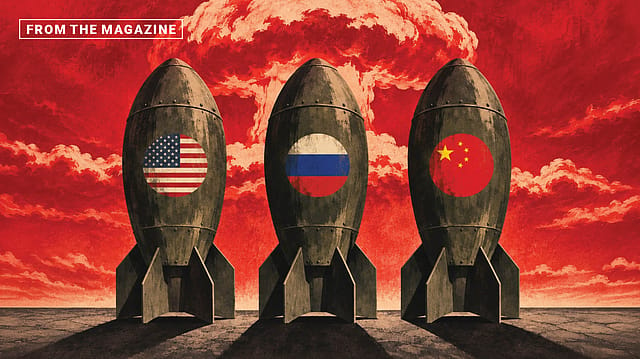
For 80 years, the nuclear question had a grammar of two. Washington and Moscow built, brandished and bargained, and a brutal symmetry—mutually assured destruction—kept the peace. Each could ruin the other and neither could prevent it. Treaties, hotlines and inspectors were the switches of that standoff. That architecture is being demolished. Beijing, whsose arsenal stood at a few hundred warheads at the turn of the decade, has crossed 600 and, by Pentagon estimates, may pass 1,000 by 2030. New silos, a fast-growing stockpile of fissile material and a submarine-launched capability complete the picture. The last bilateral pact between the US and Russia had lapsed while Beijing declined to sit at any table. Strategists call it the “three-body problem”, and the borrowed metaphor is exact: three bodies, mutual pull, no stable orbit. Deterrence calibrated against one rival cannot simply be doubled for two. Every US warhead added to answer China invites Russian matching; every Chinese increment alarms Washington. A summit of three leaders can discuss arms control and offer anodyne statements, but only two of them have practised deterrence. The old balance rested on mutual understanding. The new one rests on mutual suspicion. Opacity, unlike arithmetic, cannot be managed. What’s a race without rules but a wager?
China’s Long Game on Taiwan

China has stopped announcing its Taiwan drills. Over recent weeks, more than a hundred PLA Navy and coast guard vessels, two carrier groups and units drawn from three theatre commands have fanned out across the western Pacific, with no name, no communiqué, no warning. Australian strategist Mick Ryan interprets this as rehearsal: surprise practised deliberately and Washington’s reflexes measured alongside it. The deployment’s geometry is instructive. Ships hold station between Taiwan and Guam, a carrier heads for the Bashi Channel, and supply vessels slip through Japanese waters to feed them. This is a navy learning to keep American help from arriving, not merely to throttle Taiwan’s trade. Washington’s reply has been underwhelming. While Donald Trump can sit down with Xi Jinping and Vladimir Putin in Shenzhen, talking of nuclear arsenals and Iran, Beijing has brushed aside arms-control overtures. Since for the US president personal diplomacy substitutes for strategy, allies are left to infer US priorities from the seating order. Tokyo is rewriting its defence doctrine in earnest. The Quad leaders’ first summit in two years in Manila was a useful signal. But a signal is not a deterrent for Beijing any more, if it ever was.
Asturias Comes Home
Miguel Ángel Asturias has finally come home. Fifty-two years after he died in Madrid, the diplomat-novelist’s ashes have been interred in Guatemala City, ending an exile imposed by the country he spent a lifetime imagining. Born in 1899, he fused Maya myth with surrealist technique, and won the 1967 Nobel Prize in Literature. His novels indicted dictators and plantation owners alike. When the CIA toppled President Jacobo Árbenz in 1954, Asturias too was erased: nationality revoked, books banned, refuge in Paris. Significantly, his remains travelled home only after Bernardo Arévalo’s election. Regimes can silence writers but not outrun them.