Nepal Flood Disaster: Death Toll Rises to 734, 2,498 Missing as Bhote Koshi Swells Again
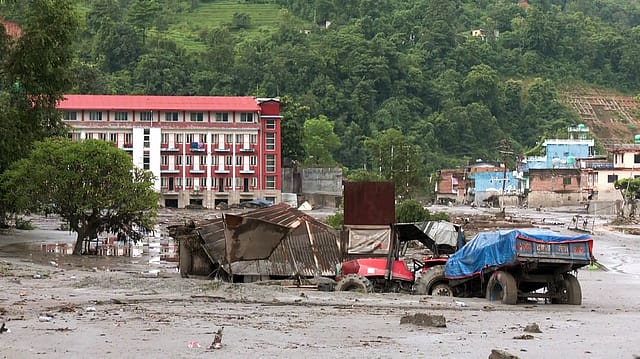
The bodies did not remain where the flood killed them. They travelled with uprooted trees, sections of buildings, vehicles, boulders and mud through the Bhote Koshi and Trishuli river system, moving from the Nepal-Tibet frontier into districts far downstream.
By 9 am on Sunday, only 13 bodies had been recovered in Rasuwa, the district where the disaster entered its most destructive phase. Chitwan, hundreds of kilometres away, had recovered 259. Nawalparasi East had found 184. Nawalparasi West reported 82. Gorkha recorded 58, Nuwakot 52, Dhading 50 and Tanahun 36.
Nepal’s National Disaster Risk Reduction and Management Authority said the nationwide total had reached 734 bodies and human remains. The wording matters. Some recoveries consist of body parts, meaning identification will require forensic examination and the final number of individual victims may change. Another 2,498 people remain missing or out of contact, according to the government’s latest bulletin reported by The Kathmandu Post. The figure is higher than the 2,419 cited in the initial ANI report and represents the latest official update available on Sunday morning.

Zeroing In on ECI
09 Oct 2026 - Vol 05 | Issue 41
Constitutional legitimacy versus political opportunism
Among the missing are 589 foreign nationals, 127 Nepalis travelling or working with foreign visitors, 933 people associated with hydropower projects and 85 members of Nepal’s security forces. The government says 8,186 people have been rescued. For thousands of families, the distinction between “missing” and “dead” remains the only hope left.
The River Begins Roaring Again
The danger did not recede with the first flood. Nepalese authorities issued another warning on Sunday after the flow of the Bhote Koshi increased in Rasuwa. Rescue workers, riverside communities and relief teams in Rasuwa, Nuwakot, Dhading, Chitwan and surrounding areas were told to remain vigilant.
The Flood Forecasting Division reportedly found that the Trishuli River at Galchhi in Dhading was flowing around three metres above its normal level. During the August 26 catastrophe, it had surged above 14 metres in the same area.
Communities that had already evacuated once were forced to prepare again. The fresh warning creates a cruel operational problem. Search teams must work close to the river, excavate unstable debris and enter damaged tunnels. Rising water can endanger the people attempting to rescue those trapped by the previous surge.
Rain, fog and broken roads have repeatedly interrupted helicopter and ground operations. Bridges have disappeared. River channels have shifted. Power and communications remain unreliable in several affected areas. In Galchhi and other downstream settlements, homes and agricultural land sit beneath thick layers of silt. Some buildings remain standing but cannot be entered safely. Residents have returned to find the physical shape of their neighbourhoods altered.
A disaster that lasted minutes has created terrain that may take years to repair.
What Caused the Bhote Koshi Flood?
The precise chain of events remains under scientific investigation, but the emerging evidence points towards a massive ice-and-rock collapse rather than an earthquake.
The US Geological Survey initially detected seismic energy in the region and classified it as an earthquake. Further analysis indicated that the signal came from a large mass movement.
According to a Reuters reconstruction, part of a glacier near Langtang Lirung collapsed and generated an avalanche containing ice, rock and sediment. The avalanche descended into the Lhende Khola catchment, temporarily blocking water behind an unstable natural dam. When that obstruction failed, the released water combined with debris and accelerated through the valley.
The resulting flow reportedly travelled at speeds approaching 50 metres per second in its fastest phase. It swept through the border region, struck infrastructure around Gyirong and Rasuwagadhi and entered the Bhote Koshi-Trishuli system. Water levels downstream rose extraordinarily quickly. The flood carried enough sediment and rock to alter river channels and bury structures that had stood above the previous flood line.
Early descriptions called the disaster a glacial lake outburst flood. The developing scientific picture is more complicated. It may have begun as an ice-and-rock avalanche that blocked a river, created a temporary lake and released a debris-rich flood when the natural dam failed. Scientists still need satellite imagery, field evidence and measurements from both sides of the border to establish the full sequence.
Climate change cannot be assigned as the cause of one collapse without detailed attribution. Rising temperatures are nevertheless destabilising Himalayan ice, thawing frozen ground and increasing the risk of rockfall, avalanches and sudden floods across the region. The mountains are losing some of the frozen material that once helped hold them together.
The Hydropower Tunnels
Some of the most desperate rescue operations are taking place underground. Nepal’s official missing list includes 933 people associated with hydropower projects along the Bhote Koshi and Trishuli corridors. The projects placed workers, offices, powerhouses, roads and tunnels beside rivers whose force they were built to harness.
The flood damaged more than a dozen operational and under-construction projects. Some facilities were buried. Others became part of the riverbed. At Upper Trishuli-1, hundreds of workers were initially reported missing. Rescue teams have since brought out survivors, but large numbers remain unaccounted for across the hydropower corridor.
At Trishuli-3A, rescuers drilled or opened a small passage into a mud-blocked tunnel and began pumping air inside. The plan was to enlarge the opening into a manhole through which a technical team could enter. More than 100 workers may remain trapped in tunnels at different sites, according to international reports. Their precise locations and conditions are uncertain.
Thermal drones have been used, but the depth, distance and layers of mud can prevent them from detecting signs of life. Excavators cannot easily reach sites where roads and bridges have been destroyed. Some tunnel entrances sit behind tonnes of wet sediment and debris.
Workers at Rasuwagadhi, Chilime and other projects are also missing. Officials have expressed hope that people inside underground powerhouses or tunnels may have survived if ventilation pipes remain open and chambers were not completely inundated.
The same underground structures can offer protection and become traps. Nepal’s hydropower expansion has transformed its electricity sector and created a major export opportunity. The disaster has exposed the concentration of risk along narrow Himalayan river valleys.
Projects naturally cluster where water drops rapidly through steep terrain. Roads, transmission lines and construction camps follow. A single debris flood can therefore strike several plants and hundreds of workers in succession.
The immediate task is reaching them. The longer question is whether dam sites, worker accommodation, tunnels, warning systems and evacuation routes were designed for a Himalayan risk profile that is changing faster than historical records can capture.
Twenty-One Hospitals and Hundreds Without Names
The recovery of a body does not end the search.
Unidentified bodies and remains have been distributed across 21 hospitals in affected districts. Morgues have filled. Temporary storage arrangements have been created as forensic teams attempt to establish identity through clothing, physical characteristics, dental records, fingerprints and DNA.
Decomposition, injuries and the long journey downstream make visual identification increasingly difficult. A body found in Chitwan may belong to a worker from Rasuwa, a tourist travelling towards Tibet, a resident of Nuwakot or somebody who had never been registered on an official missing list. Families must travel between hospitals or submit biological samples without knowing whether the relative they seek is among the recovered.
The 734 figure should, therefore, be read as the number of bodies and human remains reported by authorities, rather than a complete ledger of named victims.
The scale of the missing list creates another complication. It contains overlapping categories: local residents, project employees, foreign tourists, Nepali guides and assistants, security personnel, customs and immigration officials, park workers and people whose last confirmed location may have been far from where the flood eventually carried them.
Officials must remove duplication while adding people whose absence has only now been reported. The numbers will continue to move. The grief has already arrived.
The Foreigners Who Vanished Along a Himalayan Route
The flood struck a border corridor used by traders, hydropower workers, trekkers and religious tourists travelling towards Mount Kailash and Lake Manasarovar in Tibet.
Nepal says 589 foreign nationals remain missing. China has separately reported hundreds missing in Tibet, including nationals from more than 20 countries. The Nepal and Tibet lists cannot simply be added without checking for overlap. A traveller may have entered through Nepal, crossed the border and appeared in the records of more than one jurisdiction.
Reuters reported on Sunday that Chinese authorities had listed 261 missing foreign nationals in Tibet, including 104 Nepalis and 49 Indians. Across Nepal and Tibet, the confirmed toll had reached at least 750, while more than 3,000 people were missing, according to the same report. Nepal accounted for 734 recovered bodies and nearly 2,500 missing; China reported 16 deaths and 546 missing.
Those figures remain provisional. The border itself has complicated the response. The physical event crossed from one jurisdiction into another, while satellite data, river warnings, tourist manifests and rescue operations remained divided between national systems.
Nepal and China have exchanged information, and Chinese specialists are assisting with technical rescue work. Questions about upstream monitoring and the speed of warning will require a detailed review after the immediate emergency. A flood does not stop to clear immigration. Rescue information still does.
India Sends Tunnel and DNA Teams
India’s fourth relief flight landed in Kathmandu carrying approximately 11 tonnes of equipment and supplies, according to External Affairs Minister S Jaishankar and the Indian Embassy in Nepal.
The consignment included blankets, sleeping bags, tarpaulins, plastic sheets and hygiene kits. More significantly, India sent technical personnel equipped to support tunnel search-and-rescue operations and forensic specialists for DNA identification. Those capabilities correspond to Nepal’s two most urgent needs: finding possible survivors beneath hydropower sites and returning names to bodies recovered downstream.
India and China are among the countries providing specialised assistance on the ground. Nepal has accepted targeted support even as its own army, police and Armed Police Force continue leading the operation. Nearly 20,000 Nepalese security personnel have now been mobilised. Helicopters have rescued 279 people from hydropower tunnels and airlifted 227 foreign nationals, according to the government.
Thirty-seven trucks carrying food and other relief materials have been sent towards affected districts. Helicopters have delivered supplies to areas cut off by landslides and broken roads, including Uttargaya and Dhunche.
Fuel has become part of the rescue calculation. Helicopters, excavators, generators and relief vehicles must continue operating while road access remains fragile. Authorities are maintaining diesel, petrol and aviation-fuel stocks in Nuwakot. Every litre now carries time.
More Than 8,000 Rescued
The disaster’s expanding death toll can obscure a second number. Nepal says 8,186 people have been rescued. The Nepal Army, Nepal Police and Armed Police Force have evacuated stranded tourists, workers, villagers and people trapped at project sites. Helicopters have landed in narrow valleys under unstable weather. Teams have crossed debris where roads no longer exist.
The rescue of 279 people from a hydropower tunnel provides evidence that underground survival remains possible. Yet the operation is moving from broad evacuation towards increasingly difficult searches. People who could reach high ground, wave to aircraft or call emergency services were generally found first. Those still missing may be inside tunnels, beneath collapsed structures, under metres of mud or dispersed along the river system.
Each passing day reduces the chance of survival for anybody badly injured or trapped without water and air. Families nevertheless continue waiting outside command centres and hospitals. Missing is a factual category. It is also a form of suspended mourning.
A Country Facing a Second National Reconstruction
Nepal is still rebuilding parts of the country damaged by earlier earthquakes, landslides and floods. The Bhote Koshi disaster has now destroyed roads, bridges, homes, tourism infrastructure, hydropower facilities and transmission systems across a critical economic corridor.
More than 90,000 people have reportedly been affected across Nepal and Tibet. Nepal’s finance minister has estimated that reconstruction may require $4-5 billion. That figure remains preliminary, but it indicates the national scale of the damage.
The losses extend beyond physical structures. Hydropower is central to Nepal’s development strategy and export ambitions. Tourism supplies jobs and foreign exchange. The border crossing supports trade with China. River valleys provide farmland, roads and settlements in a country where level ground is scarce.
Reconstruction cannot consist of placing the same infrastructure back in the same danger with the same design assumptions. Scientists will need to map unstable slopes, glaciers, temporary lakes and river channels. Hydropower companies will have to reassess worker housing, tunnel ventilation and evacuation systems. Nepal and China will need stronger real-time sharing of upstream data. Communities require warnings that arrive in minutes, through sirens and local networks, even when mobile towers fail.
The August 26 flood was generated high in the mountains. Its consequences travelled the length of the country.
The River Carries the Evidence
Rasuwa recorded the disaster first. Chitwan recovered most of its dead. Between them lie Nuwakot, Dhading, Gorkha, Tanahun and the Nawalparasi districts, each holding another part of the flood’s human trail. The distribution explains why the final toll remains impossible to know.
A body can travel hundreds of kilometres. A worker can remain alive behind a tunnel wall. A foreign visitor may appear on two missing lists. A human fragment may require DNA before it can be counted and returned.
Rescuers are drilling into mountains. Forensic teams are matching families to the dead. Helicopters are flying relief above broken roads. And the Bhote Koshi has begun rising again. Nepal has recovered 734 bodies and human remains. It is still searching for 2,498 people. The river has carried many of the answers downstream.
With inputs from ANI