Inside Iran’s Power Struggle: IRGC vs Moderates Explained
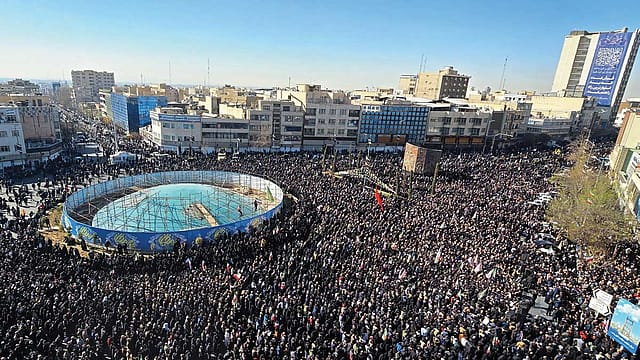
A decisive internal shift appears to be reshaping Iran’s power structure, with the Islamic Revolutionary Guard Corps (IRGC) tightening its grip over both military strategy and diplomatic engagement, raising fresh concerns over regional stability and stalled negotiations.
Who is really in charge in Tehran right now?
A dramatic consolidation of power within Iran suggests that the hardline Islamic Revolutionary Guard Corps (IRGC) has effectively taken command of both the country’s military apparatus and its diplomatic direction.
According to a report by The New York Post, IRGC Commander Maj. Gen. Ahmad Vahidi, backed by a close-knit inner circle, has emerged as a central authority figure in Tehran. This shift has been reinforced by recent developments, including maritime confrontations in the Strait of Hormuz and the abrupt decision to sidestep scheduled peace talks with the United States.
The Modi Years
02 Oct 2026 - Vol 05 | Issue 40
A Nation Rebuilt
How did moderates lose ground so quickly?
The transition appears to have sidelined relatively moderate voices within Iran’s establishment, particularly Foreign Affairs Minister Abbas Araghchi.
The Washington-based Institute for the Study of War (ISW) noted that Araghchi had tentatively agreed to reopen the vital Strait of Hormuz after discussions with the Trump administration. However, that move was overruled by the IRGC, which insisted the waterway remain shut in response to what it described as an American blockade of Iranian ports.
The shift underscores a broader marginalisation of officials who once played a key role in diplomatic engagement, leaving them with little influence over critical decisions.
What role does the Vahidi–Zolghadr alliance play?
The report highlights that Vahidi’s authority has been significantly strengthened by support from Mohammad Bagher Zolghadr, an IRGC veteran and current Secretary of the Supreme National Security Council.
This alliance has cemented control over the Strait of Hormuz, where Iran’s naval strategy has pivoted toward fast attack vessels following losses suffered by its conventional fleet in recent conflicts.
Their partnership also extends into diplomacy. Zolghadr was inserted into Iran’s negotiating team earlier this month specifically to ensure adherence to IRGC directives and the broader strategic vision of Supreme Leader Mojtaba Khamenei.
Why did tensions escalate in the Strait of Hormuz?
Over the weekend, tensions surged as Iran targeted at least three vessels attempting to pass through the Strait of Hormuz, leaving hundreds of ships stranded in the Persian Gulf.
The action reinforced the IRGC’s message: the critical oil transit route remains firmly under its control and subject to its blockade strategy.
This escalation not only heightens regional risk but also signals a willingness to leverage chokepoints as tools of geopolitical pressure.
What triggered the crackdown within the negotiating team?
Internal friction appears to have played a decisive role in reshaping Iran’s diplomatic posture.
According to the ISW, “Zolghadr sent a complaint to senior IRGC leaders, almost certainly including Vahidi, that Araghchi had surpassed his mandate during the negotiations by expressing flexibility regarding Iran's support for the Axis of Resistance.”
This complaint reportedly sparked swift action. The think tank added, “Zolghadr's anger caused senior leaders in Tehran, including former IRGC Intelligence Organization Chief and long-time member of Mojtaba's inner circle, Hossein Taeb, to call the negotiating delegation back to Tehran.”
The episode underscores how even limited diplomatic flexibility is now being curtailed by hardline oversight.
Who holds ultimate authority now?
The emerging power structure places Vahidi alongside Mojtaba Khamenei as key decision-makers.
According to the report, Khamenei has remained out of the public eye since sustaining injuries in airstrikes that killed his predecessor. In this vacuum, the IRGC’s influence has expanded further, effectively overshadowing civilian leadership.
Figures such as Araghchi and Parliament leader Mohammad Bagher Ghalibaf—despite their own anti-Western rhetoric—are now viewed as comparatively moderate and increasingly sidelined.
What does this mean for diplomacy with the West?
The ISW assessment paints a bleak picture for future negotiations.
It notes that Araghchi and Ghalibaf lack the “leverage or formal executive authority to shape decision-making,” making meaningful engagement with Western powers increasingly unlikely.
The New York Post report also challenges claims from Washington that Iran’s leadership had become more moderate following the loss of several high-ranking officials during recent conflicts.
What lies ahead for the region?
With no clear timeline for the resumption of talks and a fragile ceasefire hanging in the balance, uncertainty continues to cloud the region’s immediate future.
The coming days—especially ahead of the Tuesday deadline for the ceasefire—could prove critical in determining whether tensions de-escalate or spiral further.
For now, the consolidation of power within the IRGC signals a harder, more uncompromising phase in Iran’s military and diplomatic posture.
(With inputs from ANI)