India AI Impact Summit: PM Modi Strengthens Ties with Switzerland, Netherlands
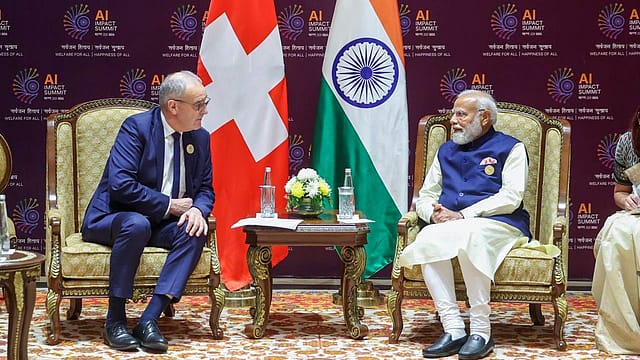
On the sidelines of the India AI Impact Summit 2026 in New Delhi, Prime Minister Narendra Modi held crucial bilateral meetings with Swiss President Guy Parmelin and Netherlands Prime Minister Dick Schoof. The engagements underscored India’s rising centrality in global artificial intelligence governance, innovation partnerships and digital-era trade diplomacy.
On Thursday, PM Modi met Guy Parmelin and Dick Schoof, both among the 20 global leaders invited to the summit. The meetings focused on AI governance, innovation, sustainability and strengthening bilateral economic ties.
India–Switzerland: Shared Vision on Responsible AI
President Parmelin voiced strong support for India’s human-centric approach to artificial intelligence.
In an exclusive interview with ANI, he said, “Switzerland very much welcomes and supports the focus of the AI Impact Summit which is well presented in the three Sutras: People, Progress, Planet: We fully agree that we need to develop and use AI in a way that everyone in the world can benefit from the potential that AI offers. This includes economic and societal progress for everyone. At the same time, we need to make sure that we respect our planet as the basis of all lives and that AI is developed and used in a sustainable way.”
The Modi Years
02 Oct 2026 - Vol 05 | Issue 40
A Nation Rebuilt
Highlighting India’s growing stature in AI, Parmelin added, “We admire how India has developed into a powerful player in AI research and innovation. Switzerland sees significant potential for deepening collaboration with India.”
He further noted, “I am delighted to see Swiss startups here at the summit bringing bold ideas, cutting-edge technologies, and a strong spirit of innovation to explore new opportunities for collaboration with Indian partners.”
On governance and responsible innovation, he emphasised shared values: “With respect to responsible innovation in AI, Switzerland and India share the common belief that we need to ensure that AI is used for the public good--supporting inclusive economic growth, social progress, sustainability, and solutions that benefit society at large. We attach great importance to close cooperation with India in the developments regarding the creation of international and multilateral agreements on the governance of AI.”
Looking ahead, Parmelin said the summit’s outcomes would shape future global discussions. “Switzerland thinks that the principles established at the AI Impact Summit here in Delhi provide good guidance for international collaboration: development of human capital; broadening access for social empowerment; trustworthiness of AI systems; energy efficiency of AI systems; use of AI in science; democratizing AI resources; and use of AI for economic growth and social good,” he explained.
“These should also feed into the global dialogue on AI, which the UN will organise this summer in Geneva. In addition, we will also build on the structures for voluntary cooperation established in Delhi to advance these principles,” he added.
He also highlighted Switzerland’s leadership in shaping international AI norms, describing the Council of Europe framework convention on AI as “the first international legally binding treaty on AI and offers not only a legal instrument, but a framework for global cooperation regarding democracy, human rights and the rule of law when it comes to AI.”
Encouraging India’s participation, Parmelin said, “While more and more countries from the global south, including Brazil, have joined the process, we would like to encourage India to consider joining this work, too. And of course, we look forward to working with India to shape the upcoming UN dialogue on AI.”
Trade and Economic Ties: India–EFTA Agreement
Beyond AI governance, Parmelin highlighted the recently concluded India-EFTA Trade and Economic Partnership Agreement (TEPA), pointing to expanded market access.
“India grants Switzerland significantly improved market access for around 95% of current Swiss exports (not including gold). Swiss watches and most categories of machinery already benefit from zero duty access, and a substantial share of chemical products is likewise treated favourably,” he said.
“Regarding services, Switzerland benefits from improved access for its financial sector, where India now allows higher foreign equity limits and clearer licensing procedures. The agreement also facilitates the temporary entry of installation and maintenance specialists, enabling Swiss firms to support their equipment locally,” he further noted.
India–Netherlands: AI Boom and ‘Middle Powers’
In his engagement with PM Modi, Dutch Prime Minister Dick Schoof highlighted India’s rapid AI growth and the importance of collaborative global leadership.
During his visit, Schoof attended sessions at Bharat Mandapam and participated in discussions on international cooperation to responsibly accelerate AI development.
In a post on X, he said, “AI is booming here in India. On this first day of my visit, I spoke with various experts about AI technology and policy and India's role in this area on the world stage. I also took part in a conference attended by representatives of government, the business sector, and civil society.”
He stressed the role of bridge-building nations, stating, “We discussed the importance of international cooperation among like-minded countries to responsibly accelerate the development of AI. Middle powers need to take the lead on this, serving as a bridge between the Global North and South. That is where our strength lies, also as the Netherlands.”
The Ministry of External Affairs welcomed his visit, saying, “Warm welcome to the Prime Minister Dick Schoof of the Netherlands. He was received by Minister of State Jitendra Singh on arrival in New Delhi. PM Schoof will attend the India-AI Impact Summit; his participation will further deepen and strengthen the India-Netherlands bilateral partnership.”
(With inputs from ANI)