IDF Strike In Beirut, Drone Intercepts In Saudi Arabia Mark Fresh West Asia Flashpoints
Tensions continued to escalate across West Asia on Tuesday, with multiple incidents reported in Iraq, Saudi Arabia and Lebanon, according to various media outlets.
An Iraqi armed group claimed responsibility for an attack on a hotel in Erbil that it alleged houses US troops, Al Jazeera reported.
In Saudi Arabia, the Saudi Defence Ministry said eight drones were intercepted and destroyed near the cities of Riyadh and Al-Kharj, according to Al Arabiya.
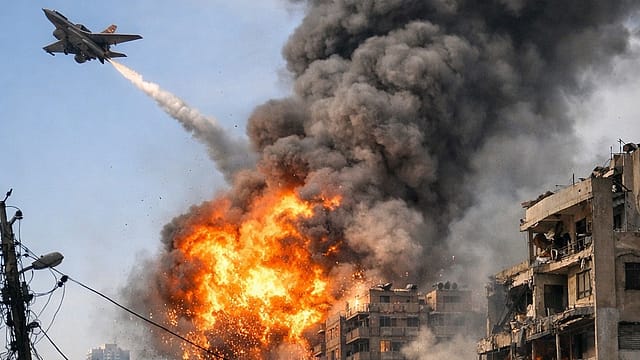
In Lebanon, IRNA News Agency reported that the Israeli regime attacked the headquarters of Al-Manar, a broadcaster affiliated with Hezbollah.
According to IRNA, Al-Manar resumed broadcasting its programmes minutes after the reported strike.
How Did the Israel Defence Forces Target Hezbollah’s Intelligence Chief in Beirut?
Earlier, Israel said that the head of Hezbollah's intelligence arm was killed in an overnight strike and Beirut said it would ban the terror group's military activities.
The Israel Defence Forces confirmed that the overnight strike in the Lebanese capital killed Hussein Makled, whom it called "the head of Hezbollah's intelligence headquarters."
The MissOil Strike
03 Apr 2026 - Vol 04 | Issue 65
The War on Energy Security
The developments come amid heightened hostilities in West Asia, with cross-border strikes and aerial interceptions raising concerns about further regional spillover.
Earlier, Israeli Prime Minister Benjamin Netanyahu on Monday backed the US-Israeli military action against Iran as part of Operation Epic Fury/Roaring Lion, saying it protects not only the US and Israel but also the world at large from "theological thuggery."
Why Did Seyed Abbas Araghchi Call the US Move a “War of Choice” on Behalf of Israel?
Meanwhile, Iranian Foreign Affairs Minister Seyed Abbas Araghchi accused the United States of entering a "war of choice" on behalf of Israel, following remarks by US Secretary of State Marco Rubio defending recent American military action against Iran and emphasising the made-up "threat" of Iran by the US.
In a post on X, Araghchi said on Tuesday, "Rubio admitted what we all knew: U.S. has entered a war of choice on behalf of Israel. There was never any so-called Iranian 'threat'."
He further stated, "Shedding of both American and Iranian blood is thus on Israel Firsters. The American people deserve better and should take back their country."
Araghchi's remarks came after Rubio said the US military operation against Iran was aimed at "eliminating" threats posed by Iran's short-range ballistic missiles and its naval capabilities, particularly concerning risks to global shipping routes.
Speaking to the press on Capitol Hill on Monday (local time), Rubio made it clear that the primary goal of the operation was to neutralise Iran's ballistic missile and naval threats.
What Did Marco Rubio Say About the Objective of the US Mission Against Iran?
"That is the clear objective of this mission," Rubio said and added that the focus was on preventing a potential threat to the US and its allies.
"Our mission and our focus is the destruction of their ballistic missile capabilities and their ability to manufacture them, as well as the threat posed by their Navy to global shipping," he said.
The Secretary of State also said that they knew Iran would retaliate to military action.
"The imminent threat was that we knew that if Iran was attacked,... they would immediately come after us, and we were not going to sit there and absorb a blow before we responded," Rubio explained.
Further speaking on preemptive action, Rubio said, "We knew that there was going to be an Israeli action. We knew that that would precipitate an attack against American forces, and we knew that if we didn't preemptively go after them before they launched those attacks, we would suffer higher casualties."
He added that a delay in responding would result in "much higher casualties."
Rubio also stated that allowing Iran to continue developing its short-range ballistic missiles was an "unacceptable risk" and insisted that the military operation had to take place while Tehran was at its "weakest point."
What Did Marco Rubio Say About US Targets and Civilian Infrastructure in Iran?
He reiterated the US stance on Iran, saying, "Our mission and our focus is the destruction of their ballistic missile capabilities and their ability to manufacture them, as well as the threat posed by their Navy to global shipping."
"The United States would not deliberately target a school. Our objectives are missiles, both the ability to manufacture them and the ability to launch them, and the one-way attractor. That would be our focus,” he said.
“We would have no interest in targeting civilian infrastructure. The Iranians are, on the other hand, targeting civilian infrastructure. They are deliberately targeting civilians because they are a terroristic regime. They sponsor terrorism, and they participate in terrorism," he added.
He also expressed support for a potential regime change in Iran. "We hope that the Iranian people can overthrow this government and establish a new future for that country."
However, he stressed that the immediate goal was to ensure that Iran no longer had the weapons that could threaten the US and its regional allies.
"We would love to see this regime be replaced... The objective of this mission is to make sure they don't have these weapons that can threaten us and our allies in the region," Rubio added.
(With inputs from ANI)