How France’s ‘Rioters Pay’ Bill Could Make Protesters Pay €10,000 for Damage They Didn’t Cause
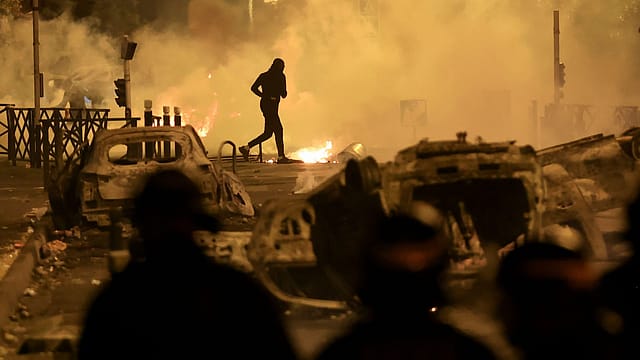
A shop window is smashed during a demonstration. Who should receive the repair bill?
The person who smashed it is the obvious answer. France’s proposed “Rioters Pay” legislation would, in specified circumstances, extend responsibility to other participants in the gathering.
The Senate approved the government bill by 229 votes to 105 overnight on October 27–28. It was transmitted to the National Assembly on October 28 and has not yet become law.
The controversy centres on a proposed form of shared civil liability capped at €10,000 per person.
That is different from a blanket fine imposed on everyone attending a protest. The dispute is about how far responsibility can extend beyond the individual who directly inflicted the damage.
WHAT WOULD SOMEONE HAVE TO DO TO BECOME LIABLE?
The Senate-adopted text establishes two routes.
Look Who's Talking Regime Change
23 Oct 2026 - Vol 05 | Issue 43
One concerns knowingly participating in a group formed to prepare violence or property damage, where offences occur within the relevant time and place.
The other concerns voluntarily continuing to participate in a gathering after police dispersal warnings, while knowing that members are committing violence, theft or property damage. This provision concerns damage arising from offences committed after those warnings in the relevant circumstances.
The proposed liability therefore requires more than simply having attended a demonstration.
But it would not necessarily require proof that the person personally smashed a window, set a fire or stole goods. That extension is the heart of the argument.
IS THE €10,000 A FINE OR COMPENSATION?
The central €10,000 provision is a cap on the new shared civil liability.
A criminal fine punishes an offence. Compensation addresses the loss suffered by a victim. Someone can face criminal proceedings and civil financial responsibility through different legal mechanisms.
“Shared liability” means the claimant need not necessarily divide the damage neatly between every person responsible. Multiple participants can be legally answerable for a loss, subject to the applicable rules and limits.
The bill does not mean that every qualifying participant automatically receives a €10,000 demand. Nor should the cap be described as a ceiling on every possible criminal penalty or existing damages claim.
The question would be what liability is established in the particular case.
WHY DOES THE GOVERNMENT WANT THIS CHANGE?
Its argument concerns victims and recovery.
France already provides for state responsibility for qualifying damage caused by gatherings. The government wants to improve its ability to recover money after compensating victims, including from people covered by the proposed shared-liability rules.
Identifying the exact person responsible for each damaged item can be difficult in a crowd.
Supporters argue that people knowingly participating in collective violence should not escape financial responsibility because investigators cannot identify whose particular action caused each loss.
The proposal originated after violence surrounding football celebrations and gained urgency following the unrest of October 17.
It is, therefore, broader than a measure aimed only at political demonstrations.
COULD WELFARE PAYMENTS REALLY BE SEIZED?
The proposal would open specified benefits to recovery claims, including family allowances and housing assistance. It also addresses recovery involving parents’ benefits where children incur relevant liability.
Amnesty International says the measures could also reach minimum-income support and reduce money available for essential household needs.
That creates a second controversy: even when a debt is legally established, which resources should remain protected?
Supporters want compensation orders to be enforceable against people with limited assets. Critics argue that taking subsistence payments can impose hardship on other household members, including children.
An order to pay and a practical ability to collect are different problems. The bill seeks to address both.
WHY DO RIGHTS GROUPS OBJECT?
Their concern is the financial risk attached to remaining in a gathering when other people become violent.
Amnesty argues that people could be held responsible for acts they did not personally commit, discouraging peaceful participation. It says liability must rest on evidence of individual culpability.
Consider a peaceful participant who encounters violence elsewhere in a crowded demonstration. Establishing what that person knew, whether warnings were heard and whether departure was possible could become decisive.
Supporters say the knowledge and participation requirements distinguish such a person from someone knowingly staying with a violent gathering.
The Senate text also exempts people remaining for a legitimate reason under the second route. Public Sénat reports that the debate identified independent observers and volunteer medics among the intended examples.
How those protections would operate matters as much as the headline amount.
DO OTHER COUNTRIES MAKE RIOTERS PAY?
Yes, although their approaches differ.
In England and Wales, the Riot Compensation Act 2016 allows eligible victims of riot-related property losses to seek compensation from the local police claims authority when insurance does not adequately cover the loss. Government guidance requires evidence connecting the loss to a qualifying riot.
Separately, criminal courts can order convicted offenders to compensate victims.
This illustrates two distinct tasks: getting money to victims and recovering money from responsible individuals. A system can provide the first without waiting for every offender to be identified.
WHAT HAPPENED AFTER CANADA’S VANCOUVER RIOT?
Following the 2011 Stanley Cup riot, British Columbia’s public motor insurer pursued civil claims against people involved in damage to insured vehicles.
A 2016 judgment found several defendants jointly liable. But the judge rejected the proposition that participation in the riot as a whole automatically made someone responsible for every damaged vehicle.
Reporting on the judgment describes a requirement for substantial assistance or a common design connecting defendants to the destruction. People acting together to overturn or destroy a vehicle could share liability.
The comparison is revealing: shared responsibility exists elsewhere, but courts still have to define the connection between the person’s conduct and the loss.
IS THERE AN INDIAN PARALLEL?
Uttar Pradesh’s Recovery of Damages to Public and Private Property Act, 2020, creates claims tribunals to assess compensation for property damage associated with riots, protests, public commotion and similar events.
That provides an Indian example of a dedicated recovery mechanism.
It should not be treated as identical to France’s proposal. The procedures, liability tests and enforcement provisions require separate examination.
Across systems, the important questions recur: who assesses the damage, what evidence links a respondent to it, and what opportunity exists to contest the demand?
WHAT HAPPENS NEXT IN FRANCE?
The National Assembly must consider the bill. The text can still change as the legislative process continues. Senate approval alone does not activate its provisions.
The eventual design must answer a difficult practical question: can victims receive effective compensation while peaceful participants remain protected from liability for someone else’s violence?
“Rioters pay” is an uncomplicated slogan. Establishing who counts as legally responsible is the harder work.