Greenland Negotiations Advance as Donald Trump Softens Stance on Europe
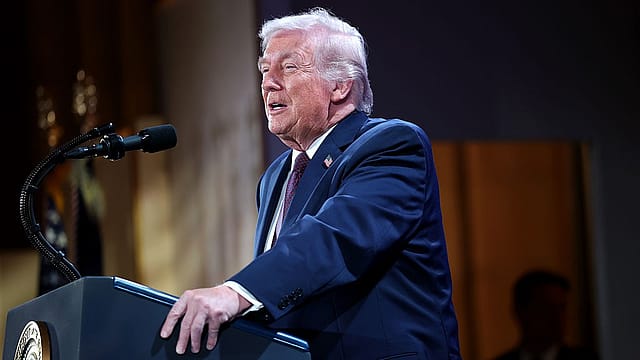
US President Donald Trump has claimed that negotiations over Greenland are already underway and close to agreement, calling the talks a “very important deal” for American national security—while noticeably softening his earlier confrontational stance toward Europe.
Speaking aboard Air Force One, Trump said discussions over the Arctic island had moved forward rapidly. “We have started a negotiation, and I think it’s pretty well agreed to,” he said, adding that Greenland “wants us to do it” and that the outcome would be beneficial to all sides.
Trump did not clarify whether he had recently spoken with key European leaders, including French President Emmanuel Macron or UK Prime Minister Keir Starmer, but his remarks come after weeks of diplomatic turbulence triggered by his earlier threats to impose tariffs on European countries unless Denmark agreed to cede control of the self-governing territory.

Zeroing In on ECI
09 Oct 2026 - Vol 05 | Issue 41
Constitutional legitimacy versus political opportunism
From brinkmanship to backchannel talks
According to Politico, initial talks involving Denmark, Greenland, and the United States have resumed in a more constructive tone. Danish Foreign Minister Lars Løkke Rasmussen said early discussions had “gone well,” even though the dispute remains unresolved.
Rasmussen and Greenland’s Foreign Minister Vivian Motzfeldt met US Vice President JD Vance and Secretary of State Marco Rubio in Washington on January 14, where the sides agreed to establish a working group focused on Greenland’s future and Arctic security, a region of growing strategic competition.
Those talks followed what Rasmussen described as a “huge derailment,” after Trump threatened punitive tariffs to pressure European governments. That threat was later walked back, with Trump citing a “framework” agreement reached with NATO Secretary-General Mark Rutte, though details remain undisclosed.
“Things escalated, but now we are back on track,” Rasmussen said at the EU Foreign Affairs Council in Brussels, adding that the first meeting of the working group had taken place in a “constructive atmosphere.”
Europe draws a line
Trump’s earlier rhetoric unsettled European capitals and briefly strained transatlantic ties, prompting calls within the EU for stronger unity and greater strategic autonomy. France and Germany even urged the bloc to consider deploying its Anti-Coercion Instrument before Washington stepped back from the tariff threat.
Rasmussen credited European solidarity for Trump’s reversal. “It has become clear that the price for going down that path has been too high,” he said.
At the World Economic Forum in Davos on January 21, Trump further softened his tone, saying the US would not use military force to acquire Greenland and confirming that the proposed 10% tariffs on European allies had been scrapped.
Instead, Trump said Washington was pursuing a negotiated framework covering mineral access and security rights—signalling a shift from coercion to leverage as the Arctic’s strategic importance continues to rise.
(With inputs from ANI)