18.9 Million Voters Decide Nepal’s Future in Post Protest General Election
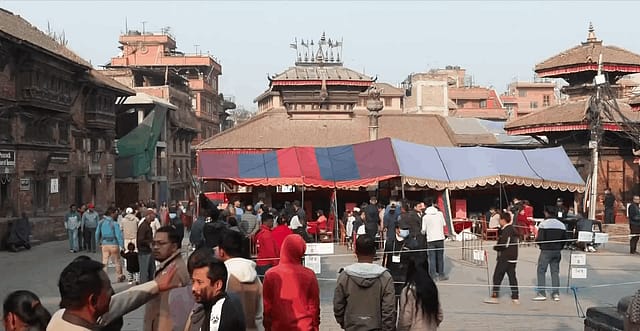
Voting in Nepal’s 2026 general election officially commenced on Thursday morning, with citizens across the country heading to polling stations to elect a new government in a high stakes contest shaped by months of political turbulence.
At the Annapurna Vinayak School centre in Kathmandu, early visuals showed orderly lines of voters, reflecting a strong sense of civic duty as security personnel ensured a smooth process in the capital.
Speaking to ANI, one voter expressed hope for the nation’s future and the impact of the newly elected leadership.
The snap polls were necessitated by the historic "Gen Z movement" in September, which resulted in the removal of the KP Sharma Oli led coalition and the subsequent dissolution of the House of Representatives, according to The Kathmandu Post.
How Did Sushila Karki’s Tenure Lead Nepal to the March 5 Mandate?
Nepal’s interim leader Sushila Karki called for peaceful elections on Thursday.
“Every vote is important in determining our future,” the 73-year old former Chief Justice, who came out of retirement to lead the South Asian nation, said in a statement.

The Liberation of Bengal
05 Jun 2026 - Vol 04 | Issue 74
A silent revolution ends the reign of fear
“Thank you for your patience and understanding, for ensuring a peaceful election,” she added.
Karki’s tenure as executive head began on September 12 with the recommendation to President Ramchandra Paudel to dissolve the lower house, leading to the March 5 mandate.
The Election Commission, receiving significant support from the Sushila Karki administration, confirmed that all arrangements have been finalised to transition the country back to an elected government after a six month interim period.
Acting chief election commissioner Ram Prasad Bhandari stated, "All the arrangements for free, fair, transparent and peaceful elections are in place."
He further "urged everyone to exercise their franchise without fear" during the 10 hour voting window, which remains open from 7 am until 5 pm.
How Many Voters and Candidates Are Competing in Nepal’s 2026 General Election?
According to The Kathmandu Post, 18,903,689 registered voters will decide the future of 6,541 candidates competing for 275 seats in the House of Representatives.
The electorate represents an increase of 915,119 voters since 2022, with 52 per cent belonging to the 18 to 40 youth demographic.
Of the total candidates, 3,406 are vying for seats under the first past the post FPTP system, while the remainder are contesting through proportional representation.
Within the FPTP system, 65 parties have fielded 2,263 candidates for 165 seats, alongside 1,143 independent contenders.
Gender demographics in the direct elections remain heavily skewed, featuring 3,017 male and 388 female candidates, with a single individual representing the sexual and gender minority community.
What Does the Age Profile of Candidates Reveal About Nepal’s 2026 General Election?
The candidate pool is predominantly older, with 1,925 aged between 41 and 60, while only 201 candidates are aged 30 or younger.
For the 110 proportional seats, 63 parties have submitted a list of 3,135 candidates, split equally between 1,772 males and 1,772 females.
To gain national party status and qualify for these seats, a party must secure at least three per cent of the proportional vote and win at least one FPTP seat.
A total of 341,113 security personnel have been mobilised across 10,963 polling stations, including 149,000 temporary "election police," to ensure a peaceful process.
A Security Council meeting chaired by Prime Minister Karki on Wednesday concluded that the current environment would likely make this election more transparent than previous cycles.
"No force can disrupt the election," Bhandari asserted, expressing confidence that high engagement from young voters would boost turnout and reduce the frequency of invalid ballots.
Historically, voter participation has averaged 69.4 per cent since 2006, though it fell to 61.4 per cent in 2022.
When Will Results of Nepal’s First Past the Post (FPTP) Vote Be Announced?
Officials expect to "publish the results of the first past the post vote within 24 hours after vote counting begins."
To expedite counting in difficult terrain, authorities plan to use helicopters to retrieve ballot boxes from hilly regions.
Large scale voter movement was reported ahead of polling day. Around 800,000 people had already left the Kathmandu Valley by Wednesday morning, according to the Metropolitan Traffic Police Division.
“More people are expected to head back to their home districts for the elections,” said Sunil Jung Shah, deputy superintendent of police. “Seeing so many people return home with their families feels like a major festival.”
Officials said such a large scale movement usually takes place only during Dashain, Nepal’s biggest festival, when more than a million people leave the Valley.
The Election Commission of Nepal suspended the movement of all public and private vehicles from midnight on March 4 until the end of voting on March 5 as part of security measures for the parliamentary elections, according to The Kathmandu Post.
Narayan Prasad Bhattarai, spokesperson for the Commission, said the decision was taken by the high level election security committee formed under Section 3 of the Election Security Management Directive, 2021, to ensure smooth and secure polling.
How Did Balen Shah’s Rise Reshape Nepal’s Political Landscape Ahead of the General Election?
The political landscape has also been shaped by the rapid rise of Balen Shah. From rap battles to city hall and now the national stage, Shah’s ascent has challenged the dominance of traditional party heavyweights.
In 2022, Shah pulled off one of the biggest political upsets in Nepal’s recent history. Running as an independent candidate, the structural engineer turned rapper defeated nominees from the Nepali Congress and the Communist Party of Nepal Unified Marxist Leninist to become the mayor of Kathmandu.
With 61,767 votes, he outperformed established party leaders, signalling a broader generational shift in voter sentiment across the country.
(With inputs from ANI)