How Saudi Arabia’s Air Defence Stops Drones and Missiles
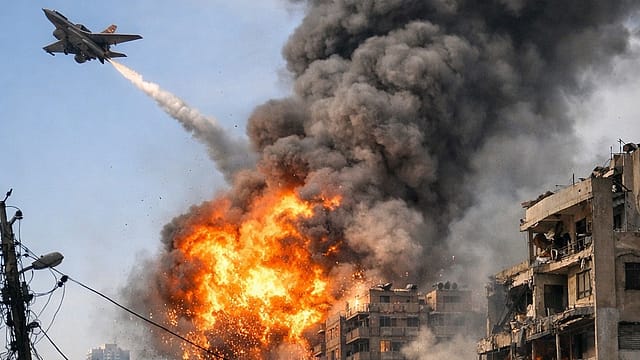
As the Iran-Israel conflict expands across West Asia, the Saudi air defence has become a frontline buffer against spillover attacks and proxy escalation. The US embassy strike, involving low-flying drones that penetrated outer defensive layers, has intensified debate over system effectiveness.
Here’s a closer look at how it works and where it faces pressure.
What Shapes Saudi Air Defence Strategy?
Saudi air defence is structured as a multi‑layered integrated air defence system (IADS) that links Patriot batteries, THAAD sites, command‑and‑control nodes, and early‑warning radars into a single network. This architecture allows far‑off radar tracks to cue short‑range systems like Pantsir‑S1, improving overall coverage and reaction time.

Freedom Issue 2026
14 Aug 2026 - Vol 05 | Issue 33
Shashi Tharoor on being radical liberal | Ram Madhav on how Gandhi used his Hinduism | TCA Raghavan on a diplomat's travels in history | Sumana Roy on the novel beyond the Booker | Carlo Pizzati on the dissolution of Borders
How Did the US Embassy Strike Reveal Its Weaknesses?
The US embassy strike demonstrated the difficulty of detecting small, low-altitude drones. While most incoming threats were neutralised, some breached initial layers before interception. The incident highlighted radar limitations against swarm tactics and terrain-hugging UAVs. It reinforced concerns about response time and layered coordination.
What Roles Do Patriot and THAAD Play?
Patriot systems form the backbone of Saudi air defence against medium‑range threats, using track‑while‑scan radar and PAC‑3 MSE interceptors that collide with incoming missiles in mid‑course flight. THAAD adds high‑altitude coverage, firing its PAC‑3 missile from the Terminal High Altitude Area Defense system to destroy short‑ to medium‑range ballistic missiles outside the atmosphere.
Why Is Short-Range Defence Increasingly Critical?
Short‑range systems such as the Pantsir‑S1M combine surface‑to‑air missiles with 30‑mm anti‑aircraft guns, making them highly effective against low‑altitude drones and cruise missiles near critical infrastructure.
These platforms are often integrated into the broader IADS, acting as “last‑ditch” defences when long‑range radars cannot reliably track small, slow‑flying UAVs.
How Has Saudi Air Defence Evolved Since 2019?
Since 2019, the kingdom has expanded the number of THAAD sites and Patriot batteries, with four of seven planned THAAD sites expected to be operational by the end of 2026 and all completed by 2028. Saudi Arabia has also started integrating South Korea’s KM‑SAM Block II medium‑range systems, diversifying sources beyond the US and deepening regional interoperability.
How Does Saudi Arabia Counter Houthi Drone Campaigns?
Saudi air defence has intercepted hundreds of projectiles attributed to Houthi forces. Engagement protocols now prioritise tiered response to conserve munitions. Short-range systems handle drones, while Patriots address missile barrages. Despite high interception claims, occasional penetrations persist. The pattern underscores the endurance nature of asymmetric aerial campaigns.
What Structural Gaps Still Remain
Low-signature drones can evade traditional radar detection. Swarm attacks risk overwhelming interceptor capacity. Sustained engagements may strain stockpiles of expensive missiles. Cyber vulnerabilities within integrated networks also remain a concern. Cost asymmetry continues to favour attackers deploying inexpensive UAV technology.
What Is the Future of Saudi Air Defence?
Saudi Arabia is expected to expand layered capabilities and explore directed-energy weapons. Future plans also include AI‑assisted tracking and laser or microwave‑based counter‑drone systems, which can engage multiple drones at low cost per shot, helping offset the expense of traditional interceptors.
Collaborative combat aircraft and unmanned sensors may also feed real‑time data into the air defence network, enabling more autonomous targeting of drones and missiles.
How Does Saudi Air Defence Compare Regionally?
Saudi air defence stands among the most layered in the Gulf, combining US-supplied interceptors with supplementary systems for point defence. The UAE and Israel operate more integrated multi-domain networks, particularly in drone detection and interception.
The recent US embassy strike highlights that regional air defence effectiveness increasingly depends on integration speed rather than inventory size.
(With inputs from yMedia)