Elon Musk Compares Jensen Huang to Michael Jordan, Says Nvidia Was Wrong to Oust Its CEO
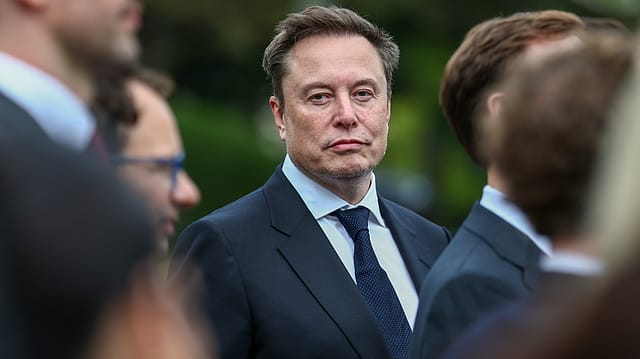
Elon Musk reached for the Chicago Bulls to explain why he thinks Nvidia made a mistake in forcing out Jensen Huang. Imagine Michael Jordan at his peak, Musk told the New York Times DealBook Summit. His team is winning, with more victories in prospect, and the Bulls decide this is the moment to drop him. “Doesn’t seem like a smart decision to me,” Musk said.
The SpaceX chief executive readily acknowledged that Huang was an old friend. But the case he made for Nvidia’s former boss rested on what a successor would have to do on the first day: command the confidence of engineers, manage a complex supply chain and deal with suppliers who had known the previous chief personally for decades. “There’s no one that can really replace Jensen,” Musk said. “He does the roles of several people.”

The Wealth Issue 2026
06 Nov 2026 - Vol 05 | Issue 45
Portraits of Dreamers and Doers under 35
MUSK’S CASE FOR HUANG STARTS WITH HIS SUPPLIERS
One detail from Musk’s account captured the difficulty he sees for Nvidia. He described Huang eating street food with key suppliers in South Korea and Taiwan. Those relationships had taken decades to build, Musk said, and the executive who cultivated them also understood the technology well enough to lead the people developing it.
Musk believes that personal connection extended to Nvidia’s own staff. Some employees, he said, had received better offers elsewhere and turned them down out of loyalty to Huang. His argument raises a question for the board as it interviews candidates: how much of what looks like loyalty to Nvidia is loyalty to the man who ran it? Musk did not name the employees or suggest that any had decided to leave.
WOULD MUSK HIRE JENSEN HUANG?
“Well, of course. But who wouldn’t?” Musk replied when asked whether he would hire Huang. He ranked his friend among the most talented entrepreneurs ever to run a company, although he made clear that the exchange was hypothetical. “Jensen’s not looking for a job, obviously,” he said.
Musk said he thought Huang was still absorbing the shock of his departure. For his friend’s predicament, he reached for a literary comparison: a George R.R. Martin story in which a central character disappears just as the audience has become invested in him.
NVIDIA’S BOARD HAS RULED OUT A RETURN
Nvidia’s newly appointed board chairman, Harvey Jones, has ruled out reinstating Huang and announced a search for a permanent successor. He also announced a new committee to strengthen oversight of national security policy and compliance with export controls.
Huang has agreed to testify before three US House committees on December 1. The hearing concerns his reported relationship with Alice Huang, a former executive at Megaspeed, and allegations that she acted as a Chinese spy. The espionage allegation has not been established as fact.
House Democratic leader Hakeem Jeffries opposed a move to bring Jensen Huang back, citing the potential risk of American technology being diverted to the Chinese Communist Party. Jeffries spoke of a risk; he did not say such a transfer had taken place. That is the question Musk’s basketball analogy leaves unanswered. His defence explains why Nvidia may struggle to replace Huang. It offers little guidance on how the board should handle the security concerns now before Congress.
With inputs from ANI