Winning the ‘Soft War’: How Iran Used Antisemitism to Divide America
Before we stopped noticing, the missiles of 2026 had owned the headlines. Now, a new report from the Simon Wiesenthal Center, The War for Western Minds, concerns the contest that did not make the headlines at all. While American and Israeli strikes broke Iran’s navy and bruised its rocket stocks, the report argues, a 30-year campaign to set Americans against one another and against their own state went almost unnoticed, certainly untouched. The name of the weapon is antisemitism, which the authors of the report call “not a sentiment, but a method”, at least as far as the regime in Tehran is concerned.
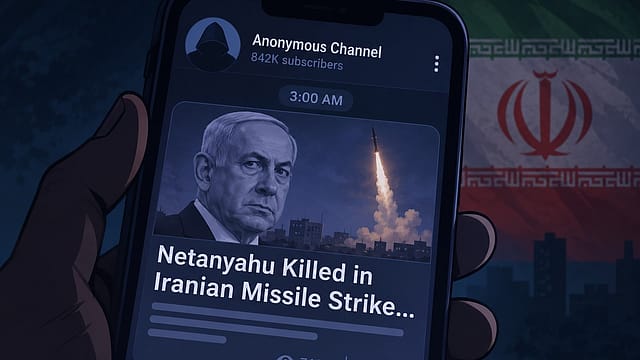
The report opens in Tehran, on a March night. An anonymous Telegram channel with 340,000 subscribers announces that Benjamin Netanyahu has died of his wounds from an Iranian missile. It is false, of course. An American influencer with millions of followers relays it within the hour; by morning millions have seen it; the eventual correction reaches only a sliver of them. The lesson: “a story does not need to be true to be effective.” No law was broken. The channel is still online.

The Wealth Issue 2026
06 Nov 2026 - Vol 05 | Issue 45
Portraits of Dreamers and Doers under 35
But why choose hate?
The answer is not theological but strategic. A state that cannot out-fight the US has long preferred to out-think it: what Tehran calls jang-e narm, or soft war. But America is a hard audience. Its far-right, far-left, black nationalists and evangelicals inhabit separate information worlds. Yet one story crosses all of them. The right hears of Jewish global control, the left of Zionist imperialism, black nationalists of racial grievance, Christian nationalists of prophecy. Different costume, same villain.

Antisemitism, the report says, is “the mechanism that renders those operations effective”. Iran invented neither the prejudice nor the technique, which the report traces to Soviet tradecraft; Tehran merely found America’s fault lines and leaned on them. The Russian ideologue Aleksandr Dugin supplied a vocabulary and a slogan, “beyond left and right, but against the center” (the Fourth Political Theory), that let hostility to Jews pass for geopolitics. Hence the report’s thesis: for Tehran, antisemitism is a security doctrine.
It didn’t begin online though. The report starts in 1996, when Louis Farrakhan’s (Nation of Islam) visit showed Iranian leaders a constituency inside American extremism. A 2006 Holocaust-denial conference, with David Duke (Knights of the Ku Klux Klan) among the guests, was, it says, “a proof of concept”. Then comes Nader Talebzadeh, a filmmaker later eulogised as “General Soft War”. Through the Hollywoodism conferences of 2011-13 and the New Horizon gatherings that followed, he seated Holocaust deniers, 9/11 truthers, Nation of Islam delegates and antiwar activists at the same table. In 2019 the US Treasury designated his organisation as a platform for Revolutionary Guard (IRGC) recruitment and intelligence-gathering. The marriage of far-left and far-right, the report insists, was arranged, not spontaneous. It calls the circuit “a radicalization pipeline with a graduation ceremony”.
The case study is the “Deadly Exchange” claim, that Israel and American Jews bear responsibility for police brutality against black Americans. In 2015 Talebzadeh announced that Iran had invited some 30 anti-Israel African Americans, because Tehran was “not very innovative” at soft war. The report calls the claim false, and says it took a genuine grievance and pointed it at Jews. A US activist campaign later gave it a name and progressive respectability. And the authors note that such groups may not even know where the idea was nurtured. (After January’s shooting in Minnesota involving an ICE agent, it resurfaced unprompted, recast around immigration enforcement.)
The internet came thereafter. The report blames American platforms: algorithms that reward outrage, moderation that arrives late, and Section 230 immunity. “A platform algorithm does not distinguish between organic outrage and engineered outrage.” The same Iranian agencies, it adds, run hackers and propagandists alike. Three IRGC members were indicted over the 2024 hack-and-leak against Donald Trump’s campaign. Counterfeit news sites, one aimed at liberals and one at conservatives, borrowed credibility from real outlets. Synthetic Israeli personas flooded feeds. One study found IRGC-linked media cited some 78,000 times on Wikipedia. After mapping more than 340 influencers and outlets, the authors find no chain of command but “ideological arbitrage”: one Gaza casualty report becomes proof of Zionist imperialism on the left and of Israel dragging America into war on the right.
Indeed, nobody in Tehran needs to telephone anybody.
US Intel Indicates Iran Is Drawing Up Plans for ‘Dirty Bomb’ Attack in Washington: Report
The report sees entry points on both flanks. On the left, antiwar groups whose slogan is peace can, it argues, carry state (Iranian) messaging without realising. On the right, October 7 triggered a turn to apocalypse: Dugin declared that end-times were all that mattered, and red heifers, a burning effigy of Baal and the Epstein files were recast as evidence of a demonic Jewish cabal for Christian audiences. Its marker is the Catholic antisemite E Michael Jones, a Tehran conference guest a decade earlier and, in July 2025, a guest on Candace Owens’ programme. Notions such as “Pax Judaica” now drift through mainstream conservative shows.
So, let’s picture this: a Republican coalition quarrelling over Israel is, for Tehran, a huge prize. And the operation, in the report’s words, “no longer requires operation”.
Fairness requires matching the report’s own care. It doesn’t say every named person is an agent; it describes a spectrum from handlers to the unwitting. It doesn’t call criticism of Israel, or of US policy, suspect. The line it draws is between opinion and “coordinated, deceptive, state-directed” machinery. The Simon Wiesenthal Center has a stake, but its sourcing is largely public records: designations, indictments, court filings.
The remedy, the report says, must be as structural as the threat. Sanctions, seizures and bans have removed nodes but the network is too redundant to even notice. Therefore, Congress should carve a narrow exception to Section 230 for content attributable to designated foreign adversaries, without repealing it. Platforms should disclose coordinated operations, label AI content, and share intelligence. Washington should also fund AI counter-influence as fast as its adversaries fund the offensive kind, and enforce the Foreign Agents Registration Act (FARA) and sanctions law, for transparency rather than punishment.
Then there is one more thing. The news media should heed the “72-hour window”—a polished narrative within two hours of breaking news signals preparation. Civil society should teach people the tricks before they encounter them. The real battlefield, the report says, “is the American mind”. And that extends to the Western mind. It is fertile ground where antisemitism with or without Iranian machinations has begun making itself mainstream again.
“Understanding the machine is the beginning of defeating it.” A ceasefire can silence the guns but it has no jurisdiction over a story. If only the regime in Tehran used its resourcefulness to do some good in the world!