The Rise and Fall of Jensen Huang
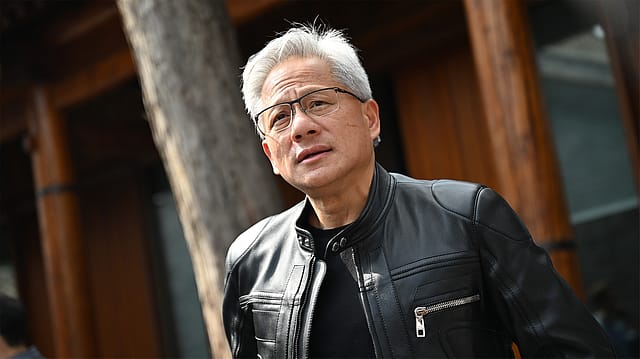
In July, Sotheby’s put a black Tom Ford leather jacket up for auction in New York. The estimate was $40,000 to $60,000. The jacket had been signed by Jensen Huang and matched to photographs of him onstage at a Foxconn event in Taipei in October 2023. It sold for $960,000 at the charity auction. Huang had given some of the credit for the look to his wife, Lori, and their daughter, Madison. They helped dress him for the stages on which he would make Nvidia’s next bet sound obvious.
Four months after the auction, on November 12, Nvidia announced that Huang had resigned as chief executive, president and a director, effective immediately. He was 63 and had led the company since its founding in 1993. A finance chief who had spent more than a decade working alongside him, Colette Kress, would run it while the board searched for a successor.

The Wealth Issue 2026
06 Nov 2026 - Vol 05 | Issue 45
Portraits of Dreamers and Doers under 35
The boy who cleaned the bathrooms
Huang was born in Taiwan in 1963. His father took a job helping start an oil refinery in Thailand when Jensen was five, and the family moved there. At nine, Huang was sent to the United States with his older brother. The boys ended up at Oneida Baptist Institute in eastern Kentucky. The institute was a high school then, so they lived in its dormitory and crossed a swinging bridge over the South Fork of the Kentucky River to attend the local elementary school.
Huang remembers his brother working on a tobacco farm. His own assignment was to clean the boys’ bathrooms after school. He told Stanford years later that he had wanted the farm job. In August 2019, the school dedicated a new building with a girls’ dormitory and classrooms. Huang and Lori had provided a $2 million matching grant. The building carries his name.
He took a job washing dishes at Denny’s and worked his way up to waiting tables. At Oregon State University, he met Lori Mills in an electrical engineering lab. In an interview with Condoleezza Rice, Huang recalled the line he used on her. “I asked her if she wanted to see my homework.” They married in 1985. Huang went on to work at chipmakers AMD and LSI Logic and earned a master’s in electrical engineering at Stanford while working full-time. Years later, he and Lori gave $50 million to help set up a research centre at Oregon State.
A diner booth and six months to live
In the early 1990s, Huang and two engineers from Sun Microsystems, Chris Malachowsky and Curtis Priem, talked through their idea for a graphics company at a Denny’s in San Jose. They founded Nvidia in April 1993, betting that people would want better 3D graphics on their computers. Games were an early reason to pay for them.
One of Huang’s clearest accounts of how close Nvidia came to failing is a story he told graduates at National Taiwan University in 2023. Nvidia was developing graphics hardware for Sega. Huang concluded that the company had taken the wrong technical approach and needed to drop the work. He told Sega to find another partner. Then he asked it to pay Nvidia in full anyway. Sega agreed. In Huang’s telling, that bought Nvidia another six months.
The company went on to make graphics processors that let computers handle many calculations at once, useful for drawing complex scenes in video games. Nvidia’s CUDA software made it easier for researchers to use those processors for other kinds of work. In 2012, a team including Alex Krizhevsky, Ilya Sutskever and Geoffrey Hinton used two Nvidia graphics cards to train AlexNet, a system that learned to recognise objects in images. In 2016, Huang personally delivered Nvidia’s first DGX-1 AI computer to OpenAI. By the financial year that ended in January 2026, Nvidia was making $215.9 billion in annual revenue.
The boss who skipped one-to-ones
In a 2024 interview with Stripe co-founder Patrick Collison, Huang said 60 people reported directly to him. He preferred to address executives together. He argued that people could make better decisions if they heard the same information at the same time. “I don’t do one-on-ones,” he said. A conversation about the company’s priorities could put dozens of senior executives in the same room with its founder.
Huang had become a salesman for what whole countries could do with those chips. Onstage with Mukesh Ambani in Mumbai in October 2024, he urged India to build its own computing infrastructure. “You should not export data to import intelligence,” he said. In May 2026, he joined US President Donald Trump’s trip to China as Nvidia was trying to retain access to a market where US export restrictions limited what it could sell. He was by then talking about chip policy with people who had the power to change it.
The week he left Nvidia
On November 8, Huang told employees he had been unfaithful to his wife and apologised to his family. Nvidia’s board opened an independent inquiry after reports that he had been targeted by a foreign intelligence effort. The New York Times reported that US officials regarded Alice Huang, a former executive at Nvidia customer Megaspeed, as a Chinese intelligence asset. Beijing rejected the spying allegation. Nvidia’s board said when it opened the inquiry that it had no reason to believe US national security or company secrets had been compromised.
The Times subsequently reported that Huang had also had a relationship with an Nvidia executive who reported to him. It cited five people who had worked at the company. Nvidia declined to comment to the Times. Reuters reported that the board met on November 11 to consider removing Huang. Nvidia announced his resignation the next morning. Its statement gave no findings from the independent inquiry.
Huang still owns about 3.6% of Nvidia. The board has begun looking for a permanent successor. On November 17, Nvidia will report earnings for the first time under a chief executive who had no part in starting the company.