A Billion Users Later, Is India's Telecom Challenge Still the Village?
In Swades, Shah Rukh Khan's character Mohan Bhargava arrives in a village carrying the tools of a modern life: a mobile phone, a laptop and a job at NASA. But in Charanpur, his phone struggles to find a signal. The village has more immediate problems, including unreliable electricity and a school fighting to stay open. Mohan eventually helps the villagers build a small hydroelectric system. The film offers a reminder that technology means little without the infrastructure to support it.
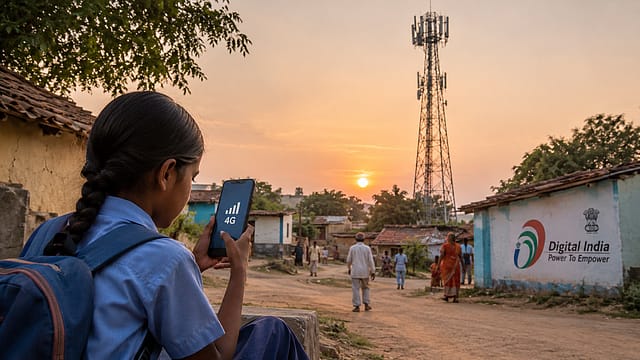
Two decades later, the infrastructure challenge has taken a different form. India is extending mobile connectivity to villages that had remained outside the 4G network. The number of villages without 4G coverage has fallen from 45,180 in 2022 to 11,372 in 2026, a reduction of nearly 75%, according to the Department of Telecommunications (DoT). The achievement is considerable. Yet the more difficult question begins after the signal arrives: what will people do with it, and can the business of providing it be sustained?
The economics of the last tower
The government's 4G Saturation Project was designed to bring connectivity to 24,680 previously unconnected villages. By November 2026, BSNL had commissioned 18,291 sites under the programme. In October, these sites recorded more than 1.86 crore GB of data consumption and served a maximum of 10.21 lakh active users in a day. The DoT put average monthly consumption at 18.3 GB per user, with each site serving around 56 active users on average.
That last figure deserves attention. A mobile site is not simply a tower planted in the ground. It requires equipment, power, backhaul and continuing maintenance. In a city, the investment can serve thousands of customers in a concentrated area. In a remote settlement, the same infrastructure may serve a few dozen active users spread across difficult terrain. The social case for extending coverage is evident; the commercial calculation is considerably harder.
The government has sanctioned another 26,000 mobile network sites to address the remaining gaps. The DoT has identified difficult terrain, high infrastructure costs, scattered settlements and remote tribal habitations among the obstacles. These are not merely engineering challenges. They affect the cost of serving each customer, the time taken to recover an investment and the amount of data that a network can realistically expect to carry. In some locations, public funding may be the only way to make the economics work.
A billion users, but a revenue puzzle
This is a striking problem for a country that has become one of the world's largest markets for mobile internet. According to the Telecom Regulatory Authority of India (TRAI), India had 1.09 billion internet subscribers at the end of March 2026. Wireless data subscribers alone stood at 1.03 billion. Average monthly wireless data consumption had risen to 25.51 GB per subscriber in FY26, from 21.53 GB in the previous financial year. Total wireless data usage grew 24.74% to 2,85,376 petabytes.
The international comparison, however, shows why the coverage story is not over. The International Telecommunication Union's 2025 estimates put rural internet use in India at 64.9%, against 79.9% in urban areas. Globally, the corresponding figures were 58% and 85%. India is ahead of the global average in rural internet use, but its own urban-rural gap remains substantial. The country has made mobile data affordable and expanded access at extraordinary scale. It has not yet ensured that people everywhere can participate in the digital economy on equal terms.
For telecom operators, this creates a peculiar business equation. More people are using more data, but the revenue earned from each gigabyte is falling. TRAI's annual performance indicators show that average revenue realisation per GB declined 10.59%, from ₹8.97 in FY25 to ₹8.02 in FY26. While total wireless data consumption grew nearly 25%, revenue from wireless data usage rose by a more modest 11.53%, to ₹2.39 lakh crore.
There is an important qualification: the decline in revenue per GB does not mean that operators are necessarily earning less from each customer. Average monthly revenue per wireless user actually rose 3.59%, from ₹174.46 to ₹180.73 in FY26. But the gap between the growth in data consumption and the growth in data revenue illustrates the challenge of monetisation. The industry has succeeded in getting Indians online and encouraging them to consume more. Getting a proportionately higher return from that consumption is another matter.
The next phase of growth, therefore, cannot be measured only by the number of connections added. It will depend on how frequently people use the network, what services they access and whether those activities generate enough value to justify the cost of extending coverage. A resident watching videos on a mobile phone is part of the data market. A small business using the same connection to sell beyond its local market, a student attending online classes or a farmer accessing digital services represents a deeper form of economic participation. The distinction matters when the network has to pay for itself.
Jio's valuation meets the cost of connectivity
The market's valuation of this digital opportunity was on display in October, when Jio Platforms made its stock market debut. Its ₹30,213-crore public issue became India's largest IPO. On its first day of trading, the company's market capitalisation stood at around ₹13.1 lakh crore, making it the country's second-most valuable listed company. At the IPO price, Jio Platforms had been valued at roughly ₹10.3 lakh crore.
The listing gave investors a direct way to buy into a business that has grown beyond mobile connectivity into broadband, entertainment, cloud and other digital services. It was also a measure of how valuable India's digital consumption has become. But Jio's valuation and the economics of a rural mobile site belong to different calculations. The government's saturation project is being implemented through BSNL and public funding, while private operators are expanding their own networks. A commercially deployed network in a densely populated market does not face the same conditions as a government-backed site serving a dispersed rural population.
Starlink and the next connectivity contest
The contest could become more complicated as satellite internet enters the picture. Elon Musk's Starlink has been seeking to establish a presence in India, where Reliance-backed Jio Satellite and Bharti Airtel-backed Eutelsat OneWeb are also preparing to offer services. All three have received satellite communication licences, but commercial rollout was still awaiting security compliance and spectrum-related steps as of early November, according to government sources reported by NDTV.
The proposed entry has already produced a public dispute. In October, Musk accused Indian incumbents of using their influence to block Starlink's entry. The government rejected the allegation, saying that all three licensed satellite operators were at broadly the same stage of the regulatory process. The disagreement is more than a clash between powerful business interests. It points to the commercial and regulatory questions that will shape India's next phase of connectivity.
Satellite broadband could be useful in places where laying fibre or building conventional mobile infrastructure is difficult. But it is not an automatic replacement for terrestrial mobile networks. Equipment costs, service prices, capacity and the nature of demand will determine where it makes commercial sense. For a remote household, the question will be whether the service is affordable. For an operator, it will be whether the market can support the investment. And for the government, it will be how to extend access without creating a system that depends indefinitely on public spending.
There is a temptation to treat every newly connected village as a market waiting to be unlocked. But fair to say that coverage does not automatically create purchasing power, digital literacy or reliable demand. Nor does the arrival of a network guarantee that local businesses, schools and households will use it in ways that generate sustained economic activity. The government may have to continue supporting infrastructure in places where private investment alone cannot justify the cost. Operators, meanwhile, will need to improve network utilisation and find services that make connectivity more valuable to customers.
In Swades, the electricity project mattered because it gave the village a means to do something it could not do before. India's rural connectivity push faces a similar test. The decline in uncovered villages is an important measure of progress. The harder measure will be what people can do once they are connected, and whether the economics of keeping them connected can work.