Did US Attacks Cripple Iran’s Missile Capabilities? Trump Makes Bold Claim
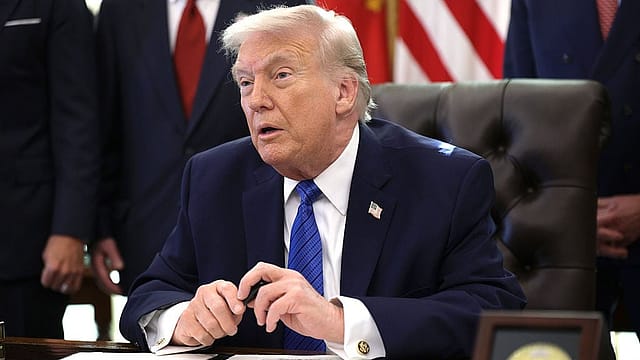
US President Donald Trump has asserted that Iran’s missile arsenal has been dramatically weakened following recent US military operations, claiming Tehran now retains only a small fraction of its pre-conflict capabilities.
Speaking in an interview with NBC News' Meet the Press, Trump argued that US actions had significantly damaged Iran’s military infrastructure and missile stockpiles.
"I would say, percentage-wise, maybe 21, 22 per cent of their missiles," Trump noted in remarks circulated online.
The US President further commented, "It's a lot of missiles, but it's not what it was when we first attacked."
His remarks present a picture of a substantially weakened Iranian military position and suggest that Washington believes its campaign has achieved major strategic objectives.
Why Are Trump’s Claims Being Questioned?
Trump’s assessment differs sharply from intelligence information reportedly presented to US lawmakers.
According to reporting cited in the story, congressional briefings indicated that Iran had restored operational control over 30 of its 33 missile installations along the strategically vital Strait of Hormuz. The same briefings reportedly suggested that Tehran still possesses around 70 percent of its pre-conflict missile inventory.
The contrast highlights an ongoing debate over the true extent of the damage inflicted on Iran’s military capabilities and whether US strikes have achieved the level of degradation described by Trump.
What Did Trump Say About the Strait of Hormuz Crisis?

Global By Design
29 May 2026 - Vol 04 | Issue 73
Is the future of fashion Indian?
Trump also expressed confidence that disruptions affecting shipping through the Strait of Hormuz would be resolved in the near future.
When asked about the number of commercial oil tankers escorted through the waterway, he responded: "A lot. I don't want say how many, but a lot."
Predicting an improvement in regional stability, Trump declared, "It shouldn't take long. One way or the other, it's going to get done. And when it's all straightened out, you're going to have oil prices drop down to maybe even lower than they were."
The comments come as rising fuel prices remain a politically sensitive issue in the United States ahead of upcoming midterm elections.
What Is the US Position on Iran’s Nuclear Programme?
While declining to provide new details about diplomatic engagement with Tehran, Trump reiterated Washington’s longstanding position that Iran must not obtain nuclear weapons.
"We're having great success," the US President said. "They're not going to have a nuclear weapon. They're in no position to have a nuclear weapon."
Iran has consistently denied allegations that it is seeking to build nuclear weapons, maintaining that its nuclear programme is intended for peaceful purposes.
Why Did Lebanon’s President Criticise Iran?
At the same time, regional tensions have extended beyond Iran and Israel to neighbouring Lebanon.
Lebanese President Joseph Aoun delivered a strong criticism of Iranian influence in Lebanon and called on the Iran-backed militant group Hezbollah to pursue negotiations rather than military confrontation.
Addressing Iran's role in Lebanese affairs, Aoun stated: "It's not your country, it's our country... It's not your job to interfere into our country."
He further accused Tehran of using Lebanon as leverage in its broader dealings with Washington.
"They are using Lebanon as a bargaining chip in their negotiation with the United States. It's unacceptable," Aoun noted.
What Is Driving the Latest Israel-Hezbollah Escalation?
The latest surge in violence followed a March 2 rocket attack launched into Israel by Hezbollah. The group said the strikes were retaliation for the assassination of Iran’s supreme leader during joint US-Israeli operations days earlier.
Israel responded with extensive airstrikes and continued ground operations in southern Lebanon, deepening fears of a wider regional conflict.
Against this backdrop, Aoun argued that negotiations represent the only realistic path to peace.
"Hezbollah must understand that (there is) no other way but to sit and talk, no other way to solve this problem and to save what's left except through negotiation and diplomacy," the Lebanese President said.
Referring to Hezbollah leader Naim Qassem, Aoun added: "It's the Lebanese people, they are not Naim Qassem('s) people."
He also stressed that "The majority of the Lebanese people are fed up with war."
What Is the Significance of the New Ceasefire Understanding?
Aoun’s remarks came after a ceasefire framework was brokered in Washington between Israeli and Lebanese representatives.
The agreement is reportedly tied to a "complete cessation" of Hezbollah's hostile activities, although it does not explicitly require an immediate halt to Israeli military operations. The arrangement remains fragile given that both sides violated an earlier truce implemented on April 17.
Despite the challenges, Aoun described the moment as a potential turning point.
There is "a great opportunity to end the state of hostility between Lebanon and Israel," he said.
Discussing Hezbollah’s weapons, Aoun argued that the issue should ultimately be handled by the Lebanese state.
"It's the job of the state... but, on one condition -- that we remove the root causes of the existence of its weapons," Aoun explained, pointing to the need for a complete Israeli withdrawal and an end to cross-border hostilities.
What Message Did Aoun Send to Israel?
The Lebanese President also called on Israel to demonstrate a commitment to ending the conflict.
"You need to show some willingness and commitment to end this war... We are willing, we are committed. Are you?" Aoun asked.
He concluded by arguing that military force alone would not eliminate armed movements in the region.
"Israel can flatten the whole country, but they will never be able to achieve their objective," Aoun said, adding, "They've tried it in Gaza. Hamas still exists."
What Does This Mean for the Wider Region?
The remarks from Trump and Aoun underscore the complexity of the ongoing Middle East crisis. While Washington argues that Iran’s military capabilities have been severely weakened, intelligence assessments suggest Tehran retains substantial operational strength. At the same time, Lebanon’s leadership is pushing for diplomacy as a means of preventing further escalation between Hezbollah and Israel.
Together, these developments highlight the competing narratives, security concerns and diplomatic efforts shaping one of the most volatile periods in the region in recent years.
(With inputs from ANI)