Octopuses Can Use Mirrors to Find Hidden Food, New Study Reveals
Octopuses have long fascinated scientists with their remarkable intelligence, problem-solving abilities and adaptability. One famous example was Inky, the octopus that escaped from a New Zealand aquarium in 2016 by squeezing through a drainpipe and making his way back to the ocean.
Now, researchers at Dartmouth have uncovered another impressive skill. A study published in Current Biology has found that octopuses can learn to use mirrors to locate food hidden from direct view, demonstrating a level of spatial reasoning previously documented only in vertebrates such as mammals and birds.
Why Is This Discovery Significant?
The study is the first to show that an invertebrate can learn to use a mirror as a tool to understand its surroundings and locate prey.
"Our findings are the first to demonstrate that invertebrates can use mirrors to understand their environment to find prey," says lead author Mary Kieseler, Guarini '25, who conducted the research as a PhD student in the Department of Psychological and Brain Sciences at Dartmouth and is now a postdoc at Switzerland's University of Fribourg. "It's a skill that previously has only been documented in vertebrates, such as in some mammals and some birds."

Flood and Fury
04 Sep 2026 - Vol 05 | Issue 36
Devighat, Nepal, August 29, 2026
The findings challenge long-held assumptions about the evolution of advanced cognition and suggest that complex problem-solving abilities may arise in very different branches of the animal kingdom.
How Did Researchers Test the Octopuses?
The research team worked with three California two-spot octopuses (Octopus bimaculoides) housed in Dartmouth's Octopus Lab.
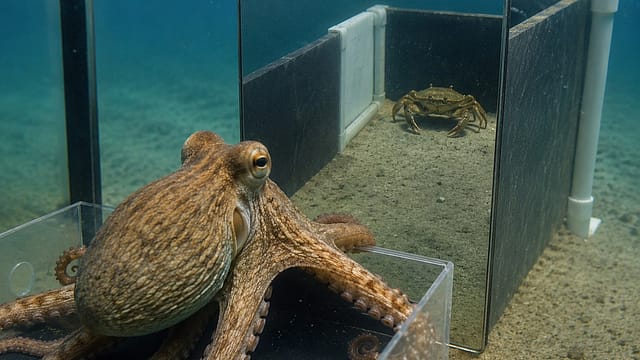
The scientists first allowed the animals to become familiar with mirrors placed in their habitat. They then trained the octopuses to understand the connection between a reflected image and the real-world location of an object.
During training, a live crab was placed inside a glass jar positioned so that it could only be seen through a mirror. To reach the crab, the octopus had to turn 90 degrees and move around a corner.
"We don't enter the world knowing how to use a mirror but learn how to use a mirror," says senior author and cognitive neuroscientist Peter Tse, a professor of psychological and brain sciences at Dartmouth. Just as new drivers learn to use a rearview mirror to track other vehicles, "Octopuses can also learn how to use a mirror to infer where things are in the world."
What Happened During the Mirror Experiment?
To ensure the results were based on visual processing rather than smell or taste, researchers did not use real prey during testing. Octopuses possess chemoreceptors that allow them to smell and taste through touch, which could have influenced their choices.
Instead, the scientists used a virtual crab image. Each octopus was placed inside a start box with a mirror positioned directly in front of it. The virtual crab appeared behind the octopus on either the left or right side and was visible only through the mirror.
To receive a reward, the octopus had to determine the actual location of the image and move toward it. Rather than approaching the reflection itself, the animals turned around and headed toward the correct side, where they were rewarded with a live crab.
Some octopuses even climbed over the side of the box to reach the projected image's location instead of taking a longer route around it.
How Well Did the Octopuses Perform?
The octopuses correctly identified the location of the hidden stimulus approximately 73 per cent of the time.
Researchers tracked a point between the animals' eyes on the mantle, the body part comparable to a head, and analysed the routes they took. While the octopuses did not always choose the shortest path, they became faster at reaching the correct location as the trials progressed.
The results suggest that the animals were not simply reacting to a reflection but were learning how to use mirror information to navigate their environment.
What Does This Tell Us About Octopus Intelligence?
The findings add to growing evidence that octopuses possess sophisticated cognitive abilities despite being evolutionarily distant from humans.
"Octopuses are among the most evolutionarily distant animals from humans, as our last common ancestor was a worm that lived 350 to 500 million years ago," says Kieseler. "Given that such a remote organism has independently evolved the means to use a mirror as a tool to process spatial cognition suggests that the underlying cognitive processes might be subject to convergent evolution, where different species evolve similar neural solutions to the same challenge."
This concept, known as convergent evolution, occurs when unrelated species independently develop similar abilities because they face comparable environmental challenges.
Could Octopuses Have Mental Maps of Their Environment?
Researchers believe the mirror-use ability may be linked to how octopuses hunt and navigate complex habitats such as coral reefs and rocky seafloors.
"Octopuses are like cats: they will sneak up on their prey and pounce, and they want to do so as fast as possible, so that they don't become preyed upon," Tse says.
Such hunting strategies may benefit from an internal understanding of space and surroundings.
"Hunters are very effective when they have a mental map of their territory, so that they know where they are in relation to their environments," says Tse. "Our work suggests that octopuses might also have internal maps, an internal representation of space."
While the researchers caution that more studies are needed to confirm whether octopuses truly maintain mental maps, the findings provide intriguing evidence that these animals may possess a far richer understanding of their environment than previously thought.
What Are the Bigger Implications of the Study?
The research highlights how advanced cognitive abilities can evolve independently in vastly different species. It also reinforces the idea that intelligence is not limited to animals with backbones or brains structured like our own.
As scientists continue to explore the minds of octopuses, discoveries such as this are reshaping our understanding of animal cognition and offering new clues about how intelligence evolves across the natural world.
(With inputs from ANI)