Demis Hassabis Calls India AI Impact Summit a “Pivotal Moment” for Global AI Cooperation
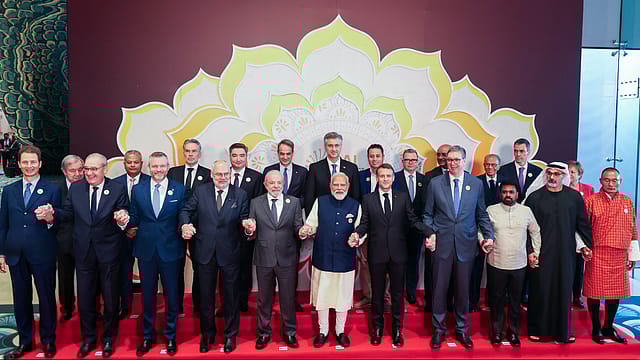
Demis Hassabis, Chief Executive Officer and co-founder of Google DeepMind, hailed the India AI Impact Summit 2026 as a critical platform for international cooperation, describing the present moment as a “pivotal moment” for the evolution of artificial intelligence.
Speaking at Bharat Mandapam, Hassabis expressed appreciation for the summit’s growth and its role in fostering global dialogue among stakeholders from industry, academia and government.
“It is a huge honour to be here today with so many of my esteemed colleagues from industry, academia and government and congratulations to Prime Minister Modi and the Indian government on convening such an impressive summit at this very pivotal moment for AI. It is fantastic to see how the summit has evolved over the years with the first meeting convened by former Prime Minister Sunak,” Hassabis said.

The Modi Years
02 Oct 2026 - Vol 05 | Issue 40
A Nation Rebuilt
He emphasised that such gatherings have moved beyond optional discussions to becoming essential for the safe and collaborative development of the technology.
“It is becoming an incredibly important convening point for international dialogue and hopefully cooperation over the future of AI,” he said.
Why Does Demis Hassabis See AI as a Key Technology for Scientific Discovery?
Reflecting on the rapid transformation of artificial intelligence, Hassabis recalled the early years of the field and the shift from a niche academic pursuit to a global industrial force.
“When we started DeepMind in 2010, almost nobody was working on AI in the industry. It was just a dream. It has been incredible to see how in the last 15 years, where we have come from those humble beginnings,” he said.
“The reason I spent my whole career working on AI is that I have always believed it would be one of the most important and beneficial technologies ever invented,” he stated.
“For me, my passion, AI is to advance scientific discovery,” he added.
The summit also featured a fireside conversation where industry leaders underscored the growing integration of AI into business operations, digital networks and innovation, while highlighting India’s emergence as a key global leader due to its scale, talent and frugal innovation.
How Is AI Reshaping Corporate Operations and Digital Infrastructure?
Sunil Bharti Mittal, Founder and Chairman of Bharti Enterprises, said AI is increasingly shaping corporate functioning and digital infrastructure.
Shantanu Narayen, Chairman and CEO of Adobe, highlighted the transformative impact of AI across sectors such as healthcare, education and access to information, noting that India is likely to become one of the largest users of AI in the coming years.
“Given the number of people who use AI in India will be greater than, I think, anywhere in the world over a few years, I think the leadership that India can play, not just in what these models mean, how do you think about data, how do you think about privacy and security and trust,” Narayen said.
He also stressed the importance of content authenticity and referred to discussions with Prime Minister Narendra Modi on ensuring trust in digital information.
How Can AI Promote Content Authenticity and Combat Misinformation?
“I want every piece of information that's produced to have the provenance and the watermark so that people can actually know what is real and what's fake,” Narayen said.
Mittal further underlined the need for open standards and global collaboration, stating that AI should remain accessible and benefit humanity.
“The Prime Minister also spoke about making open standards, keeping AI open to the world for the benefit of democratising AI, as opposed to caging it and having it in the hands of a few. This seems to be a very clear message. Engage with each other, make open standards, AI should be available to all for the benefit of humanity,” Mittal said.
Addressing concerns over proprietary models, Narayen acknowledged the tension between commercial interests and societal good.
“You're going to have the inevitable challenge between commercial enterprises who want to keep information proprietary and how do you do good for humanity,” he said, adding that open standards have historically helped technologies scale globally, citing the example of PDF.
What Makes India a Key Hub for Responsible AI and Technology Adoption?
Expressing confidence in India’s global positioning in AI, Narayen said, “I do think India is better positioned than most other countries. I'm a lot more confident about what will happen in India.”
Mittal also pointed to India’s strength in frugal innovation, citing the country’s space achievements as an example.
“Look at the moon mission. India did it at $74 million. The U.S. did it at $92 billion. And India had a perfect landing on the moon on the difficult side of the moon,” Mittal said.
Responding to this, Narayen noted that India’s cost-effective innovation model represents a unique advantage and can serve as a learning framework for global companies.
Industry leaders concluded that India’s combination of digital scale, talent, connectivity and innovation positions the country as a key global hub for AI development and responsible technology adoption.
(With inputs from ANI)