Cheaper Diesel, Costlier War: Why Trump's Putin Deal Has Infuriated Ukraine
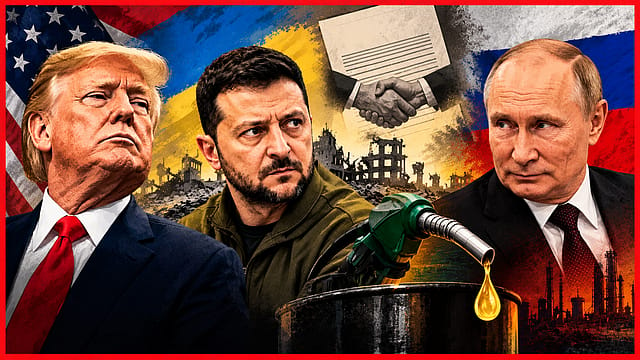
A fuel deal on Friday. A demand for a new Ukrainian president on Saturday. A British promise to stand with Kyiv.
Within two days, diesel had become the combustible centre of another confrontation between Donald Trump and Volodymyr Zelenskyy. Washington’s argument is that more Russian supply can bring down fuel prices. Kyiv’s objection is that buying that fuel gives Russia more money to keep fighting.
British Prime Minister Andy Burnham’s intervention brings the dispute into sharper focus: while Washington opens a door to Russian diesel, London says it will tighten pressure on Moscow.
Here is how the confrontation unfolded—and what hangs on it.
WHAT STARTED THE LATEST ROW?
Trump announced on October 9 that a telephone conversation with Vladimir Putin had produced an agreement to supply Russian diesel to American and international markets.

Zeroing In on ECI
09 Oct 2026 - Vol 05 | Issue 41
Constitutional legitimacy versus political opportunism
According to Associated Press, the promised shipments begin with more than 300,000 tonnes, followed by 500,000 tonnes in November, one million tonnes immediately afterwards, and a further three million tonnes subsequently. These are announced commitments; they should not be confused with fuel already delivered.
For Zelenskyy, the decision threatens the purpose of sanctions: restricting the revenue Russia can use to sustain its invasion. The disagreement quickly became personal. On October 10, Trump suggested Ukraine should replace its president, accusing Zelenskyy of missing opportunities for a peace agreement.
WHAT HAS WASHINGTON ACTUALLY CHANGED?
The announcement has a concrete sanctions measure behind it.
On October 9, the US Treasury’s Office of Foreign Assets Control issued General License 135, authorising specified transactions involving the sale, delivery, unloading and importation of Russian-origin diesel, including imports into the United States. The authorisation runs until April 7, 2027.
That distinction matters. Washington has created a temporary route for Russian diesel transactions covered by the licence. This does not mean every sanction against Russia has disappeared. But the political signal is substantial: an energy trade previously constrained by sanctions is being reopened to address fuel shortages and prices.
WHY IS TRUMP SO FOCUSED ON DIESEL?
Because diesel carries an economic cost far beyond the filling station. It powers trucks, agricultural machinery, construction equipment and the movement of goods. Rising prices squeeze businesses and can push up the cost of everyday purchases.
There is also an approaching political deadline. America’s congressional elections are on November 3, with Republicans defending their narrow control of Congress. According to Reuters, the diesel price surge has become a risk for Trump’s party.
Washington’s calculation is straightforward: additional supply could ease prices and demonstrate action before voters go to the polls. The difficulty is that the supplier is Russia—and the buyer’s partners have been trying to restrict its energy earnings.
IS UKRAINE REALLY RESPONSIBLE FOR AMERICA’S FUEL PAIN?
Trump has blamed Ukrainian attacks on Russian refineries for worsening diesel supplies. Those attacks can disrupt production, but treating Kyiv as the sole explanation leaves out the wider energy crisis.
Associated Press reports that the war in Iran has also driven up world energy prices and complicated the movement of oil from the Middle East.
The economic picture is, therefore, broader than Trump’s accusation. Russian refinery damage, disrupted trade routes and pressure on available supplies all matter.
Blaming Zelenskyy turns a complicated supply problem into a confrontation with one leader. It does not establish that removing him would solve it.
WHY DOES ZELENSKYY SEE THE DEAL AS DANGEROUS?
His objection concerns what happens after Russia receives the money.
In his public response, Zelenskyy argued that relaxing sanctions without a lasting agreement to reduce hostilities would strengthen Moscow’s ability to continue the war. He described petroleum purchases as an investment in a conflict that should be brought to an end.
“Gifts to Putin will not bring peace or any benefit to the civilised world,” he said.
There is an uncomfortable link between the trade and the battlefield. Ukraine has been attacking Russia’s oil infrastructure to weaken its capacity to wage war. Washington’s deal offers Russia an opportunity to earn money from the same energy sector. The strategic question is whether sanctions relief can purchase restraint—or whether Moscow receives relief while continuing its attacks.
WHY DID THE TIMING MAKE IT WORSE?
Because Ukrainian officials were discussing peace with American negotiators when the diesel agreement was announced.
Trump’s envoy Steve Witkoff and Jared Kushner were meeting Ukrainian representatives in Miami. The announcement left Zelenskyy questioning whether those discussions were providing political cover for a separate arrangement with Moscow.
Then came renewed bloodshed. On October 10, Russian strikes in Zaporizhzhia killed 20 people, including three children. Zelenskyy linked the attack to Washington’s easing of pressure on Russia.
That was his interpretation of Moscow’s response; it does not prove the diesel agreement caused the strike. It does explain why a deal presented as economic relief in Washington landed as a security threat in Kyiv.
WHAT HAS BRITAIN SAID—AND WHY DOES IT MATTER?
Burnham spoke to Zelenskyy on October 10 and reiterated his “complete solidarity”, according to Downing Street.
The British readout went beyond reassurance. It said the UK would strengthen sanctions and take further steps to constrain Russia’s war effort. The leaders also called for an immediate energy ceasefire, including an end to Russian attacks on Ukrainian infrastructure and Black Sea shipping. They agreed to meet in the coming days.
Britain’s position offers a different answer to the fuel crisis: reduce the attacks disrupting energy and trade while maintaining pressure on Moscow.
The emerging disagreement among partners is therefore about the route to relief. Should Russia receive greater access to energy markets now, or should that relief depend on changes in its conduct?
IS UKRAINE WILLING TO STOP STRIKING RUSSIAN REFINERIES?
Yes—but it wants reciprocity.
On October 11, Zelenskyy said Ukraine was ready to halt refinery attacks if Russia stopped striking Ukrainian energy infrastructure. Any arrangement would require credible guarantees, Reuters reported.
Kyiv is proposing an exchange: both sides stop targeting energy facilities.
That differs fundamentally from a demand that Ukraine stop its attacks while Russian strikes continue. The unresolved issue is whether Washington can secure and enforce a mutual arrangement.
An energy ceasefire would also be narrower than a peace settlement. Even if achieved, it would leave the wider war unresolved.
WILL THE DIESEL DEAL DELIVER LASTINGLY LOWER PRICES?
That remains uncertain.
The first shipment amounts to roughly 2.25 million barrels. For scale, the United States exports about 1.5 million barrels of diesel a day. Analysts cautioned that extra supply could help a tight market without producing a durable solution.
Future shipments also depend on the condition of Russian refineries. The distinction is between an announcement that moves market expectations and deliveries large enough, reliable enough and sustained enough to change prices over time. Trump has promised relief. The market still needs the fuel.
WHY DOES THIS MATTER TO INDIA?
It raises a question about consistency.
Washington has pressured India over its purchases of Russian energy, arguing that those revenues support Moscow’s war. Its own decision to facilitate Russian diesel trade invites scrutiny of that argument.
Russian energy earnings remain Russian energy earnings, whether the buyer is seeking affordable fuel in India or relief for American consumers.
The US licence does not automatically remove other restrictions or penalties affecting India. But it gives New Delhi a stronger basis to question how Washington applies its energy policy.
WHAT SHOULD WE WATCH NEXT?
Three developments will show whether this becomes a workable energy arrangement or a deeper diplomatic rupture.
First, deliveries: how much Russian diesel actually reaches buyers, when it arrives and whether prices respond.
Second, reciprocity: whether Moscow accepts an energy ceasefire with enforceable commitments.
Third, allied coordination: whether Britain, Europe and Washington can reconcile sanctions pressure with America’s new diesel opening.
The bargain’s hardest test is still ahead: can Americans get cheaper fuel without giving Russia greater means to prolong the war?
With inputs from ANI & agencies