Bangladesh Votes ‘Yes’ to July Charter as Tarique Rahman’s BNP Nears Majority
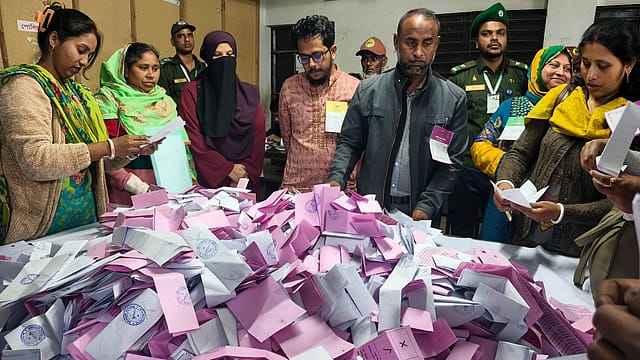
People in Bangladesh who, along with general elections had voted for a referendum in the country have expressed their support for constitutional reforms, as per local media outlets.
The 13th parliamentary elections was held yesterday alongside a referendum on the implementation of a 84-point reform package known as the '"July Charter" a document born out of the 2024 uprising that proposes sweeping constitutional reforms in order to save the country from future authoritarian rule.
According to the Daily Star, the referendum in Bangladesh saw an overwhelming YES, with 65.3% (27,00,844) of votes in favour.

Losing Memory
16 Oct 2026 - Vol 05 | Issue 42
The making of a medical and social emergency
Voters approve reforms, including the establishment of a caretaker government and an independent election commission, the introduction of a bicameral parliament, term limits for the prime minister, enhanced presidential powers and judicial independence, and increased women's representation in parliament.
Parallel to the referendum, multiple media projections indicated that the Bangladesh Nationalist Party and its allies were on course for a historic victory in the parliamentary polls, comfortably crossing the simple majority mark of 150 seats.
Is BNP set for a decisive victory in the Bangladesh election?
Vote counting has been completed in 249 constituencies, with 50 remaining.
Of the 299 seats, the BNP and allies have secured 181 seats, while Jamaat-e-Islami and its allies have won 61 seats.
The counting process is still underway and official results are yet to be declared.
The election marks the first national vote since the violence in July 2024 that ended the long tenure of then prime minister Sheikh Hasina and forced her to flee.
Early indications point to a decisive win for BNP leader Tarique Rahman, a development seen as a dramatic political comeback for the 60-year-old, whose critics have often labelled him the “dark prince”.
Rahman’s political trajectory has been marked by controversy and legacy. He is the son of former president Ziaur Rahman and former prime minister Khaleda Zia.
He left the country in 2017 after being arrested on corruption and money-laundering charges and remained in exile for 17 years before returning following his mother’s death in December 2025.
Upon his return, he was greeted by massive crowds and launched his campaign with a speech that echoed the tone of civil rights leader Martin Luther King Jr., declaring, “I have a plan for Bangladesh.”
Why Is India Closely Watching the Bangladesh Election and Referendum Outcome?
Even before official results were announced, India moved quickly to engage the incoming leadership.
Prime Minister Narendra Modi extended “warm congratulations” to Rahman and the BNP, stating that the outcome reflected the trust of the Bangladeshi people and assuring support for a “democratic, progressive and inclusive Bangladesh”.
New Delhi’s early outreach can be seen as a strategic move in the regional geopolitical contest involving China and Pakistan.
India has closely monitored the election given its potential impact on regional geopolitics and national security.
From New Delhi’s perspective, three interconnected concerns dominate: the possibility of a Pakistan-China-Bangladesh alignment, border and internal security implications including illegal migration, and the future trajectory of bilateral ties.
A closer Dhaka tilt towards Beijing or Islamabad could weaken India’s influence in South Asia and alter the balance of power in the Indian Ocean Region.
The relationship between Delhi and Dhaka was widely seen as stable during Hasina’s rule under the Awami League, which prioritised cooperation on trade, transport, border security and water-sharing agreements.
Hasina, who has been barred from contesting this election and faces a death penalty, led what was often described as a pro-India government.
How Will Bangladesh Elections Impact India Ties Under Tarique Rahman?
Rahman has signalled that he will respect India’s interests, hinting at a possible shift from his mother’s “Bangladesh first” policy.
However, a more transactional relationship could be expected from Tarique Rahman rather than an overtly friendly one.
The prospect of Jamaat joining a coalition had raised concerns in New Delhi over potential destabilisation of bilateral ties and the risk of Bangladesh becoming a launchpad for Pakistan-linked groups targeting India’s northeast.
That scenario appears unlikely with the BNP heading towards a clear majority.
China’s growing footprint in Bangladesh, including investments in infrastructure such as the modernisation of Mongla Port, is another factor shaping India’s strategic calculus, especially given Beijing’s presence in similar facilities in Sri Lanka and Pakistan.
These developments are linked to broader concerns over enhanced logistical and surveillance capabilities in the region.
Can Tarique Rahman and the BNP Ensure Minority Protection Amid Political Transition in Bangladesh?
Border management remains a sensitive issue, particularly with West Bengal and Assam, which share a 4,100-km border with Bangladesh and are heading into assembly elections where illegal migration is a key political issue.
Reports of attacks on Hindu minorities, who constitute around eight per cent of Bangladesh’s population, surged after Hasina’s fall, with some accounts citing over 2,000 incidents targeting homes, businesses and temples and prompting thousands to flee.
India has said at least 23 Hindus have been killed since Hasina’s departure and has urged visible policing and protection measures.
The interim administration led by Nobel laureate Muhammad Yunus acknowledged the deaths but maintained that most incidents were linked to non-communal causes such as land disputes and personal enmity.
Rahman has promised protection for minorities, though the BNP’s historical alignment with conservative elements will be closely watched by New Delhi.
India enjoys a nearly $10 billion surplus with Bangladesh and supplies over 80 per cent of the raw cotton used by the country’s readymade garments industry, a key pillar of its economy.
As the final results are awaited, regional and global powers including India and the United States are watching closely to see how the new government’s domestic reforms and foreign policy priorities reshape South Asia’s political and security landscape.
(With inputs from ANI)